Instrument

cello bow
François Jude Gaulard
Mirecourt,
± 1830
played by
Isaac Sam Lottman
Isaac Sam Lottman

*1787 , Mirecourt †1857 , Troyes
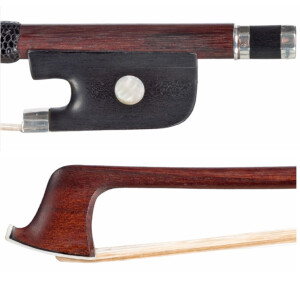
François Jude Gaulard married Ursule Fétique, who also came from a family of bow makers, and they had two sons. The eldest was Nicolas Alexandre, who was destined to become a violin maker but died young in the Algerian War, and Louis Auguste. Ursule died in 1855, after which François Jude Gaulard left Mirecourt to work with his son Louis Auguste, who had become a violin maker in Troyes, located southeast of Paris. During the last two years of his life, François Jude Gaulard continued to make bows until his death in 1857.
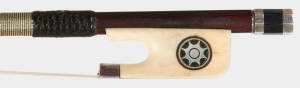
Source: Tarisio
François Jude Gaulard is sometimes called the “sun’s cane maker.” The slippers he made—mostly of ivory—beginning in 1810 featured a skillfully crafted oval inlay with a silver French fleur-de-lis, exactly like Pajeot’s. Later, he replaced the fleur-de-lis with a mother-of-pearl star with a silver border that resembled a sun with rays. He would continue to make this design for the rest of his life. This demonstrates his craftsmanship, but he did not keep pace with the constantly evolving techniques of his Parisian colleagues, who were refining the bow. They were already using a small silver plate between the sleeve and the rod, making it less fragile and easier to tension. Gaulard never adopted this method.
He made pernambuco bows with ivory frogs and sun motifs between 1820 and 1835. He crafted them with great refinement, which made them particularly fragile. He continued to decorate his frogs, sometimes with “his sun,” but also with shields after he switched to ebony frogs around 1835.
The bows that Gaulard made later—and certainly after he moved to Troyes—are somewhat less elegant. It is noteworthy that while he did make the early bows with silver or gold backs, he stopped doing so from 1820 until his death. This stands in contrast to virtually all other bow makers, who had already begun doing so twenty-five years earlier.
For his bows, he used not only the customary pernambuco, but also often snakewood, ironwood, or other exotic woods. About half of his bows are round, and the other half are octagonal. The frogs of many bows usually have a short nose and feature a finish that is slightly different from the norm; for example, he sometimes adorned the underside of the frog with inlaid decoration or simply with an ebony reinforcement without the layer of bone or ivory.
He marked his first canes in the same way as Pajeot, with an “M” after his name to indicate Mirecourt: “GAULARD M,” but from around 1825 onward, he used only “GAULARD.” Canes without a brand mark also exist.
The bow in the collection of the Musical Instrument Fund is a so-called “mariage”—a shaft made by Gaulard with a ferrule and button by François Eury. Eury was not a contemporary but a bow maker who lived 25 years earlier. The ferrule and tip were therefore added at a later date. Eury worked in the vicinity of François Tourte, from whom he adopted many techniques. Unlike Gaulard, Eury did use the silver plate between the ferrule and the shaft. One of the most distinctive aspects of Eury’s work was the silver piece that covered the front of the ferrule. The “sole,” which was also made of silver, was wide and extended from the bottom to the top of the back, which was another common feature of Eury’s work. The rod of the collection features such an Eury clasp.
Akoka J., 2017, A history of 18th Century bows, z.p.
Haine, M., 2013, “Trademarks of Instrument Makers Registered from 1860 to 1919.”
Millant, B., Raffin, J.F., 2000, *L'Archet: French Bowmakers, 1750–1950*. Paris
Thoene J., 2006, Violins & Bows, London.
Gaudfroy, B., 2001, “The Birth of the Modern Bow,” Paris.
Raffin, Jean-François; Millant, Bernard, 2000, *L’Archet*. Paris: L’Archet Éditions.
Vatelot, Étienne, 1976, *Les Archet Francais*. Sernor: M. Dufour.
Henley W., 1969, Universal Dictionary of Violin & Bow Makers. Brighton.