Instrument

violin
Francesco Goffriller
Venice,
± 1725
played by
Judith van Driel
Judith van Driel

*1691 , Venetië †1742 , Udine
For Francesco, his father’s workshop was a rich source of knowledge. Alongside Matteo, several skilled violin makers worked there—some as apprentices, others as employees. Over the years, Matteo Goffriller had been influenced by various makers in Venice, but he had primarily developed his own style and had thus become a highly sought-after violin maker in the city. He had been commissioned to build new instruments for St. Mark’s Basilica and for many prominent musicians in Venice.
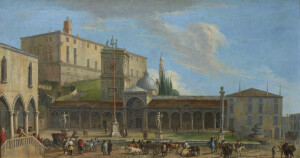
Although Venice was a fascinating city, Francesco did not stay there. Around 1714, he went to Udine, which was located 100 km to the north, right on the Austrian border. It is believed that the Savorgnan family invited him there. Many wealthy Venetians had had palaces built in Udine and were eager to continue their musical lives there. While there were musicians in the area, there was a lack of a skilled violin maker. As a result, his workshop became a meeting place for luthiers and musicians from the region.
His instruments were very similar to Matteo's, but were designed with more freedom and finished with slightly less precision.
Francesco Goffriller must have realized at a young age that his father was a prominent violin maker in Venice. His father had been very busy building new instruments for the “ospedales” and wealthy Venetians. New trends in music demanded it. Commissioned by Giovanni Legrenzi, the Maestro di Capella of St. Mark’s Basilica, he had been allowed to replace the various sizes of old six-stringed violins—which still dated from the Baroque period—with “modern” instruments. In particular, there had been a need for cellos that could better support the new music. Matteo Goffriller had had work for years, and the commission had brought him great renown.
Francesco’s mother, Maria, was the daughter of Mathias Kaiser, who had been a prominent maker of violins and lutes—instruments that were popular in Venice before Vivaldi’s time. Like Matteo Goffriller, he was from Brixen. Matteo and Maria were married in 1686 at the Chiesa di San Giovanni Grisostomo, in a ceremony attended by many of their fellow countrymen and other Venetian musicians. They had 12 children, of whom Francesco was the third.
Venice may have been a world-class center for new music, but in terms of instrumentation, it lagged far behind the rest of Italy. Francesco’s father was one of the first in Venice to realize that the shift toward new music would require new instruments in Venice as well—and that this would bring him work. Good connections with the aristocracy were essential for securing commissions. His father-in-law, Mathias Kaiser, had those connections. When Francesco was four, his grandfather died. Matteo inherited his business and merged the two workshops into a new company.
Despite the fact that many other luthiers were working in Venice, Francesco’s father had hardly faced any serious competition for twenty years. It was only with the arrival of a new generation of violin makers that this changed.
Matteo Goffriller had a major influence on the instrument makers who settled in the city over the years—and on his son as well. As early as 1709, Francesco had been permitted to make violins under his own name and had established contacts with important patrons in the city. Around 1714, Francesco completed his training. However, he could not remain in Venice. The rules of the Ordine dei Marzeri, the Venetian guild to which every violin maker was required to belong, did not permit it. In Venice, only one member of each family was allowed to practice the trade as an independent craftsman.
Many influential noble families from Venice, the Patrizi Veneziani, had a second villa or summer palace built in Udine. It was also the seat of the patricians who resided in the castle on the hill. Accustomed to the rich Venetian musical culture, they also brought musicians to Udine. The Savorgnan family, which held authority over the region, played an important role in this.
Under the influence of the Savorgnans, musical life in Udine began to flourish. Presumably invited by one of them to become a violin maker in Udine, Francesco Goffriller moved there in May 1714. He thus became the city’s first violin maker.
Although Udine had been a popular summer retreat for wealthy Venetians since the Middle Ages, it also had a serious drawback: there was a severe shortage of water. The city’s residents were forbidden from washing clothes or hides within the city walls or from throwing waste into the water. Strict penalties were imposed for wasting water. Only the patricians were exempt from these rules. Consequently, Francesco’s workshop was not located in the city center, but in Borgo Grazzano, just outside the city walls.
Francesco Goffriller’s workshop quickly became a gathering place for string players from the region. Two years after his arrival, in 1716, he married Donna Valentina, the widow of Francesco Cicuttini, a well-known musician and violin teacher in Udine. Francesco’s workshop attracted not only musicians but also the young Santo Serafin, who was born in Udine. He, too, became a violin maker, and it is believed that he learned the craft from Francesco Goffriller. Santo continued to work in Udine for four years until he moved to Venice in 1721, where he became one of the better violin makers. Francesco Goffriller remained the only violin maker in the city. While his violins and cellos did not reach the perfection of his father’s, they are nonetheless highly distinctive. He used materials that were sometimes of slightly inferior quality, likely due to the difficulty of obtaining the better types of wood in that remote corner of the country.
In 1732, Valentina died childless. A year later, Francesco remarried Elisabetta Francescone, with whom he had three children. The marriage lasted ten years. In November 1741, Francesco fell seriously ill and was admitted to the hospital in Udine, where he died on October 2, 1742. None of his children showed any interest in the craft; after his death, his workshop was taken over by an unknown violin maker.
When Francesco began his career, there was not yet a true violin-making tradition in Venice, as there was in Cremona or Brescia. That Venetian school did not emerge until a few years later, thanks to Matteo Goffriller’s influence. But even when he was already building “modern” instruments, the instruments from Francesco’s father’s workshop still varied considerably depending on the individual wishes of his clients.
As a child, Francesco must have seen instruments by Antonio Stradivari in his father’s workshop. The violin that Matteo built in 1709 bore a strong resemblance to Stradivari’s “Lady Tennant” from 1699 and to the “Dancla” from 1703. Francesco, too, was influenced by Stradivari.
It seems that Francesco’s father gave him the freedom to build his own instruments from an early age. His 1706 viola is an example of this. He was only 15 years old at the time. The “Casals” cello from 1700 is attributed to him, but the date appears to have been inscribed later. He was not allowed to sell the instruments in Venice himself; that required membership in the Venetian guild. And the guild admitted only one member per family. For this reason, Francesco was sometimes forced to have an instrument sold by a maker who was a member of the guild. There are known instruments by him that were sold by Domenico Montagnana, not under Francesco’s name but with Domenico’s label inside.
What applied in Venice in terms of performance practice was no different in Udine. In Venice, the pitch of the music was higher than in other parts of Europe. During the first half of the eighteenth century, it was lowered from the standard Venetian pitch of a’=465 to 440, a difference of a half-step. As a result, violin makers had to modify existing instruments or build new ones to replace them. And since performance practice had to be the same in both cities, this provided Francesco Goffriller with plenty of work in Udine.
For the first violins he built in Udine, Francesco presumably still had a supply of wood from Venice at his disposal. It was beautifully figured maple, which lasted him until around 1730. He used it primarily for his violins; for his cellos, he used wood with less pronounced figure. After that, he seemed to have more difficulty obtaining wood with a lively figure. This did not affect the sound, but it did affect the appearance.
Sometimes Francesco used a rich reddish-brown varnish like his father’s, but most often a light brownish-yellow varnish that he made himself. Unlike Matteo’s, it was somewhat harder, which is why craquelure is rarely found on his instruments.
Francesco’s cellos are known for their relatively small size. Musicians sometimes use the metaphor “boiling oil” to describe the intense sound of the cellos his father built, and Francesco’s finest cellos are not far behind.
Both Matteo’s and Francesco Goffriller’s work remained virtually unknown until the 1920s. Their instruments were often labeled with different names and passed off as works by Carlo Bergonzi, Domenico Montagnana, or even Joseph Guarnerius filius Andreae. As a result, they were worth more than those labeled “Francesco.”
Its label reads: Francesco Goffriller / In Udine 1726
The instrument that the Musical Instrument Fund holds in its collection is an example of the finest work he produced in Udine. It bears the label of Domenico Montagnana. Francesco Goffriller sometimes sold instruments in Venice—not under his own name, but under that of Montagnana, with whom he had a good relationship. It cannot be ruled out that Montagnana’s label was added later.
Pio S., 2020, Violin and lute makers of Venice 1640-1760, Venetie.
Goldfarb T., 2015, Art and Music in Venice, Londen.
Landon Ch., 2007, The Strad Magazine.
Vannes, R., 1981, “Universal Dictionary of Instrument Makers,” Brussels.
The Strad; In Focus 2013; John Dilworth.
Tarisio; the Cozio archive, bezocht in 2021.