Instrument

violin
Ferdinando Gagliano
Naples,
± 1778
played by
Emmy Storms
Emmy Storms

*1724 , Napels †± 1804 , Napels
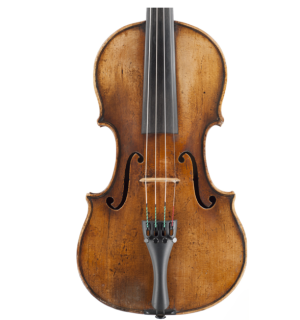
Ferdinando grew up in his father Nicolò’s workshop. Nicolò was not only a very prolific but also a highly renowned violin maker in Naples. He himself claimed to have been a student of Stradivari—not of Antonio, but of his son Omobono, who had spent a few years in Naples. As one of the few violin makers in Naples, Ferdinando’s father had a contract with three of the city’s four conservatories. He maintained their instruments and, when necessary, built new ones for them. Ferdinando did not stay with his father, but based on numerous similarities in style and technique, it is believed that he went to his uncle Gennaro for his training. Most of his brothers, who also became violin makers, continued to collaborate with one another in one way or another, but Ferdinando presumably worked alone. His instruments are considered the finest of his generation.
Ferdinando was the eldest of Nicolò’s four sons. Nicolò had married in 1724, and after Ferdinando—who was born that same year—three more sons were born: Giuseppe in 1725, Antonio in 1728, and Giovanni sixteen years later. All four became violin makers. Ferdinando did not stay long in his father’s workshop. Philip J. Kass believes that he remained involved with Nicolò’s workshop until the 1750s, but left after that. Gennaro Gagliano was Nicolò’s younger brother. Nicolò went down in history as a prominent luthier, but Gennaro is now regarded as a better craftsman. Not much more is known about him than his versatility, personal style, and great craftsmanship. This demonstrates that he was an exceptionally skilled luthier. And so was Ferdinando. His models of Amati and Stradivari were far superior to the typical, somewhat carelessly built Neapolitan instruments. The precision with which he carved his scrolls set him apart from the Neapolitan luthiers, including his own relatives.
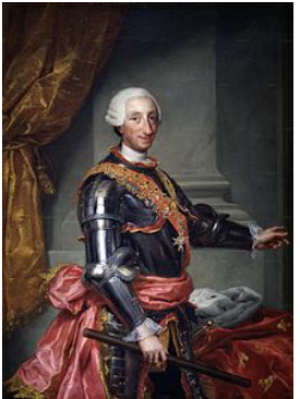
Carlo of Bourbon
With the arrival in 1734 of a new monarch, Carlo of Bourbon, prosperity had increased for a large part of the population, including musicians and the makers of their instruments. He brought a large entourage with him, ranging from architects to goldsmiths. In their wake came an entire caravan. Carlo was a megalomaniac and had very specific ideas about what the grandeur of a great European court should look like. To further glorify himself, he had the “San Carlo” built, an opera house that was to become the most beautiful and largest in Europe.
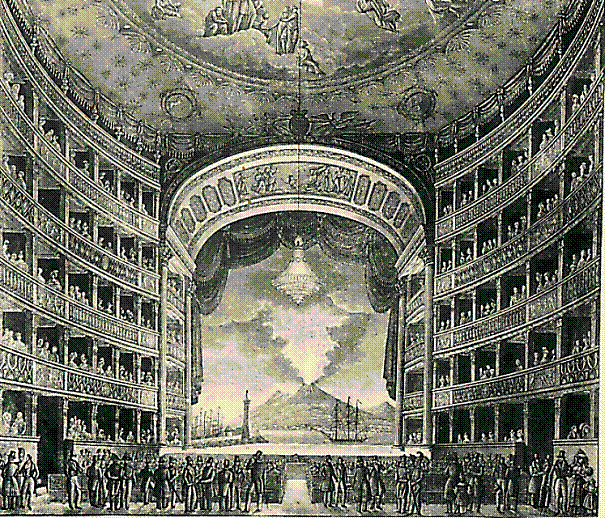
San Carlo Theater in Naples
It was inaugurated with great fanfare in the year of Fernando’s birth. More musicians had come to Naples than ever before. According to the writer and member of the “Académie des sciences,” Charles de Bosses, Naples had become the musical capital of the world in a short time. The Gagliano family of violin makers were not the only ones, but they were certainly the most important violin makers in Naples.
Around the time Ferdinando was able to begin his career, the reforms implemented by Charles of Bourbon proved disastrous for the city. Poverty increased rapidly, and as people migrated from the countryside to the city, Naples also became overpopulated. A large segment of the population was starving, and ten years later there were 9,000 homeless people. When Ferdinando was 26, the misery reached its lowest point. In 1764 alone, thousands of Neapolitans died from malnutrition and disease. Consequently, very few instruments made by Ferdinando survive from the 1760s. His father, Nicolò, was able to make a living from his work for the conservatories and from the instruments he built. Ferdinando, however, had to rely on the small number of musicians who could still afford an instrument. There were not many other skilled violin makers besides the Gagliano family.
Around 1770, Ferdinando was working as an independent violin maker. His brother Giuseppe had also started out working with their father, but he, too, continued his training with Gennaro. Later, he worked alongside Antonio, his youngest brother, in their own workshop. There was plenty of work for all the Gaglianos.

Cello formerly owned by Barbirolli, Gennaro Gagliano, ca. 1760. Photo courtesy of C. Darbelet / Vichy Enchères
Of the third generation of Gaglianos, Ferdinando was presumably the most prolific; moreover, his work was of exceptionally high quality. Connoisseurs unmistakably recognize Gennaro’s influence in the details, the models, and the style of Ferdinando’s work. Ferdinando and Gennaro were strongly influenced by Stradivari and, to a lesser extent, by Amati. Stradivari’s influence is evident in Gennaro’s ex-Barbirolli cello, which resembled a Stradivari cello from 1760 down to the last detail.
There was often some form of collaboration among the Gagliano family members, but Ferdinando presumably worked mostly on his own.
Ferdinando’s grandfather Alessandro (c. 1665–c. 1732) had been the family’s pioneer through his travels to cities such as Cremona; Nicolò and Gennaro had firmly established the family name in Naples. As the third generation of Gaglianos, Ferdinando and his brothers made Naples one of the major centers of Italian violin making in the nineteenth century.
It was customary for the sons to shape the necks and scrolls of their father’s instruments at a very young age and then varnish them. Ferdinando and his brothers did the same. Nicolò and Gennaro still had access to high-quality maple wood from the Balkans, while the other sons occasionally had to make do with locally sourced wood that had a less attractive grain. In his early instruments, Ferdinando used his father’s orange-red varnish; later, he made it darker.

Violin from the collection of the Musical Instrument Fund. The uneven placement and height of the f-holes are clearly visible.
His earliest known violin dates from 1750, and his last one is from 1795. An analysis of a violin from 1789 reveals that Ferdinando temporarily secured the top and back with wooden pins. The edge inlay was made of beech wood with strips of blackened cardboard running alongside it. The height and placement of the f-holes are not always consistent.
The soundpost was longer than was customary at the time, and both sides were also thicker than those made by many other luthiers. In addition to violins, Gennaro is also known to have made a few cellos. Ferdinando built mainly violins, a small number of cellos, and a few violas. In addition, there is also a viola d’amore attributed to him.
The label indicates that Ferdinando prided himself on being Nicolò's son.
Ferdinand Gagliano, son of Nicholas, made in Naples, 1781.
Along the soundboard, he often inscribed a series of letters and numbers that refer to a religious text as well as his initials. Religious mottos appear on many of the Gaglianos’ instruments—just as they do on many instruments made by other Neapolitans.
The labels of Ferdinando’s brothers Giuseppe and Antonio suggest that they began building instruments at an early age. Due to the churches’ haphazard record-keeping, their dates of death could not be determined and, until very recently, could only be estimated. However, based on the death certificates discovered in 2023, it has become clear that Giuseppe did not die in 1793 but only in 1820, and Antonio in 1835. Ferdinando’s death certificate is still missing. Since around 1650, at least 16 members of the Gagliano family are known to have been involved in instrument making.
Kass P.J., Strings Magazine, November-December 2023.
Voorhies J., “Art of the Seventeenth and Eighteenth Centuries in Naple,” Department of European Paintings, The Metropolitan Museum of Art.
DelDonna A., 2012, Opera, Theatrical Culture and Society in Late Eighteenth-Century Naples, New York.
Courtenay J., 1794 The present state of the manners, arts, and politics, of France and Italy; in a series of poetical epistles, From Paris, Rome, And Naples. Dublin.
Kass P. J., 2009, Guadagnini-re-evaluated, Turijn.
Landon Ch., 2007, The Strad Magazine.
Tarisio, Cozio Archive, accessed 2024.