Instrument

violin
Ferdinand August Homolka
Prague,
1867
played by
Sybren Holwerda
Sybren Holwerda

*1828 , Velvary †1890 , Praag
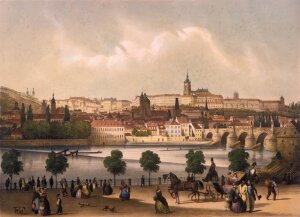
Ferdinand’s father was a violin maker and had had his own workshop in Velvary since 1809. He, too, had learned the craft from his father and, after wandering in and around Prague, had returned to Velvary, where he was born. He was by far the most talented maker to have emerged from the workshop of his mentor, the renowned violin maker Caspar Strnad, in Prague. Strnad had established a school of his own based on the Italian violin-making tradition. Ferdinand’s father had begun his apprenticeship with him at age 12 and remained there for 14 years until he was finally able to start his own business in Velvary.
Ferdinand’s father was not the first violin maker in the family. In addition to Eberle and Elias Placht, František Homolka (1778–1861) and his descendants had been important figures in Czech violin making. They were influenced by Italian and Austrian (Habsburg) schools, particularly that of Füssen in Bavaria.
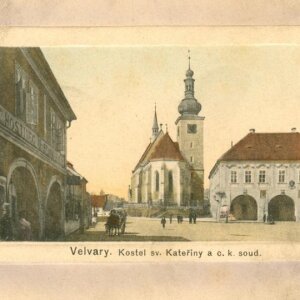
Velvary, early 19th century
Ferdinand’s birthplace was an important stop along the old trade route from Saxony to Prague, where instruments made in the surrounding villages also found their way to the Czech capital. This was also true of the instruments made by the family’s first violin maker: František Homolka.
Like his father, Ferdinand August began working in his father’s workshop at a young age. At age 16, in 1844, his career as an apprentice truly began. After one year, in 1845, he continued his apprenticeship with Josef Kratschmann in Znojmo, and after passing his master’s examination in Vienna, he went to work for Frantisek Schmidt, followed by a position with Josef Barchánek in Sopron.

He traveled on to Linz, where he began working for Johann Fitsch, and continued on to Kutná Hora to stay with his uncle Ferdinand Josef, then to Prague to work with Johann Stoss and Jan Baptista Dvořák, before finally returning to Vienna to work for Anton Fischer, who had his workshop in the building of the renowned Wiener Musikverein.
These luthiers possessed a high degree of craftsmanship. They did not so much model their instruments after the more domed Bohemian designs, but often after traditional Cremonese luthiers such as Guarneri del Gesù and Stradivari, whom they combined with their own, often subtle, style. After his travels, Ferdinand Homolka finally settled in Prague in 1854.
That was not all that surprising; Vienna was indeed the center of musical activity in the 19th century, but it was ultra-conservative. As far as the development of music was concerned, Prague followed closely behind Vienna. Around the time Ferdinand Homolka settled there, a cultural uprising began. The Czech elite increasingly resisted the dominant German-speaking culture in the empire. In Prague, people rose up to make the city the center of the Czech revival. The movement to breathe new life into the native language, culture, and history resonated with broad segments of the population.
Nationalism and Romanticism soon flourished in Prague in literature and music. Composers such as Bedřich Smetana and Antonín Dvořák drew inspiration from folk music and Czech culture. As a result, musical institutions such as the Prague Conservatory and arts organizations flourished. These came to play a vital role in shaping the Czech musical identity; Dvořák wrote his first six string quartets there in 1862, and Smetana taught at the conservatory and became the principal conductor of the city’s Royal Theater in 1866. Music and literature became the pillars of the new cultural identity.
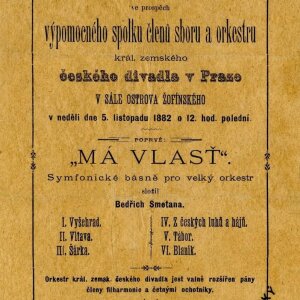
Announcement of a performance of Bedřich Smetana's cycle of symphonic poems "Ma Vlast"—music with a distinctly Czech character.
Influenced by the music that fueled the uprising, violin making in Prague experienced a tremendous boom around 1850. Over generations, the craftsmen had honed a high level of technical skill. As the political capital of the Habsburg Empire, Prague had for many years attracted discerning musicians, composers, and instrument makers, resulting in a more refined approach to violin making there—one often focused more on individual quality than on mass production in the surrounding villages.
Many of the builders who worked in Prague in the 19th century had become the most prominent in Central Europe.
In 1857, Ferdinand August Homolka opened his own business in Prague. A year later, he got married, and in 1860, he had a son, Eduard Emanuel. Even in Prague, he didn’t stay in one place for long; in total, he changed workshops seven times. Eventually, he worked from his own home on Tyn Square, a small but beautiful location in the city center.
Ferdinand August Homolka is often regarded as one of the finest violin makers in Czech history. He received widespread recognition for his excellent copies of Antonio Stradivari’s violins, but he also made copies of instruments by other Italian masters. He crafted these with great skill.
He did not intend to create a forgery; he affixed his own label to these instruments
He built some instruments in the style of Stradivari—not only in model and shape, but he also incorporated signs of aging and sometimes replicated cracks and scratches with astonishing precision. His intention was not to create forgeries; he affixed his own label to these instruments. Because Czech violin making had already reached such a high level of craftsmanship, Ferdinand Homolka’s instruments were highly prized among professional musicians.
Like the generations before him, he trained his son Eduard Emanuel himself. In addition to becoming a violin maker, Eduard Emanuel also became a violinist. He studied violin with František Ondříček and secured a position in the orchestra of the National Theater in Prague. He also continued to build instruments in his father’s workshop until he went abroad in 1886. When Ferdinand August died in 1890, he returned to Prague and took over the business.

Labels by Eduard Emanuel (son) and Ferdinand August (father) Homolka. Source: Czech Music Museum in Prague
Homolka’s violins bear a resemblance to Stradivari’s, but with a slightly higher arch. He knew how to find the right wood for each instrument, which he generally finished with a yellow to yellow-brown oil varnish; depending on the instrument he wanted to build, he used a transparent golden-yellow varnish.
His printed label read: Ferd August Homolka / in Prague 187.
Davidson, A., 2019, Reclaiming a Golden Past: Musical Institutions and Czech Identity in Nineteenth-Century Prague
Beckerman, Michael B., 2003, “In search of Czechness in music”, 19th-century music in Prague, Prague
Large, B., 1970, Smetana, New York.
St. Pierre, K., “Smetana’s «Vyšehrad» and mythologies of Czechness in scholarship”, 19th century music. Prague.
Hroch, M., 1985, Social preconditions of national revival in Europe: A comparative analysis of the social composition of patriotic groups among the smaller European nations, Cambridge.
Vannes, R., 1999, Universal Dictionary of Instrument Makers, Spa.
Henley, W., 1959 Universal Dictionary of Violin and Bow Makers. Amati Publications, London.
Libin, L., 2014, The Grove Dictionary of Musical Instruments, Oxford.
Geneanet, accessed in 2025.