Instrument

double bass
Edward Popplewell J’Anson
Manchester,
± 1850
played by
Javier Clemén Martínez
Javier Clemén Martínez

*1830 , Leeds †1892 , Hulme/Manchester
It was Georg Friedrich Handel’s arrival in London that heralded a renaissance of the double bass in England. The first English double basses date from around 1690, but musicians had preferred German instruments, after which British violin makers rarely built double basses.
Handel’s operas and oratorios quickly became popular in the English capital, and these large instruments were indispensable for their performance. However, Handel encountered a problem when it came to sourcing them: there were hardly any English makers left who could build them. Most double basses were still being imported. A few came from Germany, but if the risk of the journey was deemed acceptable, they were preferably sourced from Italy. The first English makers to learn how to build these instruments were Daniel Parker and John Barrett. Later, the makers Peter Wamsley and Joseph Hill took over this craft.
The most significant contribution to the further development of the double bass in England, however, did not come from English builders but from the virtuoso Italian double bassist Domenico Dragonetti. At the height of his fame, he had come to London, quickly moved in the highest circles, and exerted a major influence on performance practice. He was not only a renowned player of the instrument but also a great connoisseur of other string instruments.
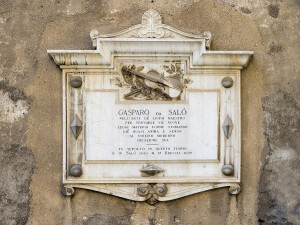
Commemorative plaque at the Church of San Giuseppe in Brescia.
Until Dragonetti’s arrival, the few English double basses were modeled after the full-bodied, arched basses built in Mittenwald (Germany). Dragonetti owned a magnificent-sounding Gasparo da Salò bass from Brescia with a different shape that would change that preference. He began collaborating with the Italian violin maker Vincenzo Panormo, who had also come to London, to supply his ensembles with instruments. This included double basses. As a young violin maker, Panormo had already built a double bass in the style of the Cremonese makers—relatively small and with a curved back—but Dragonetti wanted double basses in the style of his Da Salò. At first, Panormo refused and preferred to stick to the traditional style. The compromise was an instrument with a flat back featuring a curve, but with a shape copied exactly from Dragonetti’s Da Salò double bass. Panormo himself continued to build instruments with curved backs.
Once he had settled on the final design for his double basses, Dragonetti had wood shipped from Italy so that the London luthier Thomas Kennedy (c. 1784–c. 1870) could build the instruments there.
Dragonetti’s legacy was not limited to Kennedy and Panormo, but became the definitive form of the English double bass: an instrument with a flat back featuring a bend, a deep body, and the cello-like outline of the Da Salò bass. London became the center of double bass making, where the Fendt, Lott, and Simon Foster families built many basses of that model, which over the years were distributed throughout much of the country.
However, this was not the case in northern English cities such as Leeds, Birmingham, and Manchester. They all had their own orchestras, which used a completely different basic model: a viola da gamba-like instrument with a semicircular bottom, similar to those still being built in 1830 by violin makers James Cole Double in Manchester and William Booth (I) of Leeds.
William Booth became the mentor of Edward Popplewell J’Anson, who lived in the same city. Edward Popplewell J’Anson was the son of Joshua J’Anson and Matilda Ann Popplewell. He was born on March 24, 1830, in Leeds and baptized at “Whitehall Independent,” an independent congregation with no affiliation to any denomination. Edward proved to be at least as talented as his mentor. His work was rated “first class.” Around 1881, he moved with his wife and mother to 52 Walnut Street in Manchester, where he built mainly violins, a few violas, cellos, and an unknown number of double basses.
However, Popplewell J’Anson’s double basses differ in every respect from what was customary in northern England. In terms of design, construction, finish, and varnish, Popplewell J’Anson’s double bass most closely resembles those of the great London double bass makers. And they are still considered the finest double bass makers of the nineteenth century. J’Anson’s instrument is on par with the London basses. Meticulously finished down to the last detail and with an almost ideal tone. Few basses bearing his name remain; many were fitted with an Italian label over the years.
Label: Edward P. J’Anson, Made in Manchester. 1872
Harry Jansen, double bass maker and expert.
W.M. Morris, 1920, British violin and bow makers, London
Martin T. en G., 2018, M. Lawrence, The English Double Bass, Barnbury