Instrument

cello
Claude Pierray
Paris,
± 1720
played by
Renée Timmer
Renée Timmer

*± 1681 , Parijs †± 1742 , Parijs
Pierray’s studio was located on Rue des Fossés-Saint-Germain-des-Prés (now Rue de l’Ancienne Comédie), a lively street in Paris’s Latin Quarter. Several very wealthy families had settled there and, to add splendor to their parties, had attracted painters, musicians, and poets. Over the years, they became a source of innovative ideas in the fields of art and culture not only for the neighborhood but also for all of Paris.
Even during Claude Pierray’s early years, there was an annual fair featuring street theater, animal trainers, and puppeteers that drew large crowds. Artists could exhibit their work at the Abbey of Saint-Germain, which had become a prominent European intellectual center, giving the area not only a sophisticated but also a serious artistic character.

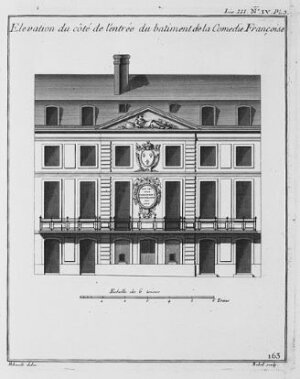
Facade of the Comédie-Française
Claude Pierray’s workshop was located practically next door to the Comédie-Française theater, which was also on Rue des Fossés-Saint-Germain-des-Prés. When the prestigious Collège des Quatre-Nations was built practically next door, the troupe was asked, on Napoleon’s orders, to relocate further away in order to limit the artists’ negative influence on the students. The theater moved to the Jeu de Paume de l’Étoile.
Over the course of Claude’s life, the Rue des Fossés-Saint-Germain-des-Prés grew into a famous street with 52 cafés where music was performed, literary salons were held, and many artists lived. Claude Pierray built viols and small cellos there, initially for local artists, but later also for musicians from further afield.
On the other side of the Seine worked Jacques Boquay, a violin maker whose instruments bore a strong resemblance to those of Pierray. Boquay’s instruments were more expensive, but Pierray’s were made of better materials, built with greater care, and finished to a higher standard. The instruments of both makers were based on the models of Andrea Amati and finished with a bright reddish-brown varnish.
Researchers who have studied Claude Pierray's instruments describe him as an excellent craftsman. His instruments were so well-made that they were sometimes mistaken for Italian ones later on.
Claude Pierray primarily built two models based on Amati’s large model. However, his instruments cannot be considered copies of this maker’s work; only their contours are reminiscent of Amati’s. His construction method differs entirely from the Cremonese technique. The wood Claude Pierray used was usually not beautifully flamed, but it was of very high quality.
At the beginning of the eighteenth century, Claude Pierray’s instruments were highly regarded and in great demand in England. The Clerkenwell collection included a “Claude Pierray” that was described in the catalog as “a particularly beautiful violin, just as good as a Cremona violin.”
Three different labels by him are known to exist, including a printed version:
Claude Pierray / Rue des Fossés, Saint-Germain-des-Prés, Paris / 1714
A printed version with a decorated border: Claude Pierray / 171.,
and a handwritten label: Claude Pierray / 1737
Lazare F. and E., 1855, Administrative and Historical Dictionary of the Streets and Monuments of Paris. Paris, Bureau de la Revue Municipale.
A History of Paris, Street by Street, House by House, 1875
Vannes, R. 1975, *Universal Dictionary of Instrument Makers*.
Hunt J., Jurors of the Guild of Musical Instrument Makers of Paris, NY
Jacquot, A., 1912, La Lutherie Lorraine et Française, Paris,
Tarizio, Cozio Archive, accessed 2023.