Instrument
violin bow
(Charles) Jean-Baptiste Collin-Mezin
Paris,
± 1910
played by
Karina Sosnowska
Karina Sosnowska

*1841 , Mirecourt †1923 , Parijs
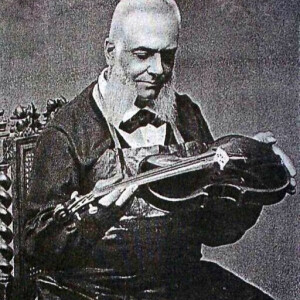
The Collin-Mézin family must have been deeply outraged when the Laberte-Humbert company registered a new trademark in 1898: “Jean-Baptiste Colin-Mezin.” With just one letter’s difference, Laberte marketed instruments that had nothing to do with Jean-Baptiste Collin-Mézin. It does, however, illustrate just how fierce the competition was and how loosely some violin makers took ethical standards.
The Collin-Mézin family of luthiers enjoyed a good reputation among musicians; they rarely drew attention to themselves, but their work certainly belonged to the ranks of the exceptionally refined French violin makers that the nineteenth century produced.
Claude Nicolas Collin (1800–1863), father of Charles Jean-Baptiste, was trained as a violin maker and bow maker in one of the many violin-making workshops in the town of Mirecourt. There he met Joseph Mézin (1789–1869), a violin maker and bow maker. He presumably worked for him for several years. In 1823, Claude Nicolas registered as the owner of a violin-making workshop in Mirecourt, but left a few years later for Brussels to work for Nicolas François Vuillaume (1802–1876). There he built violins under the name N.F. Vuillaume, but always signed his own name on the inside of the instruments he crafted.
While working for his first employer, Joseph Mézin, he had met his daughter, Odile (1818–1901). After returning to Mirecourt in 1841, he married her. Claude Nicolas was in poor health. His output was modest, and he traveled extensively to establish contacts with other violin makers. As was often the case in Mirecourt, his in-laws became involved in the new business. This combined their expertise and financial resources. Wives often helped out in the family business, and this was also the case with the marriage between Claude Nicolas Collin and Odile Mézin.
Their son Charles Jean-Baptiste was born in the year of their marriage. Jean-Baptiste later described how, as a small child, he was placed on the workbench to watch his father at work. By the age of seventeen, he already felt that Mirecourt was too small for his ambitions. His father had told him about his many trips to Paris and how great the opportunities were there for violin makers. And Charles Jean-Baptiste was just the right age to be fascinated by that. In 1858, his father applied on his behalf for a “permis” to go to Paris. It is unclear for whom he worked there; the city was undergoing rapid change, and Parisian archives were scarcely maintained at that time. Perhaps due to the unrest that followed the assassination attempt on Napoleon III in Paris, he was back in Mirecourt just two years later, in 1860.
Vuillaume, for whom his father had worked in Brussels, was by then known as an outstanding violin maker and had connections throughout Europe. Because of the good relationship between Vuillaume and his father, his chances of success there were greater than in Paris. That same year, Jean-Baptiste left for Brussels and continued to work for Vuillaume for over four years.
In 1865, he returned to Mirecourt to marry Rose Félicité Aubert (1842–1875). He opened his own workshop and also began building “St. Cecilia” instruments for Nicolas Vuillaume. But Paris continued to hold a strong appeal for him. In 1867, he settled there in the workshop that had belonged to Claude François Rambaut, who had returned to Mirecourt. Despite fierce competition, he built a reputation there as a skilled violin maker, bow maker, and repairer. In 1875, his wife Rose fell ill, returned to Mirecourt, and passed away. Their son Charles Louis was 5 years old at the time.
Charles Jean-Baptiste did not remain alone for long. A year after Rose Félicité’s death, he remarried in Paris to Marie-Thérèse Nieu (1853–1880). His son, Charles Louis, remained with his grandmother Mézin in Mirecourt. His marriage lasted only five years. Marie-Thérèse died at the age of 27.
In Paris, his clientele grew to include renowned soloists with whom he often maintained long-standing friendships. They were all full of praise for Jean-Baptiste’s instruments. This led him to participate for the first time in the great World’s Fair in Paris in 1878. He immediately won awards for both sound and appearance. He also won a silver medal in 1889 and a gold medal in 1900 for the instruments he had submitted.
Over the years, he did continue to make bows, but the number gradually decreased. Now they are rare. As his violins became more successful, he had others make more bows for him. He set high standards. Only the very best were considered qualified to make them for him.
His dedication to Parisian violin making did not go unnoticed. In 1884, he was elected a member of the Académie des Beaux-Arts, which at the time was the most prestigious institution representing a conservative movement in the arts. This role was well suited to Charles Jean-Baptiste Collin-Mézin, who had received a classical education and continued to work in a traditional manner.
In 1889, Maison Laberte-Humbert released a series of violins under the name “Jean-Baptiste Colin” without consulting anyone. Since the name had been registered as a trademark, a legal battle against Laberte-Humbert would have been doomed to failure from the start. Jean-Baptiste’s son warned that they were counterfeits, but upon further reflection, Jean-Baptiste saw the honor in it. The catalog published by Laberte-Humbert in 1905 stated that the name Jean-Baptiste Colin had since become known worldwide.
When Jean-Baptiste went to Paris, his son Charles Louis remained in Mirecourt. According to Jacquot (1926), Charles Louis had a special talent for building violins and contributed significantly to his father’s success at the World’s Fairs of 1889 and 1900. Some of the instruments that won the Grand Prix in Paris in 1900 were even partially built by him. Jean-Baptiste had successfully passed the craft on to his son.
Starting in 1901, Jean-Baptiste built a few more instruments and possibly a single bow, but two years later he stopped working. Charles Louis, his son, took over his workshop and his designs. Although Jean-Baptiste was no longer active, Charles Louis continued to list the work of both his father and himself in his catalogs until 1912. Jean-Baptiste remained a member of the Académie des Beaux-Arts until 1911, after which Charles Louis took his place.
Jean-Baptiste died in Paris in 1923 at the age of 82. His studio continued to operate until 1960 under the direction of his descendants.
Although Jean-Baptist did not distinguish himself as a great teacher of other instrument makers, his influence can be seen in the work of Joseph Chipos-Vuillaume (1847–ca. 1898), Paul Alexandre Mangenot (1862–1942), Gustave Bazin (1871–1920).
The design of his bows was based primarily on that of Voirin, the most common model at the time. Later, he generously allowed influences from the bowmakers who worked for him. These included Charles Nicolas Bazin II (1847–1915) and Charles Louis Bazin (1802–1859), Eugène Cuniot-Hury (1861–1910), Émile François Ouchard (1872–1951), Louis Morizot père (1874–1957), and Victor Fétique (1872–1933), who made many bows for him.
For all of his bows, he used—or had others use—high-quality pernambuco wood and almost always fitted them with a silver ferrule. The bows bore the stamp: “Collin-Mézin.”
Millant, B., Raffin, J.F., 2000, *L'Archet: French Bowmakers, 1750–1950*. Paris.
Vatelot, E., 1976, *Les Archets Français*. Nancy.
Jacquot, A., 1912, *La Lutherie Lorraine et Française*, Paris.
Henley W.,1959 Universal Dictionary of Violin and Bow Makers. Amati Publications. London.
Vannes, R., 1999, *Universal Dictionary of Instrument Makers*, Spa.
Tarisio; the Cozio archives, accessed in 2020.
Geneanet, accessed in 2020.
Archives Nationales de France, accessed in 2020.