Instrument
viola bow
Charles Alfred Bazin
Mirecourt
played by
Alice Sinacori
Alice Sinacori

*1907 , Mirecourt †1987 , Epinal
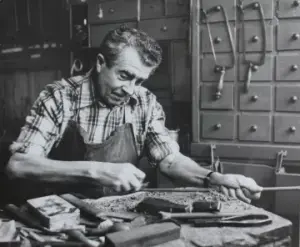
Charles Nicolas (1847–1915), Charles Alfred’s grandfather, had been one of the most legendary bow makers of his time. Outspoken, sociable, and widely respected, he had served as a city council member, and for much of his life he had been dedicated to establishing a national vocational school for violin making. His workshop was a breeding ground for important makers, producing some 3,000 bows a year at the height of his success. Charles Alfred was his youngest grandson and the fourth generation of bow makers in the family. Charles Alfred would carry on the family tradition with his exclusive bows.
Charles Alfred was born in 1907, the son of Charles Louis Bazin (1881–1953) and Jeanne Dubois (1882–1953). His father had a workshop in Mirecourt where, together with eight other employees, he made bows for a large number of prominent violin makers.
His father’s studio still exuded the atmosphere of the previous generation of Bazins, as his grandfather, Charles Nicolas, was still working there. Both were remarkable individuals. From an early age, Alfred could be found in his father’s studio, where, after school, he began learning the techniques of the trade as early as 1913. That, however, would not last long.
Shortly after Alfred’s seventh birthday, the violence of World War I began, and his father was called up for military service—not in an active combat unit, but in the military band of the 26th Infantry Regiment. A year later, in 1915, his grandfather Charles Nicolas died. In 1918, Charles Louis returned from the war. More than 275 men from Mirecourt had not survived the trenches; hundreds of others were traumatized and wounded. Among them were many violin makers and bow makers, but his father had emerged unscathed. Although Charles Louis had not fought in the trenches, like all the musicians in the regiment, he had been deployed to the front as a hospital orderly and stretcher-bearer, where he had witnessed the horrors of trench warfare firsthand. As if possessed, as Millant & Raffin (2000) described it, Charles Louis returned to work in his workshop upon his return.
In 1919, the family moved to a stately home in Mirecourt, which also housed the workshop. Charles Alfred did not truly begin his training as a bow maker until September 1922. His grandfather, whom he had known for only seven years, had made a deep impression on Charles Alfred. His bows were legendary, but he was also the great role model for how a workshop should be run—a model that Alfred was eager to emulate.
Charles Alfred was not going to take over the management of a large company. Starting in 1925, Charles Alfred took over the management of his father’s firm, but as the crisis loomed, the number of customers declined rapidly, and they were forced to lay off many of their employees; only eight remained, and by 1936, only four bow makers were still working in the workshop, including Charles Alfred himself.
For fifteen years, father and son Bazin made bows for the leading violin makers in France. They produced a number of different models, but most were based on those of Charles Nicolas, which they simply refined a bit further. These were among the most sought-after modern bows.
Since Charles Alfred could not match his grandfather’s production volume of bows, he gradually shifted his focus toward exclusivity. He refused to continue working for violin makers or trading houses and sold his bows exclusively to musicians. His bows also became more exclusive as he began to work more with precious materials such as gold and tortoiseshell.
In 1939, he married Edmée Anne Guinot (1907–1974). A year later, World War II broke out, and Charles Alfred was called to serve in late 1940. He would not see his son Patrick, who was born in 1941, again until after the war.
Upon his return, he opened his own studio, where he worked alone for a long time. In 1952, he took over his father’s business but was unable to retain most of the employees. His decision to focus on exclusivity had cost him customers.
After the war, Mirecourt was on the decline. Bows and instruments were being mass-produced in factories outside the city, and of the 2,000 people who had worked as violin makers or bow makers in Mirecourt around 1840, only a handful remained. Only the strongest could withstand the competition. Alfred’s decision not to join the mass-production trend, but instead to specialize in exclusive bows, was driven by his pride in the family name. It was a wise choice, as he was able to continue practicing his craft until his retirement at the workshop named after his grandfather. In 1953, his father died, and shortly thereafter, his mother.
Charles Alfred believed that his grandfather’s significant contribution to Mirecourt should be better recognized. Therefore, together with a few supporters, he submitted a request to the Mirecourt City Council to name a street after him. In 1960, the request was granted, and Rue Charles Nicolas Bazin became a reality. That same year, Charles Alfred Bazin bought a house on the street named after his grandfather.
For another twenty years, he successfully crafted a vast number of bows there. He had earned enough to retire in 1980. His son Patrick had chosen to pursue an academic career, and since he had no other successor, he was forced to close the workshop. Seven years later, he died as the last bow maker of the great Bazin family. Four generations of Bazins have been of inestimable value to the bow-making community and to the town of Mirecourt.
Charles Alfred made many excellent bows, usually round and made of brown-red or brown-orange wood. He branded his bows with three different stamps: the earliest bore the name “C Bazin,” and around 1955 he switched to “Charles Bazin.” Only a few of his bows are known to bear the stamp “Charles Bazin France.”
Among his colleagues and students, the best known are François Lotte (1889–1970), René Lotte, Louis Morizot (1937–1970), Louis Gillet (1891–1970), Marcel Lapièrre (1907–1979), and Jean-Claude Ouchard (1935–2012).
Musicians and bow makers owe a great deal to the Bazin family. The overall quality of their work was outstanding. Charles Nicolas, the founder, had been more or less forced by his father’s early death to forge his own path. Without being overly bound by conventions or strict guidelines, he developed into a distinctive personality through trial and error. For his son—and certainly for Alfred—things were different; for them, the path had already been laid out. This is reflected in their bows, in which the family tradition remained the guiding principle for a long time. It was not until after 1952 that Charles Alfred’s style became somewhat more personal. His bows became slimmer and had a very small tip. He managed to maintain a high standard until the early 1970s, after which the quality gradually declined somewhat.
Millant, B., Raffin, J.F., 2000, *L'Archet: French Bowmakers, 1750–1950*. Paris.
Vatelot, E., 1976, *Les Archets Français*. Nancy.
Jacquot, A., 1912, *La Lutherie Lorraine et Française*, Paris.
Henley W.,1959 Universal Dictionary of Violin and Bow Makers. Amati Publications. London.
Vannes, R., 1999, *Universal Dictionary of Instrument Makers*, Spa.
Tarisio; the Cozio archives, accessed in 2020.
Geneanet, accessed in 2020. Archives Nationales de France, accessed in 2020.