Instrument

violin
Carlo Giuseppe Testore
Milan,
1709
played by
Renate van Riel
Renate van Riel

*± 1660 , Novara †± 1737 , Milaan
In the field of violin making, Giovanni Grancino (1637–1709) is regarded as the founder of the Milanese school, and Carlo Giuseppe Testore as his student, collaborator, and successor. Carlo Giuseppe was born in Novara, forty kilometers west of Milan. Nothing is known about his time in Novara. It is believed that he met the violin maker Gioffredo Cappa (ca. 1653–1717), who worked in various towns in the same region, and that he learned the craft from him.
Cappa da Saluzzo, as he was also known, was a highly regarded luthier in his hometown, not only because of his social status, but also because he was one of the few violin makers to have been awarded the title “Maestro.” Cappa did not seem to pay much attention to the finish. His instruments are more striking than refined. Cappa worked in southern Piedmont and built instruments that resembled Amati’s so closely that Paganini wrote in 1823: “You will no longer find violins bearing his (Cappa’s) name; Pugnani has changed all the Cappa labels to Amati.” It was this luthier—who had devoted himself so successfully to his craft during his lifetime, yet was later so ingloriously forgotten—who drew Carlo Giuseppe Testore to violin making and made him his apprentice.
When Carlo Giuseppe Testore went to Milan around 1686, Giovanni Grancino was the leading architect there. Together with his brother and son, Grancino ran a workshop on Contrada Larga, a street located a short distance from the Duomo and the palace of the archbishop and cardinal. Grancino took Carlo Giuseppe Testore on as an apprentice, but when it became clear that Carlo already knew the basics of the trade, he quickly became his associate. Even after Carlo Giuseppe Testore had established his own practice, he would continue to credit Grancino as his mentor on his labels for several more years.
Carlo appears to have played an important role in Grancino’s workshop. In his early years, he was more meticulous than his employer, and it was perhaps thanks to his influence that the Grancinos’ instruments were finished to a higher standard after his arrival than they had been previously.
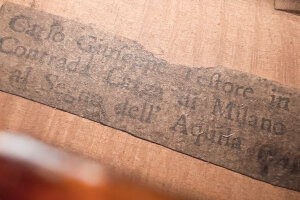
Around 1690, Testore set up his own business, also on Contrada Larga, a street where many more violin makers would establish themselves over the years. He named his workshop “Al segno dell’Aquila.” He branded the instruments he built from that point on with an eagle symbol.
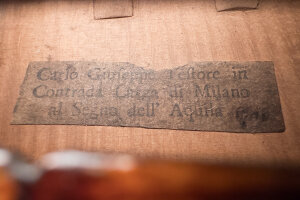
Label by Carlo Giuseppe Testore on the violin (ca. 1703) from the collection of the Musical Instrument Fund
One of the first newcomers to Contrada Larga was Bartolomeo Pasta (1640–1706). This luthier had arrived from Cremona in 1673 and had worked in Nicolò Amati’s workshop. He was viewed in the neighborhood as an unwelcome competitor, especially when it became clear that he knew a great deal about the Amati family’s construction methods, which were the standard for Italian violin making. It was only later that he was accepted by the other Milanese violin makers. After his arrival in Milan, Carlo Testore moved in with Bartolomeo Pasta.
Although it has not been proven that Bartolomeo Pasta also worked for Grancino, it is highly plausible. Grancino’s influence is still evident in the instruments made by both builders. Furthermore, Pasta’s and Testore’s views differed greatly from one another.
Carlo Giuseppe married in 1689, and a year later his first son, Carlo Antonio (1693–ca. 1765), was born, followed seven years later by Paolo Antonio (ca. 1700–1767).
Virtually no Milanese violin maker of that era was well-off. The city was under French rule and had been bled dry by high taxes. There was no sign of a rich musical culture like that found in Rome, Florence, or Venice. Moreover, the region around Milan was sandwiched between other states, which severely limited the import of goods, such as high-quality wood for his instruments. Out of necessity, the wood therefore came mainly from the local area. As a result, Testore’s instruments often lack the appealing wood grain found in instruments from other regions. This simplicity remained a hallmark of his work for a long time.
It seems highly likely that his customers did not belong to the wealthiest segment of the population. They purchased their instruments from makers in Brescia, Bologna, or Cremona.
Thanks to his good connections with the discerning aristocracy and high-ranking church figures, Grancino was able to charge more for his instruments and thus devote a great deal of time to the selection of materials, finishing, and varnish. Testore, on the other hand, relied more on musicians who earned their living through music. For them, he built instruments that may not have been the most beautiful, but in terms of sound, they were among the best instruments built in Milan.
Giovanni Grancino died in 1709. Shortly before his father’s death, his son had become involved in a violent incident with one of the other violin makers in the neighborhood, after which he was sentenced to death. As a result, the Grancinos lost their license to build violins. Giovanni Battista Grancino fled before the sentence could be carried out and illegally built a number of instruments to support himself and his family, but in Milan, the Grancino family’s role had come to an end. Carlo Giuseppe Testore subsequently became one of the city’s most important luthiers.
Carlo Giuseppe trained both of his sons himself. Under his guidance, they built instruments that closely resembled his own. His son Carlo Antonio lacked precision and a sense of refinement, while Paolo Antonio’s work varied greatly in quality. His better instruments reveal fine craftsmanship, whereas his lesser ones are downright poorly made.
Carlo Giuseppe died at the age of 77. His body of work must have been extensive. By 1701, five years after he had started his own business, he had already built 103 instruments. Many of them have been lost. Only about 150 of his instruments survive today. The majority are violins; there are also about 20 cellos, a few violas, and double basses.
His eldest son, Carlo Antonio, took over the business after his death, along with his 16-year-old brother. Paolo, as the last generation of Testore violin makers, could not even come close to matching his father’s skill. He no longer played a role of any significance in Milan.

The scroll of the C.G. Testore violin (1709) from the collection of the Musical Instrument Fund
Carlo Giuseppe Testore’s early instruments generally feature a low arch, which is characteristic of Grancino’s later period. The slender f-holes also reveal his influence. Later, they take on the form of the Guarneri models he made in Cremona. Testore’s scroll has been distinctive almost from the start of his career, featuring an oval, forward-leaning shape.
In his early instruments, the C-curves are still deep and symmetrical; around 1700, they become longer, giving the instrument a distinctly slender appearance, similar to that of Cappa’s instrument from ten years earlier.
The wood Testore used varied greatly in quality. At first, he seemed able to purchase beautifully figured wood, but after 1705, this became less common. On many of his instruments, he drew the “edge inlay” with pen and ink on the back and crafted it on the top in the traditional manner using three strips of wood. This demonstrated his extremely pragmatic approach; on the hard wood of the back, a border inlay was unnecessary and expensive, while only the soft wood of the top required an inlay to prevent splitting along the vulnerable edges. In later years, other builders often replaced the drawn lines with actual inlays.
Around 1705, he developed a more distinctive design by extending the corners. This gave the instrument a striking, pointed shape.
Throughout his career, there is hardly any period in which he consistently used a particular color. He sometimes used deep Venetian red, but he also frequently used brownish-yellow and orange-yellow.
On his early labels, he noted that Grancino was his teacher; after 1690, he omitted this information. From then on, the text simply read: Carlo Giuseppe Testore in Con/trada Larga di Milano/Segno Dell’ Aquilla, followed by the year/
The instrument in the collection of the Musical Instrument Fund was built by him shortly after the death of his teacher, Grancino, and following the conviction that same year of Grancino’s son, with whom he had collaborated. It is one of the few instruments he built from beautifully figured wood.
Chiesa C., 1996, Violinmakers at the Contrada Larga in Milan.
Kass P. J., 1989, Snaarinstrumenten van de Milanese vioolbouwers van de Contrada Larga.
Santoro E., 1989, Violinari e violini, Cremona.
Vannes R., 1999, Dictionnaire universel des luthiers, Spa
De Courcy, G.I.C., 1957, Paganini: The Genoese, University of Oklahoma
Sacchi, F, 1898, Count Cozio di Salabue: Celebrated Violin Collector, London.
Tarisio, Cozio archive, bezocht 2020

