Instrument

violin
Camillo Camilli
Mantua,
± 1750
played by
Marie-José Schrijner
Marie-José Schrijner

*1703 , Mantua †1754 , Mantua
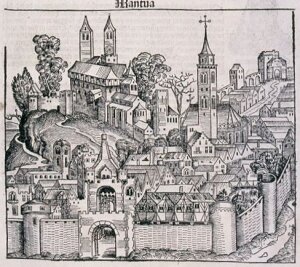
The Gonzagas of Mantua had been playing an important role in promoting secular music to a wide audience since the mid-fifteenth century. Vincenzo Gonzaga, Duke of Mantua and Montferrato, had met Claudio Monteverdi in 1601 and appointed him to his court, first as a violist and later as a composer. With this appointment, he continued in the same vein as his grandfather had done as early as 1480: providing a platform for Italy’s finest musicians and composers. This marked the beginning of a period during which Mantua rose above most Italian cities in the realm of music. The city even had an “Academia dei Timidi” where vocal and instrumental music were taught. The movement that began with Monteverdi’s 1607 opera *La Favola d’Orfeo* could only be performed with the finest singers and the finest instruments.
There was no shortage of skilled instrument makers in Mantua. They had drawn their knowledge not so much from a local tradition as from the “violin” and lute makers of Füssen. At the end of the sixteenth century, these colleagues had left their town at the foot of the Alps, scattered across northern Italy, and settled in Cremona, Venice, Brescia, and Mantua. The Füssen makers were masters of their craft. Their training was strictly regulated, and it took years before they were allowed to set up their own workshops.
Drawn by Mantua’s cultural splendor, Pietro Guarneri, the eldest son of Andrea Guarneri of Cremona, had moved to Mantua around 1785 and settled on the Contrada del Monte Negro, not far from the Camillis. In his younger years, Pietro had worked in his father’s workshop and had become an outstanding violin maker, but due to a disagreement with his father, he left there at the age of twenty-seven. During the first years of his stay in Mantua, he played the violin at the court of Vincenzo Gonzaga; later, he returned to his original trade, became the violin maker for the court orchestra, and thus left his mark on violin making throughout the rest of Mantua. At least two local violin makers benefited from this: Tomasso Balestrieri and Camillo Camilli.
Camillo Camilli was born in Mantua in 1703. His family included several scholars, the most famous of whom was his namesake, Camillo Camilli, rector and professor of the humanities in Siena. When Camillo decided to become a violin maker, Pietro Guarneri was already nearly sixty, but despite his age, he undoubtedly still served as Camillo’s great role model. Camillo must have seen his workshop, tools, and instruments, but it is not certain whether he also received part of his training there. Most researchers believe that as a boy he first hung around with him for a while before later completing an apprenticeship. Analyses of instruments do suggest, however, that Camillo Camilli drew heavily on the work of Antonio Zanotti, a violin maker at the court of Vincenzo Gonzaga, where he had succeeded Pietro Guarneri.
Antonio Zanotti called himself a “Lodegianus,” after the town of Lodi in southern Lombardy, where he presumably met Girolamo Amati in his early years; Amati was also working in Lodi around that time. As a young contemporary of Pietro Guarneri, he further developed his craft in Guarneri’s style.
When Camillo Camilli was eight years old, the ruler of Mantua, Ferdinando Carlo Gonzaga, died. He had been a rather inept ruler, whose interests had focused primarily on lavish parties and opera performances at his court. While this had been beneficial for musicians and violin makers, it had not worked out so well for the city’s other residents. He imposed exorbitant taxes on them to finance his lavish lifestyle. Not entirely unexpectedly, he lost the battle against the Franco-Austrian alliance, which had been coveting power in Mantua for many years. He sought refuge in Venice, taking thousands of works of art with him. He sold the rest to Charles II of England. After his death in 1708, the Gonzaga family lost control of Mantua and were forced to cede the city to the Habsburgs of Austria. Contrary to expectations, that change in power would turn out well for Camillo Camilli.
The Habsburgs proved to be very supportive of the Italian arts and even encouraged them, causing cultural life in Mantua to flourish once again. This time, it was not just for the elite, but also for other music lovers in the city. The Royal Academy of Sciences, Letters, and Arts and the grand theater were built, and numerous palaces in and around Mantua were restored to their former glory under their influence. Concerts held there were accessible to many.
Under the guidance of Antonio Zanotti, Camillus Camilli developed so quickly into a skilled violin maker that he became a formidable competitor to his teacher. With his refined craftsmanship, Camillo threatened to outshine him. When Zanotti feared in 1730 that his talented apprentice might also seek to take his place as court violin maker, he offered him a contract in which both makers agreed not to “compete” with one another. The contract lasted only one year. Shortly after 1731, Zanotti fell ill, and he died in 1734.
Camillus Camilli—or Camillo de Camillis, as he also called himself—came to prefer Pietro Guarneri’s style over that of his teacher over the years, and around 1740 he briefly built a number of violins in the style of Nicolò Amati.
Until his death in 1754, he continued to work on a large body of work that, as far as we know, consists solely of violins. Some of the violins are small in size, as was not uncommon in Mantua.
Camillo Camilli is highly regarded for his exceptional craftsmanship, which far surpasses that of most violin makers of his time.
Camillo Camilli was not yet well-known in his own time. It was not until the nineteenth century that his craftsmanship was recognized. In their 1903 book on violin making in Italy, the Hill brothers wrote: “Camilli was an excellent maker....his work shows considerable affinity with that of Pietro Guarneri.” The Hills were authorities in the field, and it was only after their mention that recognition of Camilli truly began to grow.
Camillo Camilli's earliest instruments date from around 1720. They bear some resemblance to those of Antonio Zanotti; they have a high arch, like those of Stainer and Girolamo Amati.
Over the next ten years, he experimented with various shapes and thicknesses of wood and significantly improved his technique. During that time, he singed the maple back of his violins—and often the sides as well—causing the grain to appear as dark lines running across the back. The wood he used came from locally felled trees. In the center of the back, he made a tiny mark in the wood, using it as a reference point from which to draw the circles. As is customary among Cremonese luthiers, these marks indicate the point where the thickness of the back changes.
In 1730, he built a violin that was meticulously detailed and beautifully proportioned, and was virtually indistinguishable from the instrument that Pietro Guarneri built in 1704, albeit a fraction smaller.
Even in 1734, he was still clearly a follower of Pietro Guarneri, but he gradually began to add a more personal touch through the shape of the scroll, the curvature, and the f-holes. The quality of the wood he used at that time is often better than it had been previously.
In 1742, Camillo Camilli appears to have returned to Pietro Guarneri’s “round” model. This step back in time was further influenced by Nicolò Amati’s so-called “large pattern” violin from 1665, ultimately culminating a few years later in a form that would become the recognizable Mantua style.
Camillo Camilli was a maker almost as meticulous as Pietro Guarneri; he had a similar approach to the details in the scroll, the rims, and the f-holes. He probably distinguished himself most by a rich yellow varnish that he used consistently and seemed to have developed himself.
Camilli died in 1754, but his model continued to be built in Mantua for a long time afterward. Philip J. Kass and Andrea Zanrè, for example, see the same curves and “lightness of form” reflected in the early work of Tommaso Balestrieri, who would continue to employ these characteristics with some regularity until his death in 1790.
The originality of Camilli’s model places him on a par with the Venetian violin makers of the nineteenth century, who, like him, experimented with the early Cremonese makers.
Unlike Pietro Guarneri, Camilo Camilli presumably did not have his own stock of selected wood; virtually every instrument is made from a different tree and varies in quality. He was also not very consistent in the way he worked the wood into the violin; sometimes he made the back from a single piece, sometimes from two, with the grain running upward, downward, or nearly horizontal.
Its label reads: Camillus de Camillis, Fecit Die XXV Augusti, Anno Dni MDCCLI.
Blot, E., 2001, Italian Violin Making, Piedmont, Italy.
Landon Ch., 2008, The Strad Magazine
Tarisio, Cozio archive, Philip J. Kass en Andrea Zanrè, New Research on the Violin Makers of Mantua, bezocht 2021
Vannes, R., 1999, Universal Dictionary of Instrument Makers, Spa
Henley W. , 1959 Universal Dictionary of Violin and Bow Makers. Amati Publications. Londen
W. Henry Hill, Arthur F. Hill & Alfred E. Hill, 1931, The Violin Makers of the Guarneri Family, 1626-1762, Londen