Instrument

cello bow
Brian Tunnicliffe
Somerset,
1985
played by
Renée Timmer
Renée Timmer

*1934 , Fairfield
Under the leadership of Arthur Bultitude, all members played an equal role. The Art Workers’ Guild sought to break down the barrier between the fine arts—such as painting and sculpture—and the applied arts or crafts. By appointing a bow maker as Master, the guild put this philosophy into practice. In 1978, Bultitude was succeeded by Seán Crampton. Crampton was also a fellow of the Royal Society of British Sculptors and held views so far removed from those of Bultitude and Tunnicliffe that Bultitude resigned his membership.
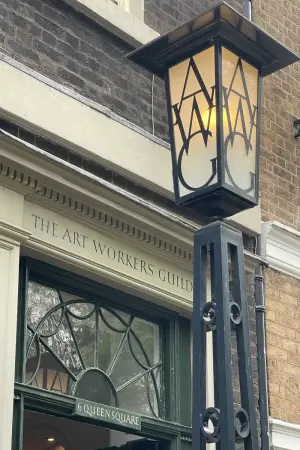
Art Workers' Guild Office since 1914

Until then, Brian Tunnicliffe had been a maker of wooden prototypes for mechanical engineering and a woodworking instructor. Arthur Bultitude was a legend in the field of bows. In 1922, at the age of fourteen, he had started working at W.E. Hill & Sons; under William Charles Retford, he had worked his way up to a managerial position at the firm and had ultimately become one of the foremost representatives of the English Hill tradition in his field. He had also been involved in research into the cause of the breaking of Hill bow tips. Two thousand bows were subjected to various types of stress to understand why the bow broke. Such an empirical approach to work was consistent with Tunnicliffe’s background as a prototype maker.
For decades, the Hill company had completely dominated the English bow market. Under the leadership of W.E. Hill and 31 highly trained bow makers, a rigid “Hill style” had emerged. This style was based on French models (Tourte for violin, Voirin for cello). These were recognizable, uniform, and high-quality bows. However, the company left no room for changes or the influence of individual makers. Starting in the 1960s, the best makers began leaving the Hill workshop to start their own businesses. Bultitude, too, turned his back on the company in 1961 for that very reason. He had worked there for forty years.
Wooden prototypes for machine parts proved to have no future, and after 24 years, Tunnicliffe decided to call it quits as a teacher. Under Bultitude’s influence, he became a bow maker in 1978. Bultitude, who was 70 years old by then, did not provide Tunnicliffe with formal training but, entirely in keeping with the original philosophy of the Art Workers’ Guild, became his mentor and advisor—a way of working that he had been putting into practice since 1961. The artisanal craft of making a bow—considering factors such as wood selection, thickness, elasticity, flex, and balance—was grounded in his 40 years of experience.
While Bultitude was a classic British cane maker, Tunnicliffe drew more inspiration from French masters of the previous century, such as Sartory and Voirin. He later developed his own style based on the work of these makers.
The renewed interest in the authentic performance practice of Renaissance and Baroque music called for bows other than the standard ones. Christopher Hogwood & the Academy of Ancient Music, Trevor Pinnock & The English Concert, and John Eliot Gardiner & The English Baroque Soloists were constantly on the lookout for authentic instruments and bows.
Brian Tunnicliffe looked to Peter Wamsley (ca. 1670–1744) of London, Richard Duke (ca. 1718–1783), and the Dodd family for examples of sticks that were suited to this musical practice. John Dodd was known as the “Tourte of England”; he owned several Tourte sticks and had reproduced them in many variations.
Tunnicliffe then went on to specialize in crafting reproductions of historical, primarily pre-Tourte, bows. Around 1987, he made a number of double bass bows with ivory frogs that are now considered rare collector’s items. In 2006, he was commissioned to create historically accurate bows for the Becket Collection at the Royal Academy of Music. Part of the collection consists of specially built replicas of Venetian Baroque instruments, for which Tunnicliffe crafted the bows. For this “Vivaldi project,” he based his designs on authentic 18th-century Italian models, appropriate for the music of Antonio Vivaldi’s era. Those bows approached the playability of a modern bow.
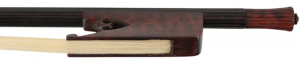
Part of an Italian-style Baroque cane. Originally, the ferrule and adjusting screw were made of ivory; they were replaced by Tunnicliffe in 2025.
Brian Tunnicliffe lived and worked for many years in Horsington, near Templecombe in Somerset, an English rural village with old farmhouses, a few country estates, and 512 residents.
Tunnicliffe’s body of work consists of violin bows, viola bows, cello bows, double bass bows, and historical and Baroque bows. Tunnicliffe enjoys a strong reputation among double bassists and Baroque musicians.
He stamped his walking sticks with "B. TUNNICLIFFE ENGLAND" and a serial number.
His sticks are played by members of, among others:
London Symphony Orchestra
Royal Philharmonic Orchestra
Orchestra of the Age of Enlightenment
In addition, his drumsticks went to musicians elsewhere in Europe, North America, Australia, and Russia.
Although he never had a large workshop with staff, he did train or mentor several makers, such as Ulf Johansson from Sweden, Henk te Hietbrink from Arnhem, and Corrie Schrijver, a violin and bow maker originally from the Netherlands, who studied with Tunnicliffe in the 1980s and went on to work in Wales and Scotland.
At the age of 87, Brian Tunnicliffe was still performing restorations and crafting new ebony fingerboards for his own ivory-inlaid double bass bows.
Brian Tunnicliffe’s expertise is still drawn upon for the reconstruction of historical bows. In 2024, Baroque double bass bows were crafted for the ensemble “Instruments of Time & Truth,” using Brian Tunnicliffe’s bows as a model.
Together with bow makers David Newton, Roy Collins, Henry Byrom, Gordon Bailey, and Andrew Bellis, Brian Tunnicliffe formed a group that breathed new life into English bow making after the closure of the large Hill workshops. All of these bow makers were mentored, to a greater or lesser extent, by Bultitude.
Brian Tunnicliffe has always remained a member of the Art Workers' Guild.
Remnant, M., 1986, English Bowed Instruments from Anglo-Saxon to Tudor Times, Londen
Commanday, R., 2012, A Millennium in 50 Years: The Discovery of Early Music, Festival and Academy of the American Bach Soloists.
Obituary - Arthur Richard Bultitude MBE Bowmaker, The Strad. Vol. 101. 1990. p. 430
Macdonald. S., 1970, The History and Philosophy of Art Education. James Clarke & Co. Londen
Arthur R, Beare CH., Bultitude, revised by John Dilworth
Oxford Music Online
The British Violin: 400 Years of Violin Making in the British Isles (by Tim Baker, John Dilworth, and Andrew Fairfax): Published by the British Violin Making Association
Plowright D.G., 1934, Dictionary of British bowmakers, Londen
Milnes and Wilson, 2016, The Hill Bow Makers 1880-1962
Stagg J.W., 2015, Bowmaking, Bradley