Instrument

cello
Bernhard Simon
Fendt
London,
± 1825
played by
Sanne van der Horst
Sanne van der Horst

*1769 , Füssen †1832 , Londen
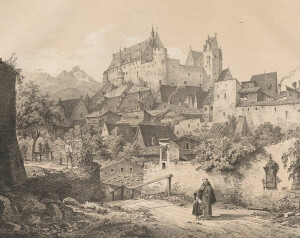
Füssen, the town where Bernhard Simon Fendt was born on May 11, 1769, was the earliest known place in Europe where stringed instruments were built. It was located on one of the major trade routes between the major German cities and Italy. Füssen was prosperous but also heavily dependent on the export of instruments. In times of unrest or war, it was vulnerable to economic stagnation. Not only did instruments cross the borders, but many violin and lute makers also left the town to earn a living abroad. Tiefenbrucker had gone to Lyon, Maler to Bologna, and members of the Seelos family to Venice. Wherever the Füssen-based makers went, new centers for violin making often sprang up.
Violin makers from Füssen were masters of their craft. Their apprenticeship lasted five years, after which they had to continue working under a master for another three years before they were allowed to set up their own workshop. They were only permitted to do so after their work had been evaluated by three established violin makers. The regulation governing this practice dated back to 1562 and remained in effect well into the 19th century. While it guaranteed an unprecedented level of craftsmanship, it did not allow for much creativity or individual development. For some young makers, that was a good reason to go abroad.
Bernhard Fendt was one of them. Immediately after completing his training in Füssen, he went to live with his uncle François Fendt, who had already settled in Paris. According to Milliot (2008), François Fendt had become one of the leading violin makers in the capital in the space of just a few years. His workshop was called “cul-de-sac St.-Pierre” and was located on rue Montmartre. That workshop became Bernhard’s new home.
What he couldn’t have known was that Paris was on the eve of a period of terror, popular anger, and uprising that would take hold of daily life in the city. Amid all this social unrest, there was little work for violin makers. The tensions came to a head in 1789 with the storming of the Bastille. That marked the beginning of the French Revolution. The hatred was directed not only against the wealthy but also against foreigners. Anyone without French ancestry faced the threat of losing everything. No one could guarantee a life of safety. Under this threat, Bernhard Fendt continued to work in Paris for a few more years, but eventually fled the chaos and violence.
In January 1798, he left for London, where there was already a large community of foreign violin makers. There, he found a new job with Thomas Dodd, who was one of the two leading violin makers. Dodd was very impressed with Fendt’s craftsmanship and, shortly after his arrival, hired Thomas John Frederik Lott to assist Fendt. Fendt trained Lott, and together they built a large number of excellent instruments for their employer.
The standard of violin making in England advanced by leaps and bounds after violin maker and dealer John Betts imported a large quantity of stringed instruments from Italy. He selected them himself, first in northern Italy, but later also in Naples, where he bought them at bargain prices. The number of instruments he imported was so great that England began imposing an import tax on them. By heavily promoting his Italian master instruments, he helped the London public come to appreciate instruments based on Stradivari’s model.
Fendt’s employer, Dodd, followed Betts’ example. He became an expert in antique instruments, traveled extensively, and purchased them wherever he could find them. He left the actual instrument-making to Bernhard Simon Fendt. When demand in England outstripped supply, Dodd had instruments built in Italy. He imported them in separate parts to avoid import duties. The unfinished parts were glued together and varnished in London. At first, he did the varnishing himself to keep the secret of his formula, but later Bernhard Fendt took over that task as well.
Bernhard Fendt left Thomas Dodd’s studio after Dodd decided to expand it in 1809 and moved to another part of the city. From that year on, he worked increasingly for John Betts, but continued to work for his former employer at least until 1823.
In 1803, the Italian violin maker Vincenzo Panormo returned to London. The Neapolitan had spent half his life traveling through Rome, Paris, London, and Dublin, and was now back. Given the interest in London for Italian instruments, Panormo, with his international knowledge and experience, would have been in high demand. But Panormo was already advanced in age, deeply disillusioned, and ended up penniless in St. Gilles, the part of the city where living conditions were among the worst in London. In the twelve years leading up to his death in 1813, he worked for various London violin makers. The instruments he built were labeled with other makers’ names, likely including those of Dodd and Betts, so no one knows exactly how many there were. Although none of them documented his presence, his influence can be seen in instruments by virtually all London makers, including those of Bernhard Simon Fendt.
Imports of Italian instruments gradually dried up in the late 1920s, prompting Bernhard Fendt to begin replicating the Italian models on Dodd’s behalf. Dodd was now largely dependent on Bernhard Fendt; he no longer did the craftsmanship himself. Dodd’s trust in Fendt was so great that he entrusted the training of his son Edward entirely to him.
Bernhard Fendt worked for John Betts for fourteen years. He specialized in cellos and double basses, which became very popular, but he also built violins and a few violas. During his time at Betts, he undoubtedly got to know Vincenzo Panormo well. Panormo may have led a modest life, but his work enjoyed enormous popularity in the city. And John Betts took full advantage of that. Fendt adopted many of Panormo’s techniques and also sold his “Italian” instruments to Dodd.
In addition to being an outstanding violin maker, Fendt was also a skilled teacher. In addition to Dodds’ son, he trained his own three sons, as well as three children of Thomas Lott and Johan Niklaus Lentz, an old fellow townsman of his. In particular, his son Bernard II, who had worked alongside him at Betts, was known for the refined Italian instruments he built after 1823. At that time, he had only just started his own business.
Around 1828, Bernhard Fendt briefly went into business for himself, but he died in 1832. His son Bernard II took over the business and entered into a partnership with George Purdy under the name “Purdy and Fendt.” The firm organized the first international violin competition in London, an event with which their name has long been associated.
With the exception of the last four years, Bernhard Simon Fendt built instruments exclusively for his employers. During his time in France, that was his uncle François Fendt; later, it was Thomas Dodd and John Betts. Instruments bearing his own label are extremely rare.
In Paris, Nicolas Lupot was the most prominent violin maker, but François and Bernhard Fendt were more influenced by the later Cremonese makers. Fent—as François was registered in Paris—had the opportunity to carefully study Italian instruments, particularly those by Stradivari. His instruments subsequently became virtually identical in dimensions to one of Stradivari’s instruments and possess a rich tone. “Fait par Fent, maître luthier, rue Montmartre, cul-de-sac Saint-Pierre, a Paris,” he inscribed on his label. Fendt and Panormo shared the Paris scene for several years. François and Bernhard Fendt did not develop a distinctive model of their own. Researchers do, however, view François and Bernhard Fendt as the makers who made a significant contribution to the gradual shift of the French style of instrument-making toward a more Italian one.
In London, Dodd and Betts had instruments built in various quality classes. The “British” violin was the simplest; the instruments by Bernhard Fendt and Vincenzo Panormo belonged to the highest class. Their work came closest to that of the great Cremonese luthiers.
The cello in the collection of the Bernhard Simon Fendt Musical Instrument Fund dates from around 1825. It is a magnificent example of the instruments he built toward the end of his career. Stradivari’s influence is unmistakably present in the instrument.
Milliot, S., 2008, *History of Parisian Stringed Instrument Making*, Paris.
Milliot, S., and Perrin, N., 2017; European Stringed Instrument Making Day. Cordes sur Ciel. Paris.
Carlson B., Schmitt J. F., Moroder I., Leonhard F., Italian & French Violin Makers - Keulen.
Vannes, R., 1999, *Universal Dictionary of Instrument Makers*, Spa.
Henley W. , 1959 Universal Dictionary of Violin and Bow Makers. Amati Publications. Londen.
Jaquot, A., 1912, *Lorraine and French Violin Making*, Paris.
Sibre, A. 1824, *La Chélémonie, or The Perfect Lute Player*. Paris.