Instrument

cello
Benjamin (I) Banks
Salisbury,
1785
played by
Michal Riefeld
Michal Riefeld

*1727 , Salisbury †1795 , Salisbury
Benjamin Banks, born on July 14, 1727, in Salisbury to George Banks and Barbary Huttoft, grew up in modest circumstances. His father was a butcher, just like his grandfather. The rest of the family were also artisans. There was no musical talent whatsoever.
Salisbury had virtually no secular musical culture, but it did have a religious one. The cathedral was the center of that culture. The church leadership and the choir played a leading role in the city’s musical activities. Musical gatherings were held in the homes of clergy members, concerts were organized in the city, and musicians exchanged ideas during music festivals in and around the cathedral. The St. Cecilia Festival, held every year in the fall, was popular and drew thousands of people.
The residents made their living from trade and from the crafts involved in producing fabrics, leather, and lace. There was one musical instrument maker: William Huttoft, who made violins and strings, repaired harpsichords in the area, and was often called upon to tune the very first piano in England—a novelty that belonged to Member of Parliament James Harris from his hometown.
The inspiration to become a violin maker came from William Huttoft, his uncle and his mother’s eldest brother. On June 24, 1741, George Banks paid him the sum of 20 pounds to take Benjamin into his service and train the boy to become a violin maker over the course of seven years. A year later, on July 26, 1742, Banks paid another ten shillings for services rendered during the first year.
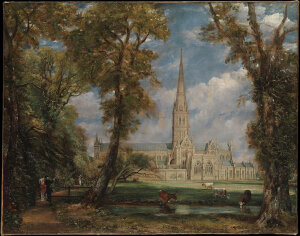
Benjamin Banks, once a novice instrument maker, settled on Catherine Street, near the imposing Salisbury Cathedral. The choir school, where children came from all over the country to receive music lessons, was just a few streets away from him. He maintained the instruments of local musicians, but he had also taken over several important clients in the vicinity of his home from his uncle, including the Earl of Pembroke of Wilton House, the Earl of Radnor of Longford Castle, and James Harris. Pembroke’s instrument collection was famous. He made several violins and cellos for both earls and earned extra income by maintaining all the other instruments in their collections.
His most important association, however, was with James Harris, a member of Parliament and a close friend of George Frideric Handel who was a regular guest at his home in Salisbury. For nearly fifty years, Harris organized and conducted concerts during the Salisbury festivals. These were held in the fall in honor of St. Cecilia and attracted thousands of visitors. In addition, Harris himself regularly gave concerts in his own home. Banks built two violins and a cello for him.
A market was held twice a week in Salisbury, where farmers, artisans, and merchants from the surrounding area traded. But it also served as a distribution hub for the region; every week, 24 carriages alone stopped there on their way to and from London, and just as many on their way to Exeter. Despite the 90-kilometer distance, Banks managed to expand his business to London with the help of his connections in Salisbury. James Longman and Thomas Cahusac were two of the most important instrument dealers there. He supplied them with the majority of his work.
James Longman was not a violin maker, but a publisher of sheet music and a budding dealer in musical instruments. Since he had started out in London, he had gone through several partners before entering into a partnership with Francis Broderip—a relationship that would last for years and prove to be a success. Only pianos were built in their workshop; the stringed instruments were supplied by various violin makers who worked for themselves or elsewhere. Henry Jay, David and James Furber, Lockey Hill, and Benjamin Banks were the best known. Even after the merger, Benjamin Banks continued to build instruments for Longman & Broderip. Their business was exceptionally successful, as evidenced by their move to Haymarket in 1782—a better, up-and-coming neighborhood.
In the winter of 1784, the workshop behind his house was destroyed by a major fire. Several instruments were lost in the blaze, as was part of his supply of wood. With the help of a few friends, he rebuilt it, but the work still took several months. All the instruments that had been ordered had to be rebuilt. p>Benjamin could not make a living from his deliveries to James Longman alone. Thomas Cahusac, like Longman & Broderip, was a major figure in the London music world. He was a music publisher and sold all kinds of instruments. In addition, Cahusac had been a leading maker of woodwind instruments for many years. His assortment ranged from the very cheapest to the very best available, including stringed instruments. Unlike Longman & Broderip, who dealt in imported Italian violins and cellos, Cahusac sold only newly built instruments. Benjamin Banks supplied his work to him for many years. Thomas Cahusac preferred the model by Nicolò Amati, and Banks built them for him in Amati’s style.
A close personal bond developed between Banks and Longman. Benjamin visited him regularly to deliver his instruments, and after he got married and had a daughter, the family moved with him to London. In 1761, Anne Banks, Benjamin’s daughter, married Cahusac’s son Thomas.
Unlike in Salisbury, London’s musical culture was flourishing. Starting in 1770, Italian opera grew in popularity; theaters were packed, and the elite organized many private performances to which sometimes hundreds of people were invited. This preference also brought Italian instruments to the attention of London musicians, making them exceptionally popular. When the Italian violin maker Vincenzo Panormo arrived in London in 1772, there were already hundreds of Italians working in the city. Panormo settled in Soho and offered his instruments to London merchants. His influence on violin making in London grew so much over the years that no violin maker in London could ignore him. Not even Banks. At first, he continued to build his Amati model, but after the enormous popularity of Panormo—who promoted only Stradivari models—Banks had to follow suit. Starting in 1775, his first Stradivari violins appeared, and a little later that year, a small Stradivari-model cello.
Benjamin likely started a modest business of his own in London at 30 Sherrard Street, not far from Golden Square. This is not certain; there are no records to confirm it, but he does list this address on his labels. In any case, he was able to expand his business, and his son Benjamin II began working with him. Benjamin II was born in 1752, the second of nine children; he was baptized at St. Thomas Church in New Sarum, Salisbury, and trained by his father.
In 1780, a violent storm toppled the majestic Lebanese cedar in the grounds of Wilton House. Benjamin Banks was commissioned by the Earl of Pembroke to make a cello from the wood of the tree. It was not a success; the sound fell short of expectations, and the cello was therefore never played. The earl, however, found it an interesting experiment and added the instrument to his collection, having it fitted with a silver plaque inscribed with the story of the cedar and its maker.
While Benjamin Banks continued to cater to the market until 1775, building whatever his clients requested—and there was certainly some inferior work among them—his instruments steadily improved thanks to his contacts with London-based makers. He built many cellos and violins, few violas, but no double basses by him are known.
His varnish was not an unqualified success. At least in the beginning, he used a thick varnish that made the wood grain virtually invisible. A color he used frequently was reddish-brown/black. Yellow/reddish-brown could be supplied upon request. Later, he used this color more and more often, but he continued to distinguish himself from other London boatbuilders with his milky, opaque finish.
His most productive period began around 1780. During that time, he built a large number of exquisite cellos, continuing to do so until his death in 1795. Benjamin II took over the business but died young. The other two sons, who had also become violin makers, moved to Liverpool. Benjamin Banks was buried in St. Thomas Cemetery in Salisbury.
In England, Benjamin Banks is considered the most important English violin maker of the 18th century.
Benjamin Banks is known as the English Amati. If that characterization applies at all, it refers only to the last seventeen years of his life. Before that, his work was primarily influenced by British makers such as Foster and Kennedy. “British” was a term used in the world of the London violin trade to refer to the simplest class of stringed instruments.
It has long been assumed that Banks built virtually no violins based on the Stainer model. However, records from Longman & Broderip show that he did build such violins early in his career. These were instruments from the most affordable price range. They were sold with the trading house’s label inside and were not recognizable as “Banks” instruments. Very few of these violins have survived to the present day.
Influenced by London fashion, he subsequently built several violins based on Stainer’s designs, but it was only at the urging of Thomas Cahusac that he began crafting his Amati-style instruments. At first, these bore only a slight resemblance to those of Nicolò Amati, but as he progressed, he crafted interesting interpretations of his great role model. Hill notes that his best work beautifully “reflects the subtlety of the original models.”
According to experts Hebbert and Hill, a number of cellos he built in the style of Stradivari are among the finest cellos made in England at the end of the 18th century. About ten of these have been recovered. Benjamin Banks began working on these instruments around 1775.
He built his cellos and many of his violins to a slightly smaller size than usual. Even in his own time, they were highly regarded for their sound and playability. His violas were also small, just as most English violin makers of his generation built them; however, most musicians preferred a slightly larger model.
His instruments are signed or stamped in various places with “B.B.” or his full name, as if he were afraid of forgeries. The placement of these markings seems to have been chosen at random, as there is no consistent or recognizable system.
The instrument in the collection of The Netherlands Musical Instrument Foundation is a magnificent example of what he built during his prime.
Flaming, J. F., 2016, English, Scottish and Irish Violin Makers, London.
Westbrook J., 2012, Panormo and His Contemporaries, Cambridge.
Baker T, Dilworth T en Fairfax A., 2001 The British Violin, Londen.
Carlson B., Schmitt J. F., Moroder I., Leonhard F., Italian & French Violin Makers - Vol. 1, 2001, Keulen.
Vannes, R., 1999, *Universal Dictionary of Instrument Makers*, Spa.
Tarisio, the Cozio archive, bezocht in 2021.
Archive of the “Apprentice Books at the Records Office,” Kew, visited in 2021.
Oxford Dictionary of National Biography, bezocht in 2021.