Instrument

violin
Andrea Postacchini
Fermo,
± 1810
played by
Maria Gîlicel
Maria Gîlicel

*1786 , Macerata †1862 , Fermo
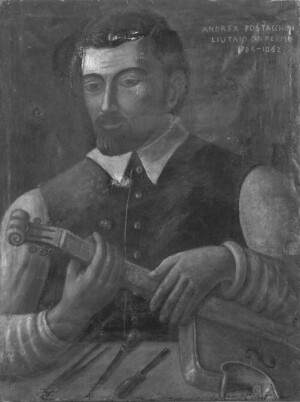
Andrea Postacchini was born in the historic town of Macerata, not far from the Adriatic coast. His parents came from a family of devout, wealthy landowners.
When Andrea was fourteen, his father died, and he was sent to the Benedictine monastery in Fermo, a few kilometers away, to become a priest. There, Andrea met a monk whose name has not been recorded, but from whom he learned to build violins using simple tools. The monk himself was self-taught.
(….) By 1815, he had already established himself as an “outstanding maker of stringed instruments,” as the connoisseur Tarisio described him
Andrea must have studied violin making in great depth, for by 1815 he had already established himself as an “excellent maker of stringed instruments,” as the connoisseur Tarisio described him. A religious life stood in the way of a career as a violin maker. Therefore, around the age of 28, he left the monastic order and settled in Fermo, where he opened a small workshop in the city center.
In 1820, he got married, and a year later, the first of his six children was born. His son Raffaele (1823–1892), who would later work with him, was born in 1823. Andrea must have traveled extensively to visit other violin makers, as there were no renowned makers to be found in the wider region. However, instrument makers or dealers likely attended the famous annual fairs in Fermo, where Andrea could study their work. It was customary to display the finest pieces they had crafted. The most well-known was the annual Palio dell’Assunta, a festival that drew thousands of people.

Palio/Procession of the Assumption

Teatro dell'Aquila, Fermo
The “dell’Aquila” theater in Fermo played an invaluable role in Andrea Postacchini’s development. It was a prestigious venue where opera, music, and theater performances were staged throughout the season. In northeastern Italy, it was even the largest and most important of its kind. That musical tradition dated back to the theater’s construction in 1652. Major figures in the music world of that era performed there. Initially, Andrea Postacchini likely took the opportunity to study the instruments that the performing musicians brought with them; later, these musicians became his customers.
Andrea’s initially rough style gradually evolved into a refined and elegant one. He did not have a style of his own; for much of his life, he made violins modeled after various old masters. His work consisted not only of building stringed instruments, but also guitars, lutes, and bows.
In 1869 (…..), his son entered this violin in a competition, where the jury awarded it the title “Stradivari of the Marche”
Starting in 1840, he participated in various exhibitions and competitions. The violin he built in 1842 has been preserved and is a fine example of his craftsmanship. In 1869, a few years after his death, his son submitted this violin to a competition where the jury awarded it the title “Stradivari of the Marche.” The violin is not yet as refined as his later instruments, but it does reveal a very distinctive style.
He spent the rest of his life in Fermo. He died in 1862 at the age of 76. His studio was carried on by his son Raffaele.
Although he was self-taught, Andrea Postacchini built a large number of beautiful instruments. He is now considered one of the top Italian violin makers of the 19th century.
His early instruments are rough and show a clearly untrained hand, but as early as 1815 the first refined violins appeared; somewhat modeled after Amati, with slender f-holes that are slightly angled and located quite close to the edge. Traces of the tools are still clearly visible in his work.
The back usually consists of two pieces of Italian maple with a beautiful flamed grain. The top of his early instruments was made of light hazel wood, which he worked in such a way that it became an excellent tonewood. Later, he chose spruce for the top. This wood came from the Alpine region and was similar to the wood used by the Cremonese and other Northern Italian makers of that era. The varnish has an attractive, transparent yellow-orange color over a clear base. Later, his varnish turned yellow-red, but remained elastic and deeply lustrous.
The jury that evaluated him in 1869 considered his work to be “a unique continuation of the direction and style of Antonio Stradivari”
His later instruments demonstrate a very precise approach to his craft, which, combined with excellent materials, reveals his solid craftsmanship. The scrolls are deeply carved; he makes the corners long and places the f-holes far apart. The jury that evaluated him in 1869 considered his work to be “a unique continuation of the tradition and style of Antonio Stradivari.”
He wrote his labels by hand; after 1845, he had them printed with the text: “Andreas Postacchini Firmanus fecit sub titulo S. Raphaelis Arcang. 18 ..”
The instrument in the collection of the Andrea Postacchini Musical Instrument Fund was built by him at the height of his career.
Azzolina U., Italian Violin Making in the 1800s and 1900s, Milaan.
Hamma, W., 1993, Masters of Italian Violin Making, Wilhelmshaven.
Vannes, R., 1985, Dictionnaire Universel del Luthiers, Brussels.
Brinser M., 1978, Dictionary of 20th Century Italian Violin Makers.
Henley W., 1969, Universal Dictionary of Violin & Bow Makers. Brighton.
Concorsopostacchini, visited in 2021.
Tarisio, Cozio Archive, accessed 2021.