Talent

Maria Milstein
plays a
violin
from Michelangelo Bergonzi
from Michelangelo Bergonzi

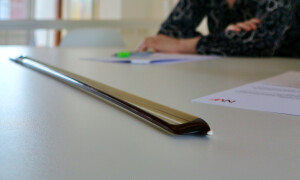
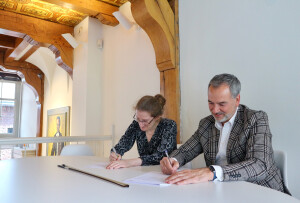
The Musical Instrument Fund has acquired an exceptionally beautiful bow, approximately 230 years old. In the hands of Maria Milstein, it seems to work like a magic wand on the Michelangelo Bergonzi violin (formerly owned by Herman Krebbers). She said: “I had to play Ravel’s *Tzigane* right away with the Radio Philharmonic Orchestra; the possibilities and the richness of tone that the Tourte managed to conjure from the Bergonzi were overwhelming—people even asked me if I was playing a Guarneri del Gesù!”
Maria and “Michelangelo” have been faithful partners since 2016. In Maria’s hands, the violin reveals itself to be a brilliant instrument, with a radiant tone that effortlessly cuts through a large concert hall. Because of its exceptional quality on the high strings, Maria was able to accept that the Bergonzi sometimes lacked a bit of power or depth on the lowest string. However, this perception changed when she once got her hands on a top-of-the-line bow and played the Bergonzi with it. The violin sounded better than with her own (albeit expensive) bow, and the improvement on the lowest string, in particular, proved to be significant. Maria tried a few other top-tier bows and discovered that the Bergonzi really came to life with some of them, giving her more scope for musical expression. That was her reason for submitting an application to the fund.
Since there was no suitable match in the fund’s existing collection, the fund decided to make a purchase. At the end of 2021, the search began for the ideal bow for Maria and the Bergonzi.
We were glad that, in addition to our own contacts, we could also count on Maria’s own international network; she went to great lengths to source as many bows as possible for the selection process. She combined concert tours abroad with visits to as many local dealers as possible, and Maria’s international fellow musicians also put us on the trail of bows offered directly by players themselves. Bows arrived in the Netherlands from Germany, England, France, and Belgium, but also, for example, from the U.S. This allowed Maria to try out and compare bows from the most important makers of the golden age of bow-making, between approximately 1780 and 1850, with Paris as its beating heart. Names such as Dominique Peccatte, Jean Pierre Marie Persoit, Jacob Eury, and Nikolai Kittel came up, and Maria went from one surprise to the next, as virtually every bow brought out qualities in the Bergonzi that she had never experienced before.
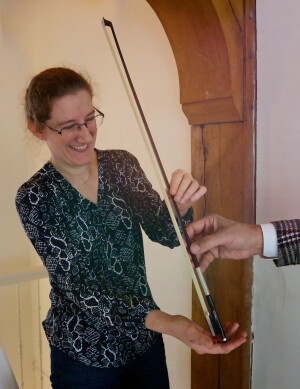
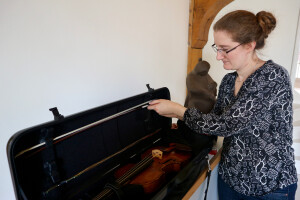
At one point, Maria seemed to have found the ideal bow: a Persoit. While the Musical Instrument Fund had this bow sent to Brussels for a second opinion, another bow offered from the U.S. came into the picture. It was a bow made around 1790 by the brothers Léonard and François X. Tourte. Normally, such a bow would be far beyond the budget available to the Musical Instrument Fund, but in this case, the bow’s ferrule and tip were no longer original, which significantly affects its value; collectors, in particular, tend to lose interest in such cases. We brought the bow to the Netherlands, and Maria tried it out. The possibilities and the richness of tone that the Tourte managed to conjure from the Bergonzi were overwhelming, according to Maria.
Naturally, the Musical Instrument Fund also had this Tourte evaluated by various experts, and it was tested by several other violinists with extensive knowledge of bows, such as Ilya Grubert and Vadim Tsibulevsky. Everyone agreed on its high quality, and we now realize even more how incredibly lucky we’ve been, because bows from this period—more than 220 years old—and made by these makers are extremely rare. The last one turned out to be the best!
The purchase of this cane was made possible by a bequest. In consultation with the family, the bequest was used to purchase the Tourte cane.