Talent

Lavanya Vossen
plays a
violin
from Lodewich Wilhelm Roumen
from Lodewich Wilhelm Roumen

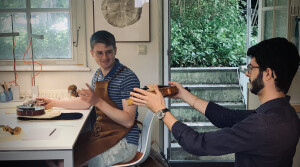
There was a lot of activity on Sint Annenstraat last week. On Thursday, violin experts Bas Maas and Christian Jünemann came by to inspect the instruments of dozens of musicians as part of the annual maintenance check. And on Saturday, violin maker Maarten Bolten shared his tips and tricks with musicians who had signed up specifically for the “repair workshop,” a new initiative by the Musical Instrument Fund designed to help musicians become even more familiar with their instruments.
It was a long-cherished wish of Geertje van der Linden, collection manager at Het Muziekinstrumentenfonds: “With your own instrument on your lap, under the guidance of a violin expert, learn what you as a musician should pay attention to. What can you do yourself, and what should you leave to the violin maker? And above all: try it out for yourself. Violin maker Maarten Bolten often gives these kinds of workshops to orchestra members. We’re very happy that he was willing to do the same for us.”
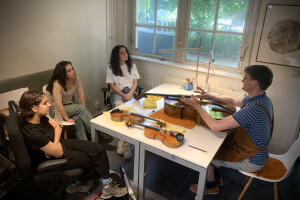
“There are quite a few things you should dare to do,” Maarten Bolten
Together with the musicians, Maarten first checked all the individual parts of the instrument and the bow. Tuning keys: Keep them turning smoothly; if they’re stiff, first unscrew them completely, remove the string, take the knob out of the knob housing, and apply a very light coating of soap, chalk, or a 6B graphite pencil to the friction surfaces. Bridge: Don’t touch it, but check regularly to see if it’s still in place or if it might be shifting, for example due to dryness. If you check often, you’ll know exactly where it belongs. Fingerboard: Be sure to check: is it still smooth? The strings act like a kind of file. If you can feel any unevenness, take it to your violin maker. It’s also good to know that the fingerboard is partly floating and partly glued to the neck. Differences in tension can arise between these two parts due to humidity or temperature. And the bridge—and this is perhaps where you’ll see the most improvement—is it straight? If not, carefully straighten it.
By yourself? Maarten: “Yes, by myself. A lot of musicians find that intimidating, but if you go about it the right way, you can do it just fine on your own.”
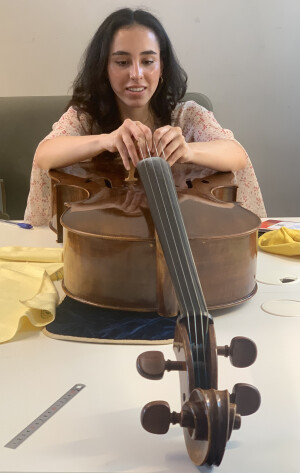
CRACK! “That sound scares me,” Anna Martirosian
Maarten picks up a violin he brought with him, adjusts the bridge, and one by one the musicians begin to practice. They’re still confident enough to play the luthier’s violin, but once their own instruments are resting on their laps, the tension is palpable.
Maarten: “Make sure you hold your instrument firmly and steadily. Support the bridge well with your fingers on the underside so it can’t flip over. A little movement really won’t hurt. Plus, this keeps the bridge flexible, making it easier to adjust it properly next time.”
For some musicians, it’s an eye-opener, while others are more experienced and want to check whether the way they’ve always done things is okay. Meanwhile, all sorts of questions come up—about worn-out strings, stains on the nut, and stiff tuning pegs. Lavanya Vossen: “I found it very helpful to hear what to do when the tuning peg is stiff. You can turn the tuning peg firmly in the peghole a few times without a string on it. The spot where the peg gets very hot—you can feel this best with your upper lip—is where the peg has the most friction. That’s where you need to apply chalk or graphite.”
“It causes me less and less stress,” Lola Jurakic
The bow is also discussed in detail. “A magical instrument,” says Maarten. “It has few parts, so it’s very important that it’s in good condition.” Make sure not to tighten the tension screw too much, as this can cause an imbalance because the bow sleeve shifts relatively far back. So have the bow rehaired in a timely manner. The silver winding: important for balance. End plate: serves an important protective function. If anything happens to it—no matter how minor—go to the violin maker for an inspection.
Giulio Greci wants to know how long the resin will last. His block is far from used up, but it feels a bit dry. Together with Maarten, he examines the resin. They conclude that it needs to be replaced.
Afterward, the musicians will receive a booklet from the Musical Instrument Fund that concisely summarizes all maintenance guidelines and dos and don’ts. A new booklet: The Musical Instrument Fund and the Art of Instrument Maintenance. It clearly outlines all maintenance information, tips on traveling with your instrument, details about humidity, maintenance checks, what to do in case of damage, and more. It also includes the phone numbers of your contact person and expert. Geertje: “It has a hardcover and cheerful little illustrations. You can read right through it. And it’s perfect to slip into your suitcase and consult whenever you want to know something.”
Musicians who would like to receive the booklet in advance can request a copy. Send an email to Indy de Vries with your name and address. We will then send you the booklet.
New maintenance workshops will be held this fall. Do you have an instrument on loan and are you interested? Please let Geertje van der Linden know by sending her an email.


