Partner of the
Hendrik Jacobs Foundation
In the context of this text, it’s funny to think that, as a young boy who played the violin, my parents took me to the Gemeentemuseum in The Hague. There, stringed instruments built in the Netherlands centuries ago were displayed in glass cases.

I can clearly remember the feeling that came over me when I saw those well-worn instruments: a mix of respect and admiration, but also a touch of melancholy, sparked by my imagination running wild about what those instruments and their owners might have gone through over the course of ten to fifteen generations since the proud craftsman had handed them over to their first buyer. Now they hung there, untouchable, as if they had been granted eternal life—albeit in deathly silence.
underexposed
During his violin-making training in England, violin maker Hubert de Launay had learned all about the old Italian, French, and English master violin makers. He was surprised to find so little information available about early Dutch violin making. “Well then, a study trip to the Netherlands it is,” he thought. He managed to get a few classmates excited about the idea and took them along to the Gemeentemuseum. There, they were granted access to the basements, where the instruments had been in storage for decades. It was an experience marked by amazement and disbelief. Amazement at the beauty and quality of the instruments built in the Netherlands during the 17th and 18th centuries by makers such as Jacobs, Rombouts, Verbeek, Kleynman, Van der Sijde, Cuypers.... And disbelief: it was incomprehensible to the young luthiers that this rich history of Dutch violin making had remained so overlooked.
Hubert wasn't about to let it go. From that moment on, he made it his mission to give the rich national history of Dutch violin making the place it deserved in the history of international violin making.
ally
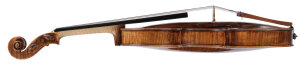
Hubert and I have crossed paths regularly ever since. As Head of Collections at the Musical Instrument Fund, I was able to grant Hubert access to our extensive collection of old Dutch instruments, which includes a number of very special and rare pieces. Hubert once confided in me that the Gijsbert Verbeek violin (Amsterdam, 1682, with original label) was what prompted him to write a book on the history of Dutch violin making. The Fund purchased the violin after it had suddenly appeared out of nowhere at an auction in London. Thanks to the original label, this violin suddenly shed light on a maker whose existence had previously been shrouded in mystery. This instrument made Hubert realize that intensive research should be able to uncover much more. He found an ally in the Musical Instrument Fund—and certainly in me personally as well.
In 2020, Hubert founded the Hendrik Jacobs Foundation. Jacobs was the doyen of the Amsterdam school of violin making, which emerged around 1650. In the coming years, the foundation will examine countless instruments and conduct extensive archival research. The information will be compiled into a book on early Dutch violin making, thereby restoring its reputation and making it accessible to a wide audience. It will come as no surprise to anyone that I jumped at Hubert’s invitation to join the board. We have the Gemeentemuseum to thank for this collaboration after all!
The Musical Instrument Fund & Heritage
The Musical Instrument Fund recognizes the value of both old and new instruments—the cultural heritage of today and tomorrow. Preserving Dutch cultural heritage is therefore one of the fund’s objectives. The collection—which one might well call a museum collection—is not housed in a museum, but is used daily by hundreds of musicians! Important violin makers have been active in the Netherlands since the 17th century.
The Music Instrument Fund’s collection also includes approximately 40 rare old Dutch string instruments and is therefore highly valued both at home and abroad. In addition, the Musical Instrument Fund regularly commissions contemporary Dutch luthiers to build instruments. These instruments will become tomorrow’s cultural heritage. The fund thus ensures that both old and new instruments are preserved in the Netherlands for future generations.