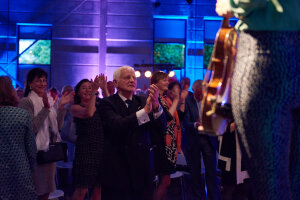
On the passing
of Wim Dik,
honorary chairman
I met Wim for the first time at a hotel in Nieuwegein in 2003, during my job interview for the position of director of Het Muziekinstrumentenfonds. I saw him sitting there, through a glass wall, and recognized him as a well-known Dutch figure. A slight panic seized me, because wasn’t that the man who had privatized the PTT a few years earlier? Who had held a whole host of other public offices? And who certainly wasn’t known for being an easy person to deal with? Was I supposed to have a conversation with him? And maybe even work with him? Do I really want that?

Wim and I hit it off right from the start. I quickly recognized Wim as someone with passion and enthusiasm. He became chairman of the Musical Instrument Fund in 2001. Then Koos Andriessen and Wim Dik, both former government ministers at the time, met in The Hague. Andriessen had been chairman of the Musical Instrument Fund for years and was looking for a successor. He knew of Wim’s passion for music, as Wim was an avid and talented drummer. As they passed each other on the stairs at the ministry, he asked Wim if he was interested in the position. Wim jumped at the opportunity, and thus began an extremely important period for the Musical Instrument Fund.
At the time Wim took office, the Musical Instrument Fund was not functioning optimally. In fact, the fund was still in its infancy. Under his leadership, things changed rapidly. Wim championed professionalization and growth. However, these are not goals in and of themselves. Wim’s true motivations are quite different: his deep love for music and his desire to help people advance in society—especially young people. He is fully committed to this cause. After passing the job interview, I’m able to help him with that. Together with him and me, a small number of staff members are rolling up their sleeves to make this happen. Together with and under Wim’s leadership, we’re becoming a true team—one that’s further supported by an extremely knowledgeable board.
The years with Wim proved to be a success for the Musical Instrument Fund. The fund grows and thrives during his tenure as chairman. This is largely due to the way Wim leads the fund. He has great confidence in the people on Annenstraat and is a leader who dares to give people opportunities by letting them act and make decisions on their own. This means optimal freedom for the Musical Instrument Fund. But that freedom also comes with an enormous level of commitment on his part. His dear wife Alice makes sure he’s always informed immediately, even when he’s busy with one of his countless other projects. Wim is always there when you need him. It’s not in his nature to meddle, but he’s always ready to help. If you have a question or a problem, he’ll drop everything for you—immediately and unconditionally. And he’s always there when something comes up—a concert, a presentation, a gathering. If necessary, he’ll—literally—climb onto a table to make his point. I can’t recall a single time in all these years that he’s ever failed to show up. Wim adores his people—and his people adore Wim.
The Musical Instrument Fund holds a special place in Wim’s heart. No one is nothing but sweet and kind—and neither is Wim. He can sharply counter stupidity or unreasonableness. But he adores the staff at the Musical Instrument Fund. Sometimes Wim calls the foundation just to remind himself once again how knowledgeable, enthusiastic, and kind the people at the office are. He always makes sure to let me know afterward: “I spoke with your colleagues the other day—what an amazing team you have there on Annenstraat.” Wim isn’t just an extremely knowledgeable, energetic, and inspiring chairman—he’s also a very warm person. He truly enjoys working together to get things done. And he’s succeeded in doing just that time and time again over the years.
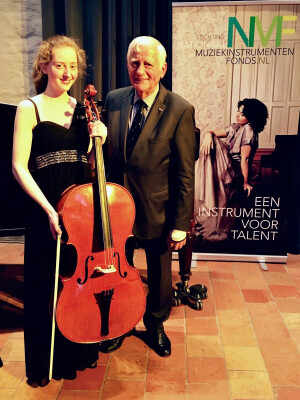
Wim has a background as a leader at companies including Unox, Unilever, and PTT/KPN, and has served as a state secretary and a professor. But alongside these major roles, he considers the Musical Instrument Fund just as important. As he bids farewell to the fund, he tells me that he has led companies with thousands of employees and that the fund was undoubtedly the smallest group he has ever chaired. “But actually, the Musical Instrument Fund was the most fun!”
In 2015, Wim had no intention of leaving the fund. And no one at the Musical Instrument Fund wanted Wim to leave. But according to the bylaws, Wim could no longer remain due to his age. Quite rightly, he was named honorary chairman of the fund upon his departure. And with the money donated by supporters, the Musical Instrument Fund is able to purchase the “Wim Dik Cello”, a new cello built by Gudrun Kremeier. Wim, like the Musical Instrument Fund itself, believes it is important to support Dutch violin making, and the purchase of this cello is living proof of that.
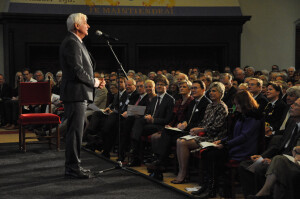
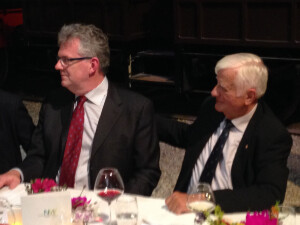
Wim has now passed away. Looking back on the years I spent with him, I think of a period that meant an incredible amount to the Musical Instrument Fund. For the musicians of the fund. For the fund’s staff. But I also think of a man who, at first, startled me a little when we first met. A man whose role in my life changed over the years of our collaboration. Slowly, I began to realize that there was more between us. That can take a while sometimes, especially when it comes to your supervisor. Often, there isn’t much room to start thinking differently about each other. But he was such a special man, who led in such a loving way. At first, he was my chairman. He was my boss. And suddenly I realized that he had long since become my friend.
The Musical Instrument Fund has lost a friend. I have lost a friend.