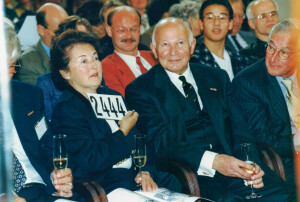
Noortje Olof: "I'm
proud that Theo
established the
fund"
It all began 35 years ago, when Pieter Moerenhout and Theo Olof came up with the idea of establishing a fund for musicians. In this interview, you’ll read about special moments that his wife, Noortje Olof, experienced alongside Theo when the fund was still in its infancy: from an article in *De Telegraaf* to a dinner with violin maker Max Möller.
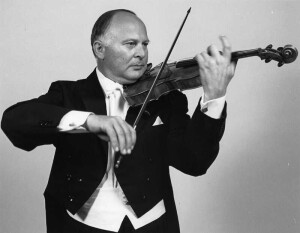
Noortje Olof (84): “I wasn’t personally involved in the founding of the Musical Instrument Fund, but as the wife of Theo Olof (1924–2012), I naturally picked up quite a bit about it. In 1988, he founded the Fund together with Pieter Moerenhout. According to Theo, this was desperately needed, because after playing a borrowed Stradivarius for years, the instrument suddenly had to be returned to the anonymous donor. We were never told why the donor wanted the violin back. It was very sad for Theo.
I was a violinist myself, but my situation was different: I played an instrument that I owned. After that unpleasant experience, Theo felt that when a musician borrows an instrument, there shouldn’t be a time limit on it. “You should be able to keep playing it for as long as you want.” That’s why he supported Pieter Moerenhout’s idea for an instrument fund. Theo felt it was very important that the loan period have no time limit.
Under the kitchen table
“When Pieter and Theo came up with the idea, Theo wrote about it in his music column in *De Telegraaf*.”
“Dear readers, take a look in your attic—maybe there’s a lovely, forgotten musical instrument lying around. Bring it to us, and we’ll make sure a musician plays it.”
Within a few days, a whole bunch of people showed up at our door with musical instruments. Some were in violin cases, some in boxes, and sometimes even in trash bags. It was wonderful, of course, but where were we supposed to put them, Theo and I wondered. We lived with our child in a four-room apartment and didn’t have any room at all for so many instruments. In the end, I temporarily stacked them under the kitchen table. A violin was also delivered by the Royal Family, but I don’t remember who had played it.’
Support from Foundations and Artists
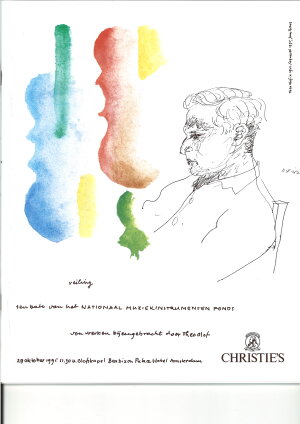
“Theo’s column really got the ball rolling. Shortly thereafter, a three-person committee was formed, and Theo became its first chairman. Together, they visited various organizations to raise funds. Through the Prince Bernhard Cultural Fund and the Dutch National Lottery, they received an interest-free loan of 700,000 guilders. The Pasman Foundation made a contribution on the condition that a Dutch luthier would build a violin to be named Pasman Violin. Later, Theo came up with the idea of holding an auction. He asked his artist friends to donate works of art for the auction. He drove all over the Netherlands to pick everything up. That auction, which took place at the Sint-Olof Chapel in Amsterdam, also raised a huge amount of money for the fund.’
Cooking Up a Storm
“Back to the time when Theo had to turn in his Stradivarius. He started playing a Lupot violin, but he didn’t like it at all. So I took the plunge and organized a small dinner party for violin maker Max Möller and his wife. I borrowed my mother’s silverware, set the table elegantly, and cooked up a feast. During dinner, I asked Max if he could find a new violin for Theo. Fourteen days later, Max showed up at my doorstep with a magnificent François Louis Pique violin from 1797, which had come from the estate of the French De Saint-Exupéry family—the family of the pilot and author of The Little Prince. Theo played a few bars of Tchaikovsky on it and was immediately sold on it. He played that violin for the rest of his life. We traded the Lupot violin at Max Möller’s for the Pique violin. We never knew if that was a good deal, haha. But it doesn’t really matter. Theo was happy that after his death, his violin would be acquired by the Musical Instrument Fund. That way, another talented violinist could play it.’
Even more recognition
“I’m proud that Theo established the fund. I think the fund could use even more attention—for example, by airing a slogan every now and then on NPO Radio Klassiek. That way, people will know the fund exists and that they can donate an instrument or money. Whenever I hear from people that an instrument belonging to a grandparent or another family member is sitting unused in the attic, I always let them know they can contact Het Muziekinstrumentenfonds.”
Take a look at the violin