Talent

Krijn Koetsveld
plays a
organ
from Klop
from Klop

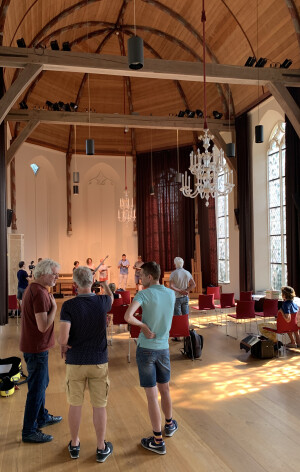
When Krijn Koetsveld approached the Musical Instrument Fund a year and a half ago, terms like “wellenbord,” “suspended action,” or “cramped pipes” were still new to us. Thanks to the intensive process that followed for the construction of a Monteverdi organ, our knowledge had fortunately been significantly expanded by the time we conducted a final test on August 27 at the Sint Aegten Chapel in Amersfoort.
The test was the crucial final hurdle that had to be cleared before the green light could be given for the final construction of the Monteverdi organ. During this test, the tonal character of the organ to be built would be determined; we were seeking the “suave” character that Monteverdi praised in 1610 when he wrote about his favorite organ with wooden pipes (“organo di legno”).
Organ builders Henk and Niels Klop had brought two chest organs to the chapel to serve as “test modules.” One organ was equipped with cedar pipes and scaling ratios based on a wooden organ from around 1605 built by Compenius. The other organ featured cypress pipes with proportions based on an anonymous organ from around 1560 located in Innsbruck.
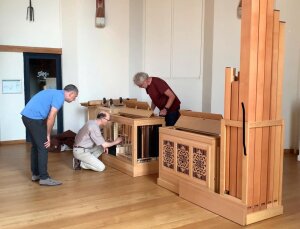
The test began with the two organists: Krijn Koetsveld (who requested the organ) and Pieter van Dijk (advisor for the Musical Instrument Fund). They took turns playing short excerpts, switching between the two organs. Thanks in part to the hall’s magnificent spatial acoustics, the differences between the two pipe models were clearly discernible. The contrast lay not in the quality, but in the character of the sound and its response. The final choice would therefore depend on how the organ would interact with a full ensemble of singers and instrumentalists.
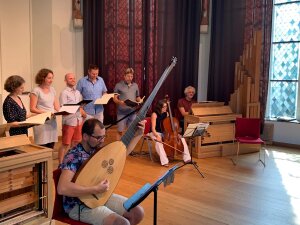
Monteverdi’s impressive music echoed off the walls and crept along the vaulted ceiling as the ensemble Le Nuove Musiche began one of this great composer’s madrigals. The ensemble was positioned between the two organs. This allowed the singers and instrumentalists to fully experience what happened when switching between organs. During several short breaks, they discussed their observations, exchanged views, and the Klop organ builders made a few more adjustments to the intonation of the organs. The organ that nearly everyone identified as their favorite seemed, from the audience’s perspective, to occasionally lack a bit of sound power. By slightly increasing the wind pressure of that organ, its only weak point was eliminated. It turned out to be the cypress pipes with the Innsbruck scale that made the hearts of the Monteverdi fans beat faster! The sound of those pipes proved to be the ideal accompaniment for the ensemble, without being overshadowed by it. A sound that supports, that speaks, that carries, that captivates. The choice was made!
The Musical Instrument Fund had invited the press and a number of stakeholders to attend the test. Among them was the private donor who is making this project financially possible for the Musical Instrument Fund. He told us that he thought it was wonderful to see how professionally and meticulously the fund had organized the test. This reinforces our belief that we’re on the right track!
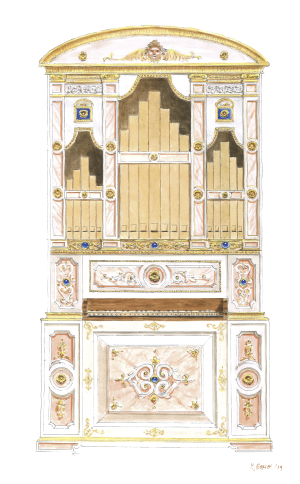
What does this look like? Here is the design sketch by the Italian decorator: