Talent

Mascha van Nieuwkerk
plays a
cello
from Orsolo Gotti
from Orsolo Gotti

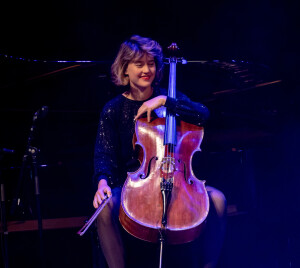
After a long search, cellist Mascha van Nieuwkerk has recently begun playing a unique, “crispy” Italian cello. The instrument was chosen following an extensive sound test involving seven cellos. With the help of a jury of experts, including teachers and cellists, Mascha and the Musical Instrument Fund selected an Italian cello built around 1900 by Orsolo Gotti. How does such a process work, what does the fund do, and what challenges do musicians face?
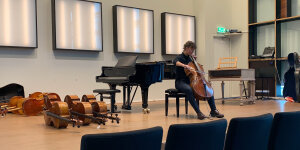
In late 2017, we received a request from Mascha for a different cello. “I’ve been playing your 18th-century Dutch Lefèbvre since 2010, and I still love it dearly. The instrument has taken me a long way. I got off to a flying start in my career with Fuse. I’ve now entered a new phase, and my imagination is taking me further. I’m looking for an instrument that gives me the power to make my personal musical voice heard even more strongly—one that blends seamlessly into the ensemble yet can also stand out with a distinctive, soloistic voice.” Mascha tried out various cellos from the collection of the Musical Instrument Fund. But her dream instrument wasn’t among them at the time. Thanks to a bequest, a wonderful opportunity suddenly arose. The fund was able to acquire a cello in the category Mascha was looking for.
On behalf of the fund, collection manager Geertje van der Linden set out to find one: “Experts and luthiers, the Dutch Group of Violin Makers... I let everyone in our network know that we were looking for a cello of a certain caliber. If the sound, condition, and price were right and the provenance was clear, they could participate in a sound test. We found seven high-quality instruments: French, English, German, Italian, Belgian, and Dutch cellos dating from 1770 to 2001.” On the stage in the Sweelinck Hall at the Amsterdam Conservatory, they lie side by side, waiting to reveal their souls.
To properly evaluate the instruments, cellists Michael Müller and Geneviève Verhage were invited to join Mascha. Geertje: “Michael is someone who pushes the instrument to its limits. He delves into its soul, puts himself completely aside, and will give every cello a chance. Geneviève’s playing style is somewhat similar to Mascha’s. For Mascha, it’s wonderful to hear the instruments in her hands.” Mascha, Michael, and Geneviève take turns picking up the cellos to play them both gently and with vigor. Mascha: “Michael came up with an approach that worked very well. First, we played longer pieces, giving the cellos a chance to introduce themselves in detail. Then, Michael repeated the same passages in quick succession on the different instruments, so you could really compare them. After that, it became even more systematic, and he tackled the cellos string by string. It was really helpful to be able to listen to him from the audience. When you’re playing yourself, your ear gets clouded by your own playing experience. A few contenders that had stood out when I’d played them myself were ruled out after hearing Michael play. And other instruments, which weren’t as well-played, were given another chance.”
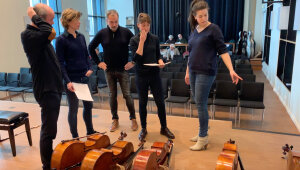
While Mascha, Michael, and Geneviève play, four panel members listen from behind the table: Geertje and her colleague Frits Schutte, cello teacher Monique Bartels, and double bassist Peter Stotijn, both members of the Instrument Committee. Geertje: “Tone color, projection, character… you try to interpret what you hear as best as you can. The goal is to purchase an instrument that, after Mascha, will be loaned to other musicians as well. That’s why advice from multiple experts is important to us.”
After the sound test, three favorites remain, and Mascha is told which instruments they are: an old Parisian cello built by Louis Guersan around 1770, and a Northern Italian cello built by Orsolo Gotti around 1900. The panel also selects the French cello built around 1905 by Pierre Hel. It hasn’t been played in 60 years, still sounds quite closed off, and deserves another chance. Mascha’s own trusted Lefèbvre also remains in the running. Mascha: “It’s now clear to me that I shouldn’t have just set it aside.”

The acoustics in the sound check hall are good. Geertje: “Here in the Sweelinck Hall, every cello sounds beautiful, so to speak. To see how they perform in drier spaces or a hall with more reverberation, the three favorites will be joining Mascha on tour. Moreover, the cellos have so far only been played solo. It would be great if Mascha could try them out with Fuse, with piano, and with an orchestra. That’s the only way to really see if their expressiveness holds up when played alongside other instruments.”
A few weeks later, Mascha and Geertje conducted a second sound check with the members of Fuse. Mascha: “I played the cellos anonymously before a concert. My bandmates couldn’t agree at all. Emma (van der Schalie, violinist) was in love with the Lefèbvre. She loved my familiar, trusted sound. Tobias (Nijboer, bassist) was completely taken with the dark bass tone of the Guersan. And Julia (Philippens, violinist) was a huge fan of the Gotti. Once the Gotti joined the ensemble, we were suddenly in complete agreement and knew for sure that it had to be that one. It could blend in and take solos. The Hel was ruled out, but I did give it a lot of extra attention and love during all those weeks because it came in so far behind.”
In the weeks following the sound check, Mascha and the Gotti grew closer and closer. “I discovered new things at every concert. Sometimes you suddenly find a connection, and then it’s completely gone again. You can feel the instrument evolving. We had a lot of performances, and the Fuse repertoire really started to sink into the Gotti. As a player, you also grow into the instrument. Sometimes it all came together beautifully.”
On behalf of the Musical Instrument Fund, Geertje is very pleased with the choice of the Gotti. “At first, I was a fan of the Guersan. But when she started playing the Gotti with Fuse, I was sold. It’s a versatile instrument with a wide range of acoustic possibilities. It gives Mascha a lot of freedom, adapts to her playing, has a strong presence, and at the same time is easy for her to control. Going through a process like this teaches you not to judge or make decisions too quickly.”
What is it like for Mascha to say goodbye to her old instrument from the Musical Instrument Fund? “It doesn’t feel at all like I’ve lost it. The memories of playing the Lefèbvre are also in this new instrument. It’s as if it’s been reincarnated. It marks the end of an era, but it doesn’t feel like a huge shock or a loss. That’s also because the Lefèbvre was part of the sound test. We really took a thorough approach, and I was able to take plenty of time to make the transition.”
About the Gotti
“Crisp, velvety, and open”—that’s how Mascha describes the Gotti. “It sounds just like it looks: warm, with a beautiful, dark, woody tone. At the same time, the Gotti allows for excellent articulation. It’s like a dessert—you know, one of those really delicious, soft cakes topped with those crispy, crunchy nuts.”
The cello was built by Orsolo Gotti (1867–1922) around 1900 and comes from a long tradition of violin making in Pieve di Cento, northern Italy. Carlo Carletti, a student of the famous violin makers Fiorini and Pollastri from Bologna, established his workshop there in the late 19th century and passed on the craft to his sons Natale, Orfeo, and Nullo Carletti, as well as to Orsolo Gotti and his son Anselmo.