Talent

Zenzele Mthembu-Salter
plays a
double bass
from Jaap Bolink
from Jaap Bolink

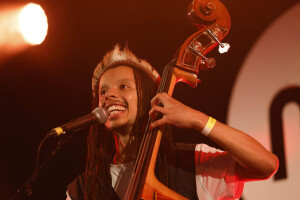
Thanks to the generous support of our donors, the Musical Instrument Fund is able to provide instruments to talented musicians. One such musician is South African double bassist Zenzele Mthembu-Salter. Since February, he has been on loan from the fund a double bass built by Jaap Bolink. Read on to get to know him.
“I moved from South Africa to the Netherlands to study at the Conservatory of Amsterdam. Unfortunately, I wasn’t able to bring my instrument with me abroad, so once I arrived in Amsterdam, I played the conservatory’s double basses for a long time. That worked out fine for a while, but I really wanted to have my own double bass. I heard about the Musical Instrument Fund through my teacher, Clemens van der Feen, who had also had a double bass on loan from the fund. And a few of my fellow students who have instruments from the fund also recommended it to me. I immediately started reading up on the fund and submitted an application. The Music Instrument Fund has high-quality instruments, and that’s exactly what I was looking for. I found that in this double bass. I’m very happy with it and enjoy playing it.’
“At first, I was shown photos of the available double basses. I saw an instrument from 1969, which really piqued my curiosity. I tried out a few double basses, and when I got to this one, it immediately caught my attention because of its resonance. When I plucked the open A string, it sounded incredibly beautiful, and the tone really spoke to me—even when played with the bow. I tried other instruments, but this was the one that felt the most natural. The instrument suits my playing style and my posture. I don’t feel that way with all instruments. With this bass, I just didn’t want to stop playing. That’s when I decided: Yes, this is the one!
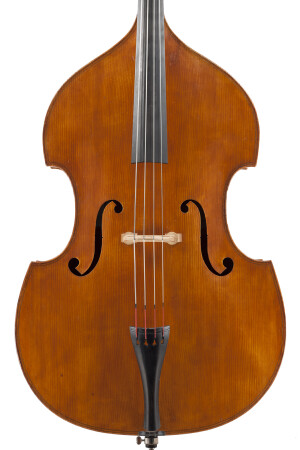
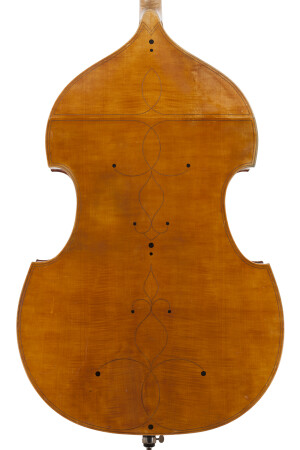
Another thing I really like about this double bass is its flat back. That’s quite unique for a double bass. I talked about it with Jaap Bolink, the builder of this instrument. Last week, I met him for the first time at his workshop in Hilversum. He told me that someone had asked him back in the 1960s to make this instrument with a flat back. It’s the only double bass he’s ever made with a back like that. It also features a beautiful design—a sort of medieval ornamentation—which makes the instrument even more unique. That’s also why the instrument caught my eye so much. It’s so well-made. Bolink is an established instrument maker.’
“Yeah, hahaha. Because it looks nice. It’s almost a work of art.”
“It was really nice to talk to Jaap. I was able to ask him to make some minor adjustments to the double bass. For example, he was able to fix some buzzing. It’s a very old instrument, but it’s been very well maintained. And I want to keep it in good condition, too. I’m looking forward to performing with it in the coming years.”
“Partly because, from a young age, I was taught by a wonderful Dutch double bassist who moved to South Africa, Hein van de Geyn. He’s a fantastic double bassist who performed extensively in the 1980s with artists such as Chet Baker, John Abercrombie, and Toots Thielemans. A true legend in the jazz world. When he retired, he moved to South Africa and opened a bakery there—coincidentally, in the neighborhood where I grew up. When I was a teenager, I was looking for music lessons, and Hein became my musical mentor. He really shaped me as a bassist. He encouraged me to perform with him and advised me to attend the conservatory in Amsterdam, where he knew many musicians. Besides, I wanted to broaden my horizons and challenge myself to meet new people. The Netherlands has been good to me. It’s been really great so far.”
“I didn’t start out on the double bass; I started with the acoustic guitar. All my brothers played guitar too, but I wanted to do something they didn’t, so I switched to the electric bass guitar. It was through Hein that I got into jazz. He introduced me to a lot of jazz musicians, like Miles Davis. Hein taught me double bass technique on an electric bass. That ultimately made it easier to make the switch. “‘When you’re big enough, you have to start playing the double bass,’ Hein said. I think I was nineteen when I started.”

“Yes, the first album I recorded was with my brother and a few other South African musicians. That album, titled Future Kwela, came out last year. We mainly play South African jazz and singer-songwriter music. My brother plays guitar, and I play bass and sing as well. I’m trying to reach the level of my choir, haha.”
“I started the choir, Ingoma Yesintu, about two years ago. It consists of a few singers I met at the conservatory, a double bassist (that’s Zenzele, ed.), and a percussionist. The idea is to have a completely acoustic setup so we can play anywhere. We’re currently recording an album. And the highlight will be a performance with the entire choir during my bachelor’s recital. That’s what I’m working toward right now.”
“The music is influenced by many styles, such as European classical music and American jazz, but at its core, it’s African. I write the compositions and choral music. I love all kinds of music, and I enjoy combining them. I draw inspiration from my teachers here, and at the conservatory I get to interact with musicians from all over the world. I know no boundaries when it comes to genres. I write the lyrics in English and in my native language, Zulu. I teach them to the singers, who, by the way, aren’t from South Africa. That’s how we bring South African vocal culture to Europe.”
“I’d love to play live as much as possible and perform at festivals. Last year, I had the chance to open Bass Fest in Rotterdam. That was a great opportunity for me as a young musician. It would be even more amazing to share my music with the Bolink, especially with diverse audiences. I also hope to travel throughout Europe and play in places like France and Belgium. Live music is the most important thing to me.”
A high-quality musical instrument is often very expensive, but also indispensable. A good instrument fosters the development of talent, inspires, and challenges. By donating to the Musical Instrument Fund, you help provide more than 435 talented musicians with a good instrument that suits them on an ongoing basis. The Musical Instrument Fund and the musicians are extremely grateful to you for this!
Get to Know the Talents