
Iconic
advertising wing
handed over
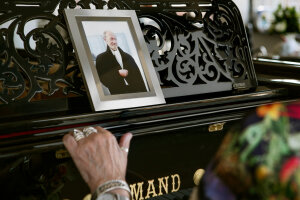
The notorious poet Cor Vaandrager described him as “that silent genius from Rotterdam.” Composer and pianist Peter Snoei was best known for his iconic TV commercials, but he also set poems by Gerard Reve and Franz Kafka to music. Thirteen years after his death, his widow, the artist Marianne Grootenboer, is donating her “mysterious” husband’s grand piano to new generations. “Lately, the piano has been standing here like a silent monument—that can’t be the point.”
The Carl Mand grand piano will soon be missing this majestic view: the meter-long curved glass wall of the ninth-floor apartment on the waterfront offers a panoramic view of Rotterdam’s Koningshaven, toward the city center, with the Erasmus Bridge rising to the west and the Willemsbrug to the east. Pianist and composer Peter Snoei searched all over the Netherlands for this instrument, says his widow, Marianne Grootenboer. “He wanted a grand piano with a light touch but a deep sound. Peter had once heard a Carl Mand like this and had immediately fallen in love with the sound.”
Follow the Nieuwe Maas—which you can see from behind the wing—upstream, and you’ll naturally arrive at the instrument’s birthplace. The builder, Carl Mand, was the son of a woodworker in the Rhine city of Koblenz. Near his parents’ home was also the summer residence of a wealthy Berlin banking family. Their son—the future composer Felix Mendelssohn—encouraged Carl Mand’s older brother to deepen his musical knowledge by learning to build pianos in Vienna. But Nikolaus died young, and Carl took his place. After completing his training, he returned to Koblenz, where Carl started his own business in 1835. The company won countless awards, even became a purveyor to the German empress, and, in its heyday, produced three thousand grand pianos a year. In the twentieth century, the legendary piano manufacturer went under: it survived the aftermath of World War I, but the financial crisis of the early 1930s dealt the final blow.
photos: Jesse Kraal
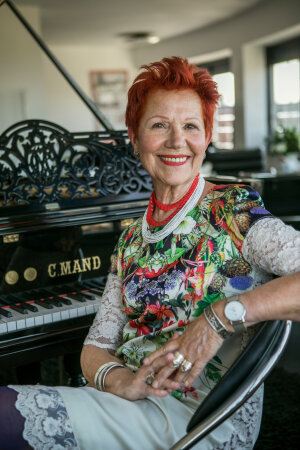
Writer and visual artist Marianne Grootenboer displays a drawing she made with her son: the design for an oval table with multiple tabletops at different heights. “Like a kind of shadow of the grand piano,” she says, “this piece of furniture will fill the empty space in the room.” Before her lies the score for Carmina Reviana—Peter Snoei composed the song cycle based on poems from Gerard Reve’s collection Nader tot U. A letter from the author is included. After listening to “Your Setting of My Poems,” the florid Reve observes that “much would be gained if the singing were louder—not in the sense of being outwardly less animated—and if the music were played slightly less loudly, so that the accompaniment could employ crescendos and fortissimo without drowning out the singing.”
She smiles.
Grootenboer (80) and Snoei met when they were in their early twenties. Comedian Gerard Cox, who was married to a friend of hers, stopped by one day and said, “I know a great pianist; he’s from Rotterdam and went to boarding school in Groningen.” The two saw each other and immediately had the same thought: “I married the wrong person.”
It wasn’t until after her divorce—almost forty years later—that they met again, both single now, at the Kunsthal in Rotterdam. “He walked up to me, and it was just like before,” she says. “The same feeling as the first time. I knew it. This was him. And he felt it, too. Nine months later, we got married. We were able to enjoy each other’s company for about ten more years. Then he died. A virus in the brain, the doctors said. Ten days later, Peter was dead.”
Snoei was a versatile musician. He made a name for himself in the advertising world with iconic TV commercials, for which he also wrote the scripts. They stuck in the collective memory like catchy tunes. There were too many to list. Such as: “Socks and jackets and pants and ties: Omo washes them clean through and through.” Or: “The aroma greets you the moment you open Supra: that’s Van Nelle.” And also: “A warm welcome to this party with fine fish and delicious meat—and… the sauces from Calvéeeeeee.” Snoei packaged the message into mini-songs lasting less than thirty seconds, complete with verses and choruses. “And his biggest secret,” Grootenboer reveals, “was the descending third. ‘That’s how I made my money in advertising,’ he always claimed.”
In addition to commercials, Snoei played in jazz bands such as Hyacinth and Popera, alongside poet Jules Deelder. And whenever he sat down at the piano to improvise, people would usually say that Snoei was “monking” again, as if he were the Dutch counterpart to the American jazz pianist Thelonious Monk. He was a quiet and mysterious figure, often surrounded by women. “An intriguing guy,” Grootenboer thought. “A sphinx.” Saxophonist Hans Dulfer, with whom he often performed, spoke of him in those terms. “I played with Peter for a year and a half, two years,” he told me, “but he never exchanged a word with me.” Poet Cor Vaandrager described him as “that silent genius from Rotterdam.” There was, incidentally, a hint of jealousy in those words, because Peter’s first wife had initially been Vaandrager’s girlfriend.’

When Snoei did open his mouth, it was usually to deliver a sharp one-liner, Grootenboer recalls. “He had an intelligent sense of humor and a knack for language. You can hear that in his catchy copy and wordplay for those TV commercials. Was there a nice prize to be won in a tagline contest? Peter would enter—and he always won.”
Snoei worked in his studio in the Lloyd Kwartier, but also often at Carl Mand’s home. “He was actually always sitting at the grand piano. He spent his entire life there. It started when he was a toddler. His mother was the first female taxi driver in the Netherlands. A lively lady. She loved music and bought a pianola. But her lessons weren’t going very well. One day she came home a little early and found three-year-old Peter at the instrument. He was playing songs from the radio by ear. His parents always spoke of him as “a peculiar child.” Peter, of course, had some autistic traits—he was a gifted person with Asperger’s. Through music, he was able to carve out a place for himself in the world.’
While the music in television commercials is typically playful—often masterful parodies of existing styles—on the album Melodies & Movements —which he recorded at home behind his Carl Mand at the beginning of this century—a pensive and meditative sound predominates: the languid atmosphere of a late-summer evening. Here, too, he often blends reflections on musical forms, as in Tango mazurka and J.S. Blues —for which jazz musician is the old Johann Sebastian Bach not a source of inspiration? “These were pieces he played during the house concerts we gave here seven times a year. Or sometimes he’d play them on a warm afternoon with the windows open. ‘Encore! Encore!’ people would shout from their boats in the harbor below.”
Next to the grand piano stands a dodecahedron, a mysterious “spherical shape” with twelve pentagonal faces. “Things like that fascinated Peter,” says Grootenboer. “He was a member of the Freemasons and the Rosicrucians. Those philosophies captivated him. He was the study leader for the mystics among them and led all kinds of rituals. Sometimes Peter composed pieces of music based on numerology. He was a remarkable man.”
She shows me a painting of a man who is half real, half shadow. “That was Peter. Someone who moves from one world to another. He didn’t mind dying, either. He gave me a call. “Just ring that bell if anything comes up,” he said. So when I organized a house concert after his death, I did just that. Then he had to come by for a bit. Peter didn’t believe in gods, but in energy that isn’t lost.”
Marianne Grootenboer was born in 1941 in Rotterdam. She is an artist and writer. In addition to drawings and paintings, her work also includes objects, installations, and performances. Color is a major theme in her work. What do colors mean to people? Her extensive research into this question has led to exhibitions and performances. She also writes poetry and children’s books that she illustrates herself. Her book *Mees and the Secrets of the Dezzler Clan* was recently published.