Talent

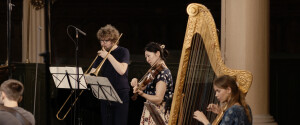
Elise Dupont
plays a
violin
from Willem van der Sijde (Syde)
from Willem van der Sijde (Syde)

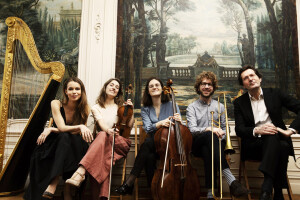
Out of a love for early music and to celebrate its tenth anniversary, the Castello Consort is releasing a CD featuring compositions from the 17th-century Low Countries. This anniversary edition, titled “Symphoniae,” features a number of historical instruments from the collection of Het Muziekinstrumentenfonds. Among them is a beautiful virginal, which the consort will also be taking on tour this spring. Trombonist Matthijs van der Moolen and cellist Anne-Linde Visser talk about the CD, the tour, and the unique instruments.
The Castello Consort, founded by trombonist Matthijs van der Moolen, has taken on various forms over the years, but has always been able to rely on a core group of musicians. In 2017, the ensemble participated in EEEmerging, a European program for young early music ensembles. In 2020, on its own initiative and after years of research, the consort commissioned the construction of an organ specifically for the ensemble. The instrument was built by Orgelmakerij Reil (Heerde), based on 17th-century Italian models.
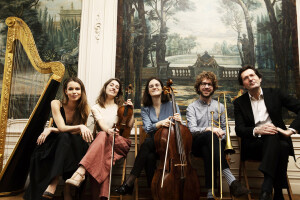
Photography by Sarah Wijzenbeek

Johannes Vermeer's Music Lesson
Last year, the Castello Consort celebrated its tenth anniversary. One of the first programs the ensemble put together during those ten years consisted of works by the Flemish composer Nicolaes à Kempis. His music served as the starting point for *em* *Symphoniae* */em*, the CD that was the icing on the cake of the anniversary year.
Although the program had been on the music stand for years, it had never been recorded before. “For a long time, we thought we weren’t ready for it yet,” says Matthijs. “But at some point, we found a way to bring the program together from separate pieces into a single whole.”
The CD features music from the Low Countries. “We think it’s going to be a very rich CD, because it features many different continuo instruments. It’s all quite melancholic and dramatic, but also charming. Perfect for cold, rainy days. We hope not only that listeners will enjoy it, but also that they’ll get a sense of what the Low Countries sounded like back then.”
For this recording, the ensemble borrowed a special instrument from the collection of the Musical Instrument Fund: the Willem Kroesbergen virginal. This virginal (muselaar) was built based on a model by Ruckers. According to Matthijs, it is a typical instrument of the 17th-century Low Countries. “You see it often in paintings, for example in Vermeer’s works. Moreover, Ruckers was one of the most important virginal and harpsichord makers in Antwerp at that time.”
On the CD, the ensemble also performed a composition by Frescobaldi, interpreted in the style of the Low Countries. Many Italian composers settled in this region at that time. This piece is dedicated to the virginal and another instrument from our collection: ‘de Snoeck’. Anne-Linde borrowed this basse de violon (Brussels, 1715) for the recording. “It’s truly a distinctive instrument, and it works very well with this music.” Especially for this Snoeck, contemporary luthier Luis Emilio Rodriguez Carrington, in collaboration with cellist Viola de Hoog, crafted a matching bow (The Hague, 2018). According to Anne-Linde, the bow really makes all the difference.
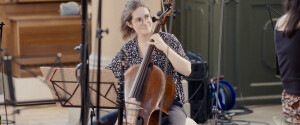
Finally, the CD features the extremely rare Willem van der Sijde violin from Amsterdam, 1691. Since 2017, this violin has been on loan to violinist Elise Dupont, who has been a long-time member of the Castello Consort. And Sakura Goto, also a violinist with the consort, plays a 17th-century Jacobs violin from a private collection. This creates a unique convergence of cultural heritage on the CD.
The recording sessions went remarkably smoothly. According to Anne-Linde, everything was recorded in two and a half days. Amid the intense focus on the work, there were also some unexpected discoveries. For example, during the recording, the ensemble stumbled upon a small button on the virginal. Matthijs explains: “When you press it, a wooden block slides to the side, causing small metal pins to strike the strings. That produces a rattling sound—a sort of distortion effect. When we heard this, we knew right away: we have to use this!”
Less desirable was the slight rattling on the third string of the basse de violon, which could be heard before and during the recording sessions. Anne-Linde had spent days trying to eliminate the noise together with the violin maker, which made the soundcheck a tense moment. In the end, the rattling turned out to be inaudible on the recording. Later, on another project, the problem had even disappeared completely. Temperature or humidity fluctuations may have played a role. “Instruments are just like people,” she says.
Finally, the tuning added extra tension and character. According to Matthijs, the entire ensemble had to adjust to the tuning of his instrument, which was a=400 Hertz. This had a major impact on the ensemble’s sound, but historically, it’s completely accurate. “Most existing recordings are made in modern Baroque tuning (415 Hertz). We thought it would be interesting to make these recordings specifically using this historical tuning. As a wind player, you’re essentially making the entire ensemble work very hard,” said the trombonist.
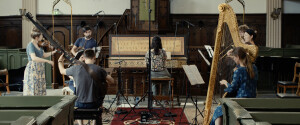
Anne-Linde had the opportunity to borrow the beautiful Snoeck from our collection for this project, but the foundation has never received a request for a historical trombone; consequently, we do not have any in our collection. This comes as no surprise to trombonists who play historical repertoire. Matthijs explains that trombones built before around 1860 are not the original instruments that people play in concerts. “Those are in museums. There are fewer of them. They’re fragile.”
That raised the question of how Matthijs found a suitable instrument for this project. He explains: “For the CD, I used an exact replica of a trombone from around 1600. If you want a good replica of a historical instrument, the price can quickly add up. Every instrument maker searches for originals they believe in and then copies them. I purchased an instrument that comes as close as possible to the original. I adapt my playing style to it, not the other way around.”

Irene Roldán plays the virginal both on the CD and on tour.
It will be a little while yet before Symphoniae is released, but fortunately you can already hear the virginal performed live in March. The Castello Consort will then go on tour with The Image of Melancholy, a program featuring expressive works by Dowland, Holborne, Purcell, and their contemporaries. A ten-part instrumental consort will showcase the quintessential English sound of the 17th century, featuring violas da gamba of all sizes, a transverse flute, and, of course, a virginal.
“What’s special is that we’ll be making our Concertgebouw debut during this tour,” says Matthijs. “And it just so happens to be the Year of Dowland. We’re really looking forward to it.”
March 12 Musica Antica, The Hague
March 14 Castle Concerts, Ewijk
March 20 Zeeuwse Concertzaal, Middelburg
March 22 Royal Concertgebouw, Amsterdam
Matthijs (laughing): “Let’s just say that trombones are pretty nice, too. Don’t forget the wind instruments.”