Behind the Scenes:
Brand-new cello
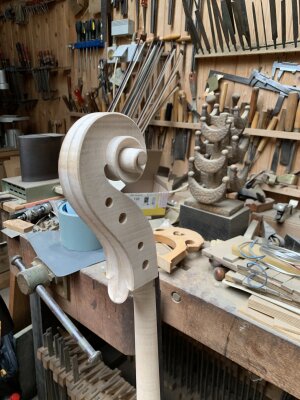
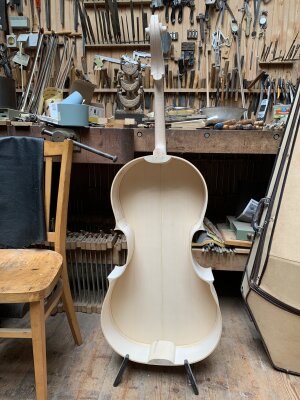
Commissioned by the Musical Instrument Fund, Daniël Royé is currently building a new cello. A cello he crafted in 2004 was purchased by a musician due to exceptional circumstances. We stopped by his workshop in Amsterdam to see how the building process is coming along. It’s always amazing to see an instrument in its early stages, still completely unfinished and in separate parts.
We'd love to give you a tour of the studio:
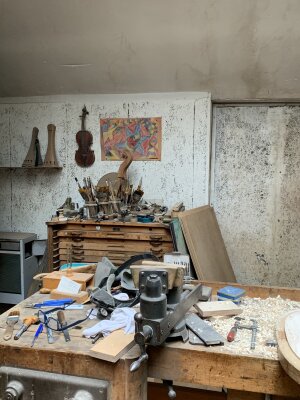
On a cold Wednesday afternoon, we are greeted warmly by Daniël Royé. His workshop looks just as you might expect from a true violin maker: different kinds of wood in every cabinet, tools on every table, and sawdust everywhere—it’s even stuck to the sleeve of his wool sweater.
Without cheating?
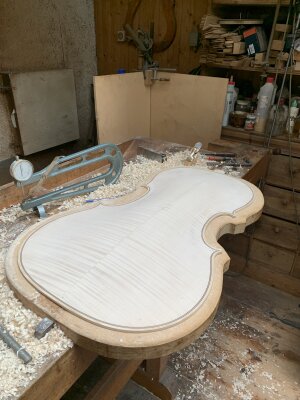
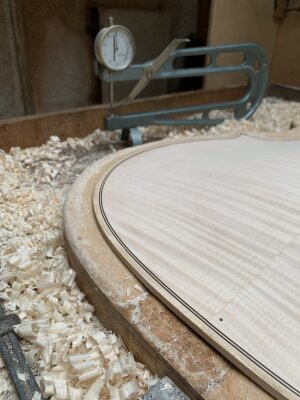
Daniël leads us straight to the cello he is building for our collection. What we see: a delicate, still-unvarnished soundbox with an unfinished top. The back is resting on the workbench, because he is busy shaping it to the desired thicknesses. And that is very precise work. To achieve the correct curves, Daniël has thoroughly studied the original Mara cello by Antonio Stradivari (1644–1737). But this new cello will not merely be a replica, Daniël believes. Thanks to years of experience (he started 43 years ago!), he also relies heavily on his own expertise.
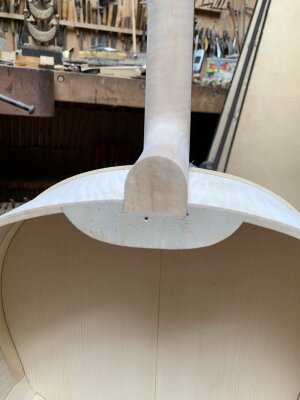
In addition to the correct thicknesses, the choice of wood is of great importance. This cello is made of several types of wood: the neck, back, and sides are made of maple; the top is made of spruce; and the fingerboard is made of ebony.
What Daniël has come to realize over the course of his career is that the top does not necessarily require slow-grown wood with fine growth rings. Daniël believes that a top with wide growth rings produces the best sound for a cello. Stradivari, Goffriller, and Montagnana weren’t put off by a top with such a broad grain pattern either. Daniël concludes that violin making is a craft in which you never stop learning. And that’s a good thing, because it keeps it fun and exciting.
Sunbathing
Although the cello isn’t quite ready for this step yet, the violin maker takes us to another corner of his workshop. He pauses in front of a handmade wooden cabinet. The cabinet is plain and unadorned: it gives nothing away. Daniël hangs varnished instruments inside it to let them dry. The cabinet contains lamps that function like a tanning bed. So the Italian sun is being replicated right here in Amsterdam!
The instruments have to dry in this drying cabinet because Daniël uses oil-based varnish, which dries very slowly. With oil-based varnish, you have more time to work on the details—that is, to create nuances in the layers, says Daniël. And that’s really beautiful and fun to do.
Language Difference
Music is so personal. What you hear, what you feel, and what you enjoy: every musician experiences and plays the same instrument in a different way. There seems to be no universal language for describing the sound and possibilities of an instrument. Because there’s a good chance that an instrument from our collection will be played by different musicians over time, Daniël strives to build a cello that’s as versatile as possible for the Musical Instrument Fund.
The Ideal Sound
To test this versatility, Daniël has various musicians play the cello (once it’s finished). He considers it important that the cello have a large volume: the instrument must be able to sound not only soft but also powerful. It must sound good in the high register and in the low register. It must be able to blend with other instruments—for example, in an orchestra—but also stand out during solo performances.
Daniël pays particular attention to sensitivity: does the cello respond to vibrato and fast notes? There are also requirements for the tone: it must be warm and bright. And flexible: you have to be able to shape the sound. In addition, the sound must be explosive (“Paaah!” Daniël exclaims, arms wide and fingers outstretched). We discuss all these qualities, but when we realize how abstract and personal these terms are, all three of us burst out laughing.
You get the idea: we're really looking forward to hearing the cello.
Culture deserves your support
Many musicians cannot afford to buy their own high-quality instruments, as they are often very expensive. Become a donor to the Musical Instrument Fund and help preserve cultural heritage in the hands of more than 435 talented musicians!
Support Our Talented People