Talent

Nathalie Flintrop
plays a
cello
from Gudrun Kremeier
from Gudrun Kremeier

The cafeteria at the Conservatory of Amsterdam is almost always crowded when I walk in. It reminds me of the time when I was studying violin in Amsterdam, but I feel very old when I see how different things are now. At one table, a boy is playing his electric guitar with headphones on. Right next to him, two young girls are sitting at a laptop, studying sheet music. I hear Spanish, English, and, I think, Portuguese as I make my way toward the Bernard Haitink Hall...
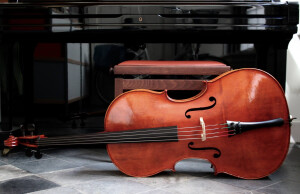
I don’t stand out with the cello case on my back. Inside the case is a brand-new cello, built by Gudrun Kremeier. She received high praise from the expert jury at a prestigious violin-making competition in Paris. In particular, the personality and uniqueness of her building style were praised. Perhaps that lies in the “knot” (knots), which boldly stands out in the wood of the top.
The Musical Instrument Fund is considering purchasing the cello, so today it will undergo a thorough evaluation by four cellists, accompanied by a pianist. We have set aside three hours for this. The Haitink Hall’s acoustics are ideally suited for revealing an instrument’s capabilities and limitations. I brought a box with five bows, because the instrument-bow combination is crucial. The Voirin bow proves to bring out the best in this Kremeier cello. The tone is more powerful with a different bow, but with the Voirin, every note blossoms and shines, and there is much greater scope for nuance. Even when Caspar Vos pushes the Steinway concert grand to its limits, Sietse-Jan Weijenberg doesn’t have to strain to keep the cello’s voice in the foreground, all the way to the back of the hall. Monique Bartels, Jeroen den Herder, and Kalle de Bie also played and listened to the cello, and everyone agreed: this instrument is a valuable addition to the fund’s collection!
It is a cello that is very responsive and reacts precisely to the cellist’s touch. It is particularly beautiful and full-bodied in the lower register, while the clarity in the upper register leaves nothing to be desired. We can expect this virtually unplayed cello to continue to develop in the hands of a skilled player, so it can only get better from here!
This cello was purchased in honor of Prof. Wim Dik, who stepped down as chairman of the board of Het Muziekinstrumentenfonds on June 3, 2015. The cello will therefore henceforth be known as the “Wim Dik” cello.