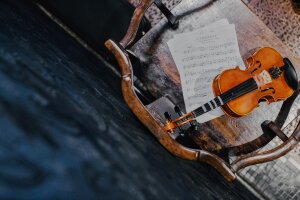
A violin that has been
in the attic since
1942...
Violinist Iefke Wang is temporarily assisting with collection management. As part of her work, she occasionally travels to meet with people who wish to donate an instrument to the Musical Instrument Fund. This often leads to some remarkable stories.
“I’m driving into Heiloo, on my way to ‘a kind gentleman who wants to donate a violin to the Musical Instrument Fund.’ That’s all I know, except for the address. I’m struck by all the greenery—I love nature. There are no sidewalks here, just grass and trees, as if I were at a vacation resort. I’m starting to get back into that vacation mood.
Hans van den Wijngaard lets me in, and I almost trip over the wayang puppets—they’re up the stairs, on the wall, everywhere. I compliment him on his beautiful home and the gorgeous surroundings. Hans and his wife are very happy in Heiloo. Over a cup of Lapsang Souchong—the first of many to come—he tells me that they’re not originally from Heiloo, but from Leiden. They moved here after he retired. My heart starts racing because my family is also from Leiden. I ask him if he happens to know the Van Gellecum or Wang family. Hans perks up, “Bas van Gellecum—he was my buddy!” I nearly choke on my tea. This kind gentleman was friends with my own uncle! My mother’s family and he were simply neighbors. He doesn’t remember my mother very well—she was still just a little girl back then. But he and Uncle Bas were very close friends. Then Hans tells me a lot about our shared history, about my grandmother, whom he was a little afraid of because she didn’t wear a flowered apron but was actually very modern.
Once we’ve gotten past our initial surprise and amazement, I ask him about the story behind the violin. The story of his father’s violin, which he wants to donate to the Musical Instrument Fund just like that. He heard about the Musical Instrument Fund on Radio 4, and since his father’s death in 2004, the violin had been sitting in the attic.
Hans’s father, Fred van den Wijngaard (born in 1909), had received the violin from his boss in 1930. He worked at Templum Salomonis, the antique and modern bookstore—which still exists today—located just around the corner from my father’s family home, across from the Pieterskerk in Leiden. Fred van den Wijngaard was an amateur violinist who played his violin in the evenings after work.
Until 1942, Mr. van den Wijngaard says…
I feel a knot in my stomach. During the war, they took in someone in hiding who, as it happened, also played the violin. Fortunately, this man made it through the war safely, even though two members of the NSB lived on the street. He was never discovered, nor were several other people in hiding on the street. Thankfully, the knot in my stomach has loosened. Many stories about the war follow. Hans, then just a little boy, carried Resistance leaflets under his clothes. When he had scarlet fever, they were given a sign by the municipal health department to put on the window to warn the Germans about contagious diseases. That sign stayed up for a good six months. They lived near the Nieuwe Vaart (now the Rijn-Schiekanaal), where there was a railroad bridge over which the Nazis transported V2 rockets to bombard the British. That bridge was bombed by the Allies in 1944. Hans still remembers it vividly. All the windows had been blown out, and you could walk straight from the backyard to the front yard—everything was gone.
But the mystery of the violin remains: why did the violin stay in its case starting in 1942?
The violin-playing person in hiding and Hans’s mother took a bit too much of a liking to each other. Probably out of jealousy and a sense of powerlessness, his father refused to play the violin ever again from that moment on. The man in hiding continued to visit them regularly after the war. When Hans finished school, he wanted to pursue a career in music. His father absolutely forbade it—teacher’s college and nothing else! Hans’s mother, however, secretly paid the tuition for the conservatory. That’s how he came to study trombone with Anner Bijlsma Sr. Hans played wherever he could and ended up joining the Residentie Orkest, among other ensembles. Whenever they performed at the Stadsgehoorzaal in Leiden, there he was—all the way in the back, in the dark—his father, listening. Hans gave many concerts with the Residentie Orkest, but mandatory military service threw a wrench in the works. When he returned, his position had been filled. With tears in his eyes, Hans explains that he decided to finish teacher’s college anyway and went on to have a long career in education. “That’s just how it was back then—you listened to your father,” he adds.
The following week, I visited a violin maker to have the violin appraised. Unfortunately, the violin is not of a high enough caliber to qualify for the collection of the Musical Instrument Fund. Nevertheless, Hans has given us permission to sell the violin. We may use the proceeds from the sale of this special instrument to benefit the Musical Instrument Fund. Once again, thank you very much, Mr. Van den Wijngaard!”