Talent

Edgars Karpenskis-Allažs
plays a
bassoon
from Wilhelm Heckel GmbH
from Wilhelm Heckel GmbH
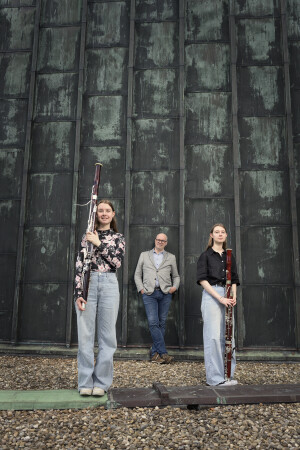
Many talented bassoonists in the Netherlands are unable to advance musically because a good instrument has become unaffordable. Market leader Heckel is driving up prices and wait times. Bassoonists Bram van Sambeek and Pieter Nuytten sounded the alarm and found a sympathetic ear at the Musical Instrument Fund. Bram: “I hope the fund’s support signals a new phase in the bassoon’s emancipation. This could have an enormous impact on the instrument’s future and the growth of Dutch talent.”

There’s a major problem in the world of bassoonists. Professional instruments, especially those made by the renowned German company Heckel—the Stradivarius of bassoonists—are gradually becoming unaffordable. And anyone who can afford to spend more than a ton to set out into the world with a new Heckel must hope that his or her parents were far-sighted enough during their early childhood, because the waiting period is about seventeen years.
Bram van Sambeek, an international bassoonist and teacher, and Pieter Nuytten, a teacher and principal bassoonist with the Rotterdam Philharmonic Orchestra, are pleased that their plea for help reached the Musical Instrument Fund. The fund has since purchased three professional bassoons. Three talented musicians are no longer limited by their instruments and can now continue on their musical paths with high-quality bassoons. “We’ve had extensive discussions with the Musical Instrument Fund, and I’m grateful that the fund took action,” says Nuytten.
“For my 15-year-old students, Emma and Roos Vondenhoff, the foundation and I found two beautiful Püchners—instruments that Bram and I started out with before we eventually settled on a Heckel. The bassoon has a warm tone, with no limitations—an ideal stepping stone.”
“My Latvian student, Edgars Karpenskis-Allažs, is already a bit further along in his development at the age of 23,” says Van Sambeek. “It’s incredible how much progress he’s already made in such a short time on the secondhand Heckel he just bought. I hope the fund’s support signals a new phase in the bassoon’s emancipation. This could have an enormous impact on the instrument’s future and the growth of Dutch talent.”

As a talented bassoonist, how do you come up with tens of thousands of euros for a good instrument? “You don’t,” replies 23-year-old Edgars Karpenskis-Allažs. “Everyone struggles with that. Everywhere.” The student of Bram van Sambeek has no steady income, which means he can’t take out a loan to buy a bassoon. “I’m incredibly happy that the Musical Instrument Fund was able to help,” he says. Together with Van Sambeek, he went on a search for a secondhand Heckel. “A bassoon we tried out in Switzerland didn’t have the tones and character that suit me well. We found the ideal instrument—built in 1998—at a Portuguese musician’s home. Every day I discover something new, and the more I play it, the more endless the possibilities seem.”
