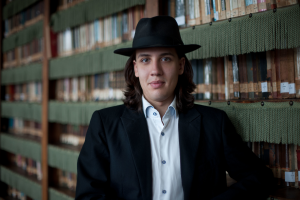
Noa Eyl
violin
Dear visitor,
My name is Noa Eyl, and I started playing the violin when I was five years old. My desire to become a violinist was already clear when I was two, but it was difficult for my mother to find a music school willing to give violin lessons to such a young child. Through a series of connections, she received—as if by a “stroke of luck”—Coosje Wijzenbeek’s phone number.
Under Coosje’s guidance, I spent 13 years learning nearly everything a professional musician needs to know.
From an early age, I played with the string ensemble “The Fancy Fiddlers,” which included all of Coosje’s students.
The wonderful thing about this was that the older violin students served as a great source of inspiration for the very youngest ones.
So we didn’t just learn to play the violin from Coosje, but also from each other.
It was wonderful, then, that I, too, eventually became one of the “big ones” and was able to lead the ensemble myself for a number of years.
In addition, I played a lot of chamber music and won various competitions both as a soloist and as part of chamber ensembles, including twice the National Final of the Princess Christina Competition and the International Charles Hennen Competition.
After studying with Coosje, I went on to the Conservatory of The Hague.
There, I studied with Jaring Walta.
This turned out to be far too conservative an approach for me, one that stripped me of all freedom of interpretation.
I noticed that all the students played with the same fingerings and the same bowing techniques, which meant they all played in the same way.
While this was actually a source of support for many, I was (as it turned out) too individualistic for that.
I was also deeply drawn to the art of improvisation, so I could often be found in the jazz department rather than in the classical violin corridors.
This was to the displeasure of Jaring and the administration, which led me to decide to end my studies.
After spending a year searching for a suitable teacher, I realized that what I was looking for was something I really had to teach myself.
This changed briefly when I heard that Jeffrey Bruinsma was teaching jazz violin at the Amsterdam Conservatory.
I auditioned, and funnily enough, during the audition the committee asked me, “Why aren’t you studying classical violin?
” I ended up taking lessons from Jeffrey for a year, and he opened many doors for me in the art of improvisation. The downside was that I was only allowed to play jazz and had to unlearn my classical “habits.”
But I wanted to become a violinist because I loved the sound of the violin so much, and it was a reflection of what I felt and what I wanted to communicate. In the jazz program, I was expected to sound more like a trumpet or a saxophonist. I had to play without vibrato, with minimal bowing, and always with a microphone because the percussion was always so loud. So after a year, it became clear to me that I had to go my own way again. I returned to classical music to regain that nuance and took lessons with Benzion Shamir.
I also played in various ensembles and orchestras, and I played in many folk music ensembles to earn money.
Folk music has always appealed to me greatly because, for me, it’s the ideal middle ground between classical music and jazz.
Here, I didn’t have to adhere to orthodox rules but rather drew from traditions, and I truly gained the freedom to express myself as I wished.
As a result, a whole new world opened up for me, and I finally began making music without boundaries.
Nowadays, I would describe myself more as an independent artist, for whom the violin has truly become the instrument that reflects my sound and my way of interpreting music.
I am immensely grateful to the Musical Instrument Fund and everyone who has supported me in this, because there has always been the confidence that what I wanted was just as valuable as wanting to play in the Concertgebouw Orchestra.
These days, I play in various folk ensembles and a salon orchestra; I have a jazz combo, and I do a lot of work in cabaret. I also still play classical repertoire, but never the way you might hear it on countless recordings—no, I play it my way. I hope to meet you at one of my performances, and I’d love to hear whether I’ve been able to move you with my violin playing.

