Instrument

violin
Willem van der Sijde (Syde)
Amsterdam,
1691
played by
Elise Dupont
Elise Dupont

*± 1663 , Nieuwerkerk †na 1696 , Amsterdam
The first mention of him as a violin maker dates back to 1689, which might explain why we only find violins made by him from the 1690s onward. Unfortunately, it is not known how long he was active as a violin maker due to the lack of notarial records and a death certificate, but the last known label bearing his mark dates from 1696. Unfortunately, there is still no confirmation of the rumor that he later moved to The Hague. In any case, he was certainly productive during those years. While it was initially thought that his work was rarely found, extensive recent research has shown that he was one of the most prolific makers of the Golden Age.
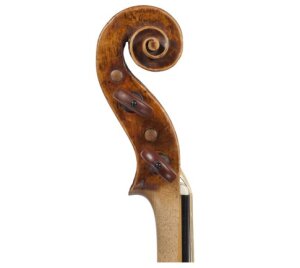
The earliest known example is the 1691 violin from the collection of the Musical Instrument Fund. It is a violin that showcases both the refinement and the freedom of his craftsmanship. The finesse lies primarily in the delicate inlay, beautiful edges, and slender shape. But his free-spirited approach is evident in the tool marks on the back and the gouge strokes on the scroll. The fragile construction of his scrolls likely caused many to be lost. In the years that followed, Van der Sijde developed a style entirely his own; while the 1691 violin still shows strong Amati influences, he soon arrived at a highly distinctive model with a rounded arch and, often, a slightly longer body.
The Curl of the Violin (1691) from the collection of the Musical Instrument Fund
By around 1694, little remained of the Amati model, and we see large-sized violins with wide inlays. A very distinctive feature is the placement of the f-holes very close to the edge inlay, which creates his characteristic broad breast on the top. At first glance, his work appears bold and full of character, but the longer you look at the arching and the edge inlay, the more you can see Van der Sijde’s finesse and control over his tools.
In any case, during the brief period he was active, he demonstrated that he was among the very best of Dutch violin makers. Its rich golden-yellow ground reflects beautifully beneath its varnish, which ranges in color from amber to orange and reddish-brown; the colors are bright and vivid, and over the years, a beautiful patina or craquelure has sometimes developed—a fine example of 17th-century varnish work. Van der Sijde thus demonstrates that he was truly one of the masters of the Amsterdam school.
D.J. Balfoort, 1931 *Dutch Violin Makers*, H.J. Paris, Amsterdam.
Bolink, J., Giskes, J., Lindeman, F., and Stam, S., 1999, 400 Years of Violin Making in the Netherlands, Amsterdam.
Amsterdam City Archives, accessed in 2025