Instrument

violin
Pietro (II) Guarneri
Venice,
1725
played by
Frederieke Saeijs
Frederieke Saeijs

*1695 , Cremona †1762 , Venetië
Pietro Guarneri was born in the “Casa Orcelli-Guarneri,” a modest house in the center of Cremona where his father and grandfather also had their workshops. He was the second child of Giuseppe Guarneri “Filius Andreae” and Barbara Franchi. The house had belonged to the parents-in-law of his grandfather Andrea, but after Andrea’s marriage to Anna-Maria Orcelli, the couple had continued to live there. It became the birthplace of all their descendants. The Guarneri family was certainly not wealthy; Giuseppe’s father had been forced to take out a substantial loan and rent out part of the house to pay off other debts. It was conveniently located: close to the Stradivari family and in the shadow of the Church of St. Domenico.
In Cremona, there were only four families engaged in violin making: the Amatis, the Ruggieris, the Stradivaris, and the Guarneris. In Cremona’s rather strict hierarchy, Stradivari was the foremost. The most influential, however, was Amati, whose model the others continued to follow for a long time. Of the Cremonese violin makers, the Guarneri family had the greatest difficulty staying afloat.
Pietro’s father, Giuseppe “filius Andreae” (1666–ca. 1730), was a skilled craftsman, but his instruments could not compete with those of his great contemporaries. The wood he used was simple—sometimes beech, poplar, or linden—and not always cut in the same way. His instruments met the musical demands of his time but did not surpass them. Compared to those of his great fellow townspeople, his instruments were affordable; they cost only one-fifth of the price Stradivari charged.
Of the Cremonese violin makers, the Guarneri family had the hardest time staying afloat
In 1695, the second of their six children, Pietro Guarneri, was born. He was followed three years later by Giuseppe “del Gesù” (1698–1744). Over the course of about eight years, their father, Giuseppe “filius Andreae,” trained both of his sons to become violin makers. Together, they worked under his guidance in the family workshop for ten years. Around 1715, Pietro had already built several violins on his own, about which the expert Charles Beare wrote in 1999 that “there was one in which I recognized his [Pietro’s, ed.] hand with certainty, and that it had been Arthur Grumiaux’s superior instrument.”
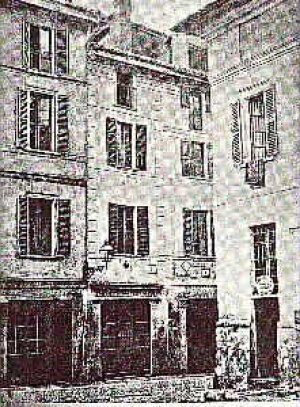
Orcelli-Guarneri House
In 1719, Pietro left the “Casa Guarneri” workshop to work elsewhere in Cremona. This was a remarkable decision for that time; never before had a son in Cremona left his father’s business in this way. He had been trained by his father all those years and “had the prospect of a career as a master violin maker,” as Hill put it.
Pietro’s departure was likely prompted by the decline in demand for instruments still based on the old Amati model, but also because the Guarneri family was gradually being overshadowed by the rise of the far more successful Stradivari. Stradivari was innovative, produced a large number of instruments, and built primarily for the more affluent. Moreover, Cremona began to lose its dominance in violin making due to the emergence of new centers both within and outside Italy. As an additional reason for his departure, Hill (1989) notes that the differences of opinion between Pietro and his father, with whom he lived under the same roof, had become too great for them to remain together any longer. As a competitor to his father, he built his instruments in Cremona for several years without assistance from others before moving to Venice around 1724.
Even though Venice had passed its heyday, it remained attractive to musicians because of the allure of its colorful, exuberant life. It was a city life set to music. Aristocratic families owned opera houses and, in some cases, valuable collections of instruments. They played and sang themselves and appreciated skilled musicians. The separation of church and state had blurred there. The Doge, who was elected by the people, was in charge of both spiritual and political affairs.

Teatro Grimani Opera House in 1709. Engraving by Vincenzo Maria Coronelli
Public festivals—of which Venice had more than anywhere else in Europe—were colorful and spectacular events. Venice never had fewer than six opera companies, which together performed a total of thirty-four weeks a year in the city’s eleven opera houses. Between 1725 and 1750, Venetian audiences saw and heard ten or more new operas each year. Venetian nobles and academies financed the musical programs on a large scale. Talented musicians were generously rewarded. On holidays, church services were not so much religious ceremonies as they were grand instrumental and vocal concerts. German-speaking violin makers, who were generally far more skilled in their craft than makers from other regions, had formed a sizable community in the city.
Venice has never had fewer than six opera companies, which together performed a total of thirty-four weeks a year in the city’s eleven opera houses
In 1724, the year Pietro Guarneri arrived in Venice, there were dozens of violin makers working in the city, but only a few were considered true Venetian masters. Matteo Goffriller (1659–1742), as the founder of the Venetian school, was the city’s most influential violin maker until a few years before Pietro’s arrival, but “new” makers such as Domenico Montagnana (1686–1750), Carlo Tononi (1675–1730), and certainly Santo Serafin (1699–ca. 1758)—who enjoyed the patronage of several prominent Venetian noble families—proved to be formidable competitors and were on the rise.
No instruments labeled “Pietro Guarneri” have been found in Venice prior to 1725. Presumably, it took him a year to meet the strict requirements that the Venetian Scuola dei Marzeri (the former guild of craftsmen) imposed on anyone who wanted to work in Venice. Only after he had demonstrated sufficient craftsmanship was he admitted to the guild and permitted to build instruments under his own name. Pietro further developed his mastery under Matteo Sellas II, in whose workshop he had begun working upon his arrival in Venice and with whom he remained until he was able to establish his own business in 1733.
Matteo Sellas II was the grandson of the renowned lute and guitar maker of the same name. With nine family members, the Sellas were well represented in Venice. No instruments made by Matteo II himself are known to exist, but stringed instruments were built in his workshop by several German violin makers and by Carlo Tononi, who came from a prominent family of violin makers in Bologna. The instruments they built were sold unlabeled to the Ospedali, conservatories, or to musicians who lacked the necessary financial means. Only Carlo Tononi and Pietro Guarneri built under their own names and were increasingly able to work on commission. Tononi died in 1730, and Pietro remained the sole master violin maker at Sellas until 1733, when he had enough regular customers to open his own workshop.

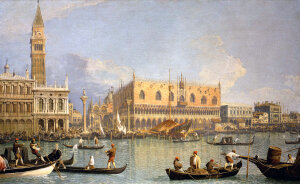
View of the Palazzo Ducale, Venice. Canaletto, 1755
In 1728, Pietro Guarneri married Angiola Maria Ferrari, a young woman from a modest Venetian family. None of the Guarneris served as witnesses at the wedding; instead, Matteo Sellas signed on their behalf. A year later, the first of their ten children was born. Given that the witness—who was of high nobility—signed the baptismal register for their youngest son in 1743, Pietro must have risen over the years within the rather closed social hierarchy of Venetian society.
Pietro made a name for himself with his instruments, which closely resembled those of Stradivari, his former neighbor in Cremona, whose instruments and craftsmanship he admired. It was a style that had been popular in Venice for some time.

Memorial stone for Vivaldi at the Ospedale della Pietà
After he started his own business, commissions began to come in from wealthy amateur musicians as well as from the various Ospedali, of which the Ospedale della Pietà was the most famous. The Ospedali had evolved from charitable institutions for orphans into luxurious establishments where Venetian patricians sent their daughters—for whom they preferred not to pay a dowry upon marriage. Music was important and was considered part of their “social standing.”
Most Ospedali had a collection of high-quality instruments, but each girl who joined was preferably expected to have her own instrument. Leading violin makers, including Pietro Guarneri, had contracts with the Ospedali. They built, sold, repaired, and rented instruments. Under Vivaldi, who led the Ospedale della Pietà for thirty years with a few interruptions, music education there had reached a very high level. Large audiences attended their performances. A new oratorio or concert was composed for virtually every holiday.
Given the differences between the instruments made by the two brothers, there was no more than a modest degree of collaboration or influence
Pietro and his brother “del Gesù” almost certainly had contact with one another in Venice. For “del Gesù,” the instrument makers in the city were an important source of new knowledge in his field. Given the differences between the instruments made by the two brothers, there was likely no more than a modest degree of collaboration or mutual influence. Hill (1931), however, does identify parts of instruments on which the brothers appear to have collaborated.
Between 1733 and 1762, Pietro built a body of work whose full extent has not been fully documented, but which must have been modest in comparison to that of Stradivari or Goffriller.
None of his children had any ambition to follow in their father’s footsteps. In Mantua, his uncle and namesake Pietro Guarneri had already died in 1720; his father had passed away around 1739; and his brother Giuseppe del Gesu had died in 1744, making Pietro “of Venice” the last of the Guarneri line. After an illness that lasted only a few days, Pietro Guarneri died in 1762.
In the past, so much attention had been focused on his father, “filius Andreae,” and his brother, “del Gesù,” that the musicologist de Piccolellis wrote as late as 1885 that the name “Pietro Guarneri, son of Giuseppe,” was unknown in Italy. It was not until years later that experts discovered the quality of Pietro’s work, and the recognition he deserved began to grow. Today, he is considered one of the last great Venetian violin makers.
Of the ten years that Pietro worked in Cremona, only a few instruments are known, all dating from 1721. They are based on the Guarneri family model. Only connoisseurs can distinguish Pietro’s work from that of his father and brother. Regardless of which family member built an instrument, it was always labeled “Giuseppe ‘filius Andreae’.” It was only after Pietro left his father’s workshop that he was able to build instruments under his own name.

Violin (1725) from Pietro Guarneri's early years in Venice
His early Venetian works show only a faint resemblance to his father’s style. Outwardly, they resemble Stradivari, but with a “Venetian” red varnish that he applied thickly. In the years that followed, he sought to develop his own style. He did not find it immediately; until 1730, he still drew on his Cremona period several times, incorporating elements from Amati and his grandfather Andrea Guarneri. It is striking that he never once referred to his father’s work. Over the years, he developed his own model, which became a fusion of the Cremona style and the Venetian school of Matteo Goffriller.
After Pietro became independent in 1733, a period began during which he built his finest instruments. The materials he used to make his instruments remained simple until around 1735. No beautifully figured wood, but a magnificent varnish that he applied quite thickly, in the Venetian style. Starting in 1740, signs of the influence of his contemporary Serafin began to appear in his violins. Whichever model he chose, the scroll on virtually all of his instruments remained almost entirely true to the “Guarneri” family model, which he continued to perfect in Venice.
Although there was a great demand for cellos in Venice after obbligato bass parts in sacred and secular music had become increasingly popular, Pietro presumably built no more than ten cellos. They are broadly shaped and feature pronounced corners. Because Pietro usually placed the f-holes far to the outside, the width is further emphasized. He built mainly violins and a few violas.
The instrument that the Musical Instrument Fund holds in its collection, made by Pietro Guarneri “of Venice,” is one of the very first instruments he built in Venice.
W. Henry Hill, Arthur F. Hill & Alfred E. Hill, 1931, The Violin Makers of the Guarneri Family, 1626-1762, Londen.
Hill W. Henry, Arthur F. Hill & Alfred E. Hill, 1902 Antonio Stradivari: His life and work (1644-1737), London.
De Piccolellis, G. 1885, Ancient and Modern Lute Makers, Successori le Monnier, Florence.
Pio S., 2019, The Sellas Family of Violin and Lute Makers, Journal of the Violin Society of America.
Jalovec, K., 1957, Italian Violin Makers, Prague.
Vannes, R., 1981, “Universal Dictionary of Instrument Makers,” Brussels.
The Strad; In Focus 2013; John Dilworth.
Goldfarb T., 2015, Art and Music in Venice, Londen.
Tarisio; the Cozio archive, bezocht in 2020.
Hargrave R. G., 2011, The Working Methods of Guarneri ‘del Gesù’ and their Influence upon his Stylistic Development.