Instrument

violin
Pierre Silvestre
Lyon,
1858
played by
Vivian Giesbertz
Vivian Giesbertz

*1801 , Sommerviller †1859 , Lyon
Sommerviller, the birthplace of Pierre (II) Silvestre, was an unremarkable village of 600 people on the Meurthe River. His father, Pierre (I) Silvestre, had been a Benedictine monk in Luneville until 1795 and, after leaving the order, had tended the vineyards of his former abbey. In 1800, he married Christine Baraban from Sommerviller and continued to live in his wife’s hometown. In 1801, their first son, Pierre, was born.
In 1804, Pierre Silvestre changed careers and became a teacher of French language and literature at a small college in Saint-Nicolas-de-Port that he had founded himself. Every day, he walked the few kilometers from his school to Sommerviller. After a few years, he became a teacher in Vézelise and finally moved with his wife and two sons to Mirecourt in 1810, where he began teaching the same subject. The family did not have much luck, as four of their six children died shortly after birth. Their father also died young; Pierre was sixteen and his brother Hippolyte (1808–1879) was eight. Their uncle Laurent Blaise, one of the many skilled violin makers in Mirecourt, took the two boys under his wing. Pierre began training as a violin maker with Blaise, and Hippolyte soon followed him into the trade.
A few years after completing his apprenticeship, Pierre became one of Lupot's regular employees in Paris.

Nicolas Lupot, Henriette Lorimier, 1805
To complete his training as a violin maker, Pierre went to Nicolas Lupot in Paris. Lupot had opened a workshop in 1806 on Rue Croix-des-Petits-Champs, where several violin makers were based. To be accepted by Lupot, Pierre Silvestre must have already been a skilled craftsman, as Lupot was already a leading figure in his field at the time. Shortly before Pierre’s arrival, in 1823, Nicolas Lupot had been appointed violin maker to Napoleon’s Imperial Chapel. Even after Napoleon’s fall, he remained in the service of the new rulers as “luthier de la Chapelle Royale.” A few years after completing his apprenticeship, Pierre became one of Lupot’s permanent employees.
The French court possessed a large collection of instruments, including several built by Stradivari, Guarneri, and other masters from Cremona. These were regularly entrusted to Lupot’s workshop for repair or maintenance. Pierre Silvestre thus had ample opportunity to study them. In Lupot’s workshop, instruments were built in Stradivari’s style, and thanks to the superior finesse that Lupot and his staff demonstrated at every stage of the building process, Lupot found enthusiastic admirers for these instruments.

After Nicolas Lupot’s death in 1824, his workshop was taken over by his son-in-law and former employee, Charles François Gand. Gand was known as an outstanding violin maker; he had previously successfully taken over Jean Gabriel Koliker’s business and was also a businessman. His company would remain one of the most prestigious enterprises in the field of traditional French violin making well into the 20th century. In Paris, Gand was appointed to the Chapelle Impériale as the successor to Nicolas Lupot, and in addition to being a violin maker for the French court, he also became the violin maker for the Paris Conservatory. Pierre Silvestre continued to work for this founder of the Gand dynasty for another five years before striking out on his own in 1829—not in Paris, where competition was fierce, but in Lyon.
Lyon was the second-largest city in France, but when Pierre Silvestre moved there, it had no more than one old opera house and a few small venues where music was performed. It lacked the rich cultural life found in Paris. Still, he had chosen his new home well. After the Revolution and Napoleon’s rise to power, the number of amateur musicians playing at a high level grew, and—in keeping with the fashion of the time—they also performed many short symphonic works. The city had fiercely resisted the Revolution and now reaped the rewards of that resistance.
Between 1825 and 1850, investments were made in opera and other orchestras, in an academy of fine arts, and in music schools that trained many amateurs and professionals. And a large new opera house was even built. The city was internationally renowned for the manufacture of various types of musical instruments, but there were hardly any violin makers there. Demand for violins skyrocketed in the first half of the 19th century as Lyon developed into a regional capital thanks to its favorable location near borders that had become accessible via Napoleon’s newly constructed roads. For musical instrument merchants, Lyon became a paradise. Paris did remain the center of violin making, but far from the capital, Pierre Silvestre faced virtually no competition.
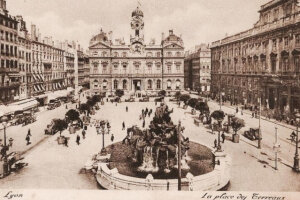
Place des Terreaux, Lyon
In 1831, Hippolyte joined forces with his brother Pierre in Lyon. Hippolyte had trained with J. B. Vuillaume in Paris and later became one of his regular employees—a privilege reserved only for the most talented. They opened a new shop on the Place des Terreaux. It was located on one of the city’s most beautiful squares, which was also home to the Académie des Beaux-Arts and City Hall. A new opera house opened its doors that same year and was just a stone’s throw away from the firm “Silvestre Frères.” It drew musicians and music lovers from all over Europe to the city.
‘The instruments made by theSilvestre brothers are among the finest thattraditional 19th-century French violin-making hasproduced’
Pierre and Hippolyte worked together until 1848. After that, Hippolyte left, and Pierre continued on his own. Their business was a great success; their instruments were sold throughout France and exported to other countries in Europe. During the time he worked alone, Pierre built approximately 350 instruments. After Pierre’s death in 1859, Hippolyte returned to Lyon to take over the firm, which had since grown into a large company. He remained there until 1865, after which his nephew, Hippolyte Jean Chrétien (1865–1884), took over. After his death, the business closed.
The refined craftsmanship of the Silvestre brothers resulted in instruments that rank among the finest produced by traditional 19th-century French violin making. Pierre’s instruments are regarded as just slightly superior to those of his brother.
In 1844, the brothers participated in the “Exposition Nationale” in Paris and won a medal. That was the first in a series of entries that consistently earned them high praise. The last time Pierre participated in an exhibition was in 1855. He submitted two violins to the Exposition Universelle in Paris. He received an honorable mention for these instruments.
Pierre mainly built violins, less frequently violas, and only a few cellos. In total, just under 350 of his instruments are known to exist. He based his work on several models by Stradivari and, on rare occasions, on those by Andrea Guarneri.
His instruments demonstrate excellent craftsmanship; they are refined in every detail and are considered among the finest built in France during the nineteenth century. Their quality is evident not only in their construction but also in their sound.
Pierre's instruments are more highly regarded than his brother's.
Pierre Silvestre remained active until shortly before his death.
Pierre Silvestre’s work was already highly regarded in his own time. Albert Jacquot (1853–1921) wrote in his overview of French luthiers: “Pierre had a reputation for being an exceptionally talented violin maker. In terms of tone, varnish, and the finesse of the workmanship, his instruments are more sought after than those of his brother.”
Pierre usually used a beautiful, dark red varnish that he applied in such a way that it made the instrument look slightly older.
The instrument in the collection of the Musical Instrument Fund was built in 1858, just one year before his death.
Milliot, S. and Perrin, N. 2017, Lecture 3; European Stringed Instrument Making Day. Cordes sur Ciel.
Thöne J, 2008, Italian & French Violin Makers, Dubai.
Carlson B., Schmitt J. F., Moroder I., Leonhard F., 2007, Italian & French Violin Makers, Keulen.
Vannes, R., 1999, *Universal Dictionary of Instrument Makers*, Spa.
Millant, R., 1979, J-B Vuillaume: His Life and Work. Hill & Sons, London
Henley W., 1959 Universal Dictionary of Violin and Bow Makers. Amati Publications. London.
Jacquot, A., 1912, *La Lutherie Lorraine et Française*, Paris: Tarisio; the Cozio archives, accessed in 2020.
Geneanet, accessed in 2020.
Archives Nationales de France, accessed in 2020.