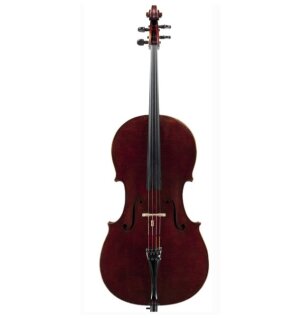
Instrument

cello
Pierre & Hippolyte Silvestre
Lyon,
1835
played by
Emma Warmelink
Emma Warmelink

Sommerviller, the birthplace of Pierre and Hippolyte Silvestre, was an inconspicuous village of 600 people on the Meurthe River. Their father, Pierre Silvestre (I), had been a Benedictine monk in Luneville until 1795 and, after leaving the order, had tended the vineyards of his former abbey. In 1800, he married Christine Baraban of Sommerviller and continued to live in his wife’s hometown. Their first son, Pierre, was born in 1801, followed by Hippolyte in 1808.
In 1804, their father had given up his calling as a monk and become a teacher of French language and literature at a small college in Saint-Nicolas-de-Port that he himself had founded. After a few years, he became a teacher in Vézelise and, in 1810, moved with his wife and their two sons to Mirecourt, where he began teaching the same subject. The family did not have much luck, as four of their six children died shortly after birth. Their father also died young; Pierre (1801–1859) was sixteen and Hippolyte (1808–1879) was eight. Their uncle Laurent Blaise, one of the many skilled violin makers in Mirecourt, took the two boys under his wing. Pierre began training as a violin maker with Blaise, and Hippolyte soon followed him into the trade.
To complete his training as a violin maker, Pierre went to study with Nicolas Lupot in Paris. To be accepted by Lupot, he must have already been a skilled craftsman, for Lupot was already a master of his craft in his day. He was the “luthier of the Chapelle Impériale” under Napoleon and, even after Napoleon’s downfall, remained in the service of the new rulers as the “luthier de la Chapelle Royale.” A few years after his apprenticeship, Pierre Silvestre became one of Lupot’s permanent employees.
Pierre Silvestre had ample opportunity to study instruments by Stradivari, Guarneri, and other Cremonese masters, as the French court possessed a large number of instruments made by these luthiers. These instruments were regularly entrusted to Lupot’s workshop for repair or maintenance.
After Nicolas Lupot’s death in 1824, his studio was taken over by his son-in-law and former employee, Charles François Gand. Pierre Silvestre continued to work for Gand for another five years before striking out on his own in 1829—not in Paris, where competition was fierce, but in Lyon.
Lyon was the second-largest city in France, but when Pierre Silvestre moved there, it had no more than one old opera house and a few small venues where music was performed. It lacked the rich cultural life found in Paris. Still, he had chosen his new home well. After the Revolution and Napoleon’s rise to power, the number of amateur musicians playing at a high level grew, and—in keeping with the fashion of the time—they also performed many short symphonic works. The city had fiercely opposed the Revolution and now reaped the rewards of that stance. Between 1825 and 1850, investments were made in opera and other orchestras, in an academy of fine arts, and in music schools that trained many amateurs and professionals. And a large new opera house was even built.
The city was internationally renowned for the manufacture of various types of musical instruments, but there were hardly any violin makers there. Demand for violins skyrocketed in the first half of the 19th century as Lyon developed into a regional capital thanks to its favorable location near borders that had become accessible via Napoleon’s newly constructed roads. For musical instrument merchants, Lyon became a paradise. Paris did remain the center of violin making, but far from the capital, Pierre Silvestre faced virtually no competition. Pierre Silvestre’s business benefited so much from the increased demand for high-quality instruments that he persuaded Hippolyte to come to Lyon as well.
Around 1827, Hippolyte Silvestre had completed part of his training with Laurent Blaise. Blaise was not a great luthier, but he was a good teacher. And Hippolyte proved to be talented. He was allowed to continue his training with Jean Baptiste Vuillaume in Paris. Vuillaume was a charismatic figure who had countless innovations in violin making to his credit and inspired his employees to achieve extraordinary results. He was also a shrewd businessman. When Hippolyte joined his firm, the company was on the cusp of tremendous success. Within ten years, Vuillaume’s firm had grown into a company producing hundreds of instruments and bows each year. After five years, Hippolyte rose to become one of Vuillaume’s permanent employees.
Pierre’s business was already a huge success after just two years. So much so that he asked his brother to help him expand it further. In 1831, Hippolyte left Vuillaume and moved to Lyon as a craftsman with a wealth of experience. The brothers opened a new shop on the Place des Terreaux, one of the city’s most beautiful squares, which was also home to the Académie des Beaux-Arts and City Hall. A new opera house opened its doors that same year, just a stone’s throw from “Maison Silvestre Frères.” It drew musicians and music lovers from all over Europe to the city.
In 1844, the brothers participated in the “Exposition Nationale” in Paris and won a bronze medal.
Pierre and Hippolyte continued to work together until 1848. After that, Hippolyte returned to his hometown of Sommerviller to take things a bit easier. The business was a great success and remained so even after Hippolyte’s departure; their instruments were sold throughout France and also exported to other countries in Europe.
Pierre died in 1859, and Hippolyte returned to Lyon to take over the firm, which had by then grown into a large company. He remained there until 1865, after which his son, Hippolyte Chretien (1865–1884), took over. After his death, the business closed.
The refined craftsmanship of the Silvestre brothers resulted in instruments that can be counted among the finest produced by traditional French violin-making in the nineteenth century.
Their collaboration in Lyon lasted seventeen years. They built instruments primarily based on the models of Stradivari and Guarneri.
Their label read:
Peter and Hippolytus, Brothers, made it in the forest at Lyon. Year 1838 No:
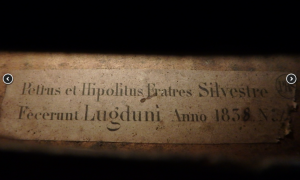
Source: Tarisio
During the years they worked together, they built just under 350 instruments, mostly violins, with a few violas and only a handful of cellos. Almost all were built based on models by Antonio Stradivari and Guarneri del Gesù. The color differed from what these makers used; the brothers usually finished their instruments with a dark red varnish.
Their instruments demonstrate exceptional craftsmanship; they are refined in every detail and are considered the finest ever built in France in the nineteenth century. This quality extends not only to their construction but also to their sound.
The work of the two Silvestre brothers was already well-loved in their own time. Albert Jacquot (1853–1921) had already praised them in his overview of French builders.
The brothers did most of the work themselves in Lyon, but around 1840, François “Malafoff” Brugère (1825–1875) became their regular collaborator.
Milliot, S. and Perrin, N. 2017, Lecture 1; European Stringed Instrument Making Day. Cordes sur Ciel.
Thöne J, 2008, Italian & French Violin Makers, Dubai.
Carlson B., Schmitt J. F., Moroder I., Leonhard F., 2007, Italian & French Violin Makers, Keulen.
Vannes, R., 1999, *Universal Dictionary of Instrument Makers*, Spa.
Millant, R., 1979, J-B Vuillaume: His Life and Work. Hill & Sons, London.
Jacquot, A., 1912, La Lutherie Lorraine et Française, Paris.
Tarisio; the Cozio archives, accessed in 2023.
Geneanet, accessed in 2023.
Archives Nationales de France, accessed in 2023.