Instrument

violin bow
Nikolai Kittel
Saint Petersburg
played by
Tosca Opdam
Tosca Opdam

*± 1806 , Sint-Petersburg †1868 , Sint-Petersburg
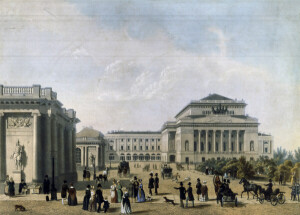
Nikolai Ferdinandovich Kittel was born in St. Petersburg around 1806, but was an Austrian citizen. His parents were from Vienna and had moved to Russia shortly before his birth. Nothing is known about the early years of his life, but in 1820 Nikolai began an apprenticeship with a violin maker who, according to the certificate of craftsmanship he received five years later, was named Nevall.
At the beginning of the nineteenth century, the Russians did not yet have a significant tradition of violin making. It was primarily foreign makers who brought their experience and expertise in this field to Russia. In Moscow, there were many French luthiers trained in Mirecourt, while in St. Petersburg, German luthiers trained in Markneukirchen dominated the scene. They lived and worked in close proximity to one another. Both inside and outside the violin-making workshops in St. Petersburg, the German makers met and exchanged knowledge. Nothing is known about the violin maker Nevall, under whom Nikolai trained, but it is very likely that he had a German background.
At the heart of St. Petersburg’s musical life were the music salons. These were gatherings hosted by the aristocracy for a wide range of guests: intellectuals, bohemians, writers, and musicians. A salon gathering took place almost daily, sometimes in small groups with a famous musician as a guest, but later larger gatherings were also organized with prominent guests, including even the Tsar. The number of guests at the music salons hosted by Mikhael Vilgorskii—Chief Justice of the Court, composer, and cellist—or his colleague Vladimir Odoevskii, who was a music theorist and composer, could reach as many as one hundred at a time. They often lasted until the early morning. The program was carefully curated; speakers, poets, and singers were invited, and the concerts were well prepared. Collectors of musical instruments displayed their latest acquisitions there. Many of the performing musicians were French. The violinist Pierre Rode, the Tsar’s First Soloist and author of the *Méthode de violon du Conservatoire*, was a frequent guest at the salons, as were his successors Charles Philip Lafont and François Adrien Boieldieu, who served as the Tsar’s court composer. The salon gatherings were extensively discussed and frequently reported on in the newspapers.
The certificate that Nikolai Kittel received from the guild in 1825 was an official document that allowed him to travel and requested that anyone who read it do everything in their power to assist him. Russian society was strongly based on traditional and even feudal values, in which guilds still held a powerful position. Without the guild’s permission, Nikolai would not have been able to settle anywhere in Russia.
Shortly after completing his training, Nikolai Kittel opened his own business. A year later, in 1827, he was appointed Instrument Maker for the Imperial Orchestra. The instruments he built from that year onward bore a label stating his title as Instrument Maker to the Imperial Orchestra. His work did not go unnoticed. Correspondence from the Kittel workshop and his appointment as a supplier of musical instruments to the St. Petersburg Court show that, around 1835, his clientele included the wealthy elite of St. Petersburg.
In keeping with his new status, Nikolai Kittel opened a shop on the very chic Nevsky Prospect around 1840. There, he presumably began hiring a few violin makers fairly soon after.
A year later, he married Carolina Louisa Tornau. Before the wedding, after much insistence, he received a dispensation because Carolina was Lutheran and the ceremony was to take place in the Catholic cathedral. His relationship with the St. Petersburg elite was such that one of their witnesses was the Tsar’s advisor, Jacob Lepunov. Two years later, their son Nicholas II was born, and in 1844, their daughter Catherine.
Nikolai Kittel’s clients came primarily from circles associated with musical salons. Studies by Azernikova and Palii indicate that, until the mid-nineteenth century, the salons in St. Petersburg were the primary venues where trends and musical movements emerged and where rising stars among musicians and composers were launched. Almost every day, a salon gathering took place somewhere in St. Petersburg. Visitors to the salons performed their own compositions, which were often well received. Ogarkova emphasizes the importance of music salons for enthusiasts and collectors of musical instruments.
One such collector and organizer of a major salon was Prince Alexei Fyodorovich Lvov, the violinist and composer of the official Russian national anthem. Together with his brother, he owned the most important collection of sheet music and string instruments in Russia. It included, among other items, three Stradivari violins, two Amatis, a Maggini, a Guarneri del Gesù, and many bows by great French makers. According to Lev Ginsburg, Vieuxtemps’s biographer, these instruments were regularly displayed and played during the salon gatherings hosted by Prince Lvov and his close friend and fellow collector, Prince Nikolai Golitsyn. Given that Nikolai Kittel was the only significant violin maker in St. Petersburg and maintained contacts with the court, he was almost certainly involved in the purchase and sale of instruments for these collectors.
Many famous musicians from all over Europe were invited to the St. Petersburg salons. Robert and Clara Schumann were among the guests, as were Liszt and Donizetti, Meyerbeer, and Vieuxtemps. Many were inspired by these salon gatherings to take up chamber music themselves. The wealthy amateur musicians who emerged from the circles surrounding the salons could afford expensive instruments, such as antique Italian violins and cellos and Nikolai Kittel’s bows.
In St. Petersburg, the elite was predominantly France-oriented. The lingua franca was French, and more French music was performed than German. Perhaps that was one of the reasons Nikolai Kittel went to Mirecourt, France, for his son’s education. In 1858, father and son traveled to this city, where the finest French violin makers and bow makers either came from or had received their training. Nikolai returned to St. Petersburg shortly thereafter, but his son spent two years studying under the violin maker Honoré Dérazey. Honoré had worked for nine years with Jean Baptiste Vuillaume in Paris and crafted instruments in the style of the great Cremonese masters. After returning to St. Petersburg, Nikolai II rejoined his father in the business.
In 1857, Grand Duchess Elena Pavlovna, the aunt of Tsar Alexander II, began working with Anton Rubinstein to establish an association that would provide music education in St. Petersburg. It became a new kind of musical organization: the “Société Musicale Russe.” Starting in 1859, Elena Pavlova offered the organization a home in her own residence, the Mikhailovsky Palace, where students could attend their lessons. Pierre Rode had returned to Paris, but his *Méthode de violon du Conservatoire* was used by the Société. Thanks in part to its high-quality education, this Société later became the St. Petersburg Conservatory.
The violinist Henri Vieuxtemps, who enjoyed the status of a global star, had by then settled in St. Petersburg following a tour of Europe. From 1846 to 1851, he served as a soloist at the Imperial Theater and was a welcome guest in the salons. He owned six bows made by Nikolai Kittel. Given that Vieuxtemps’s career gave him access to the finest violins and bows in the world, his choice to play with Kittel bows must have bolstered Nikolai’s reputation.
Gabriel, Grünke, and Chin have concluded that Nikolai Kittel employed four or five skilled craftsmen who were involved in the making of the Kittel bows, but it is not known which bows were made by Kittel himself. However, the work of the German maker Heinrich Knopf (1839–1875) has been definitively identified.
Until the mid-19th century, the Russian aristocracy was wealthy and competitive, vying with one another to acquire expensive Italian and French instruments. A collector strove to have at least one Stradivarius in his collection. In the second half of the century, the aristocracy’s wealth declined, and they were forced to sell many instruments. Charles-Eugène Gand, a connoisseur and dealer in Paris, offered the “St. Senoch” Stradivari cello from a collector in St. Petersburg, noting that it was the cello previously purchased by Kittel. And so many of Kittel’s bows also found their way to Europe. A significant portion of Kittel’s income must have come from this trade.
Nikolai Kittel died in 1868 at the age of 63. A large-format obituary appeared in St. Petersburg newspapers. After his death, Nikolai II sold the business and moved to Viborg, 130 kilometers from St. Petersburg, near the border with Lithuania. Since then, no more of his instruments or bows have been documented.
Although it is believed that others may still exist, only three string instruments by Kittel have survived. A cello from 1828, one from 1833 bearing the label “N. Kittel, Faiseur d’instruments pour les Theatres Imperiaux de St. Petersbourg, 1833,” and a cello without a date. The rest of his work consists of bows.
At first, Nikolai Kittel could not make a living solely from new instrument construction. In 1892, James Fleming described Kittel as “an excellent repairer, and also an outstanding bow maker.” Repairs and restoration likely constituted a significant portion of his income. It was only after his appointment to the court that this changed.
Count Nikolai Demidov, an advisor to the Tsar, had brought back a valuable Tourte bow from his diplomatic posting in Paris in 1813. Demidov was a welcome guest in the salons of St. Petersburg and was known for enjoying showing off his finds there. In 1837, the Tsar made an urgent request to Demidov to present this bow as a gift to the violinist Henri Vieuxtemps. Kittel had been in contact with him from early in his career. This Tourte bow is believed to have served as the foundation for the rest of Kittel’s work.
The earliest known bows can be dated to around 1830. They closely resemble Tourte bows, but are slightly sturdier. Soon after, he began a period during which he crafted very expensive bows. These often featured a gold ferrule and a tortoiseshell shaft. Production of these continued until the middle of the century. After 1850, fewer expensive bows appeared compared to the earlier period. From 1860 onward, when Knopf began working for him, virtually no bows made with precious materials have been found. The reason for this shift was that Russia lost the Crimean War and the Tsar abolished serfdom. The enormous costs associated with this were recouped from the aristocracy by imposing sky-high taxes on them.
Over a period of more than four decades, Kittel has had various collaborators. Yet his body of work over these forty years has been remarkably consistent. This seems to indicate that Kittel himself was responsible for sourcing the extravagant materials he used for his bows and for the detailed specifications he imposed on his employees.
Grünke and Gabriel compare Kittel’s business to that of Jean Baptiste Vuillaume in Paris. Vuillaume, like Kittel, was trained as a violin maker, yet his workshop produced high-quality bows—sometimes according to Vuillaume’s specifications—and branded with his name. Vuillaume employed some of the finest bow makers and dozens of violin makers. All the craftsmen who worked for Vuillaume produced their best work for him; before or after that, they almost never reached that level. This comparison refers to the influence Kittel had on the people who worked for him, not to his output. Kittel’s workshop was so small that it could accommodate no more than four employees and was in no way comparable to Vuillaume’s enormous workshops.
Not much is known about who his employees were. They must have been outstanding craftsmen; all authentic Kittel bows consistently meet an exceptionally high standard in terms of materials, craftsmanship, and playing qualities.
As early as 1892, Fleming assessed Kittel’s work as follows: “The bows made by this craftsman are roughly equivalent to those made by Tourte.”
The only bow maker known to have worked for Kittel was Carl Heinrich Knopf. He was trained by his uncle Christian Friedrich and made bows for the firms Bausch and Neuner before establishing himself as an independent maker in Berlin in 1868. Knopf presumably traveled back and forth between Berlin and St. Petersburg starting in 1865, but he also stayed in St. Petersburg for some time. The quality of his work for others varied, but for Kittel he used the finest materials and crafted superior bows.
The wood Kittel used was of exceptional quality. St. Petersburg was a port city where 1,600 metric tons of pernambuco and brazilwood were imported annually. A red dye was extracted from the wood for dyeing textiles, but it was not selected for use in making bow strings. Presumably, Kittel found only small quantities of suitable material there. He likely did not purchase whole logs or large pre-cut batches of wood, as his French and German colleagues often did. The wood from all the Kittel bows that have been examined comes from different trees. The fact that they were nevertheless of exceptionally high quality could mean that he personally selected small quantities from the St. Petersburg timber merchants, or that he had suppliers in France who sourced material on his behalf.
After his death, Kittel’s fame continued to spread throughout Europe and America thanks to great musicians who praised his bows. Leopold Auer was one of them. He was concertmaster of the Imperial Theater of St. Petersburg and a violin teacher at the St. Petersburg Conservatory. The Auer class at the conservatory served as a training ground for some of the most influential violinists of the time, including Heifetz, Milstein, and Elman. As the foremost violin pedagogue of his generation, Auer had a major influence on his students’ choice of instruments. Auer himself owned several Kittel bows. He gave one of them to his student Jascha Heifetz, who stated that he preferred the “Kittel” to all other bows he had ever played with. Heifetz presumably also recognized the delicacy of the Kittel bow, for he wrote, “Fortunately, I have many other bows, because my Kittel needs plenty of rest.” Heifetz’s overwhelming influence on violin playing in Europe further spread Kittel’s fame.
Both bows in the Kittel Musical Instrument Fund’s collection were examined by the team that compiled the definitive work on Nikolai Kittel. The cello bow was even selected to be depicted in full size in the book, along with only four other bows.
Grünke, Gabriel, Chin, Lim, 2011, The bows of Nikolai Ferdinandovich Kittel, Keulen.
Nicholas Kittel, The Russian Tourte , Arthur Herman, The Strad, juli 1931.
Universal Dictionary of Violin and Bow Makers , William Henley, 1957.
Fleming J.M., 1892, Fiddle Fancier's Guide.
Retford W.C., 1964, Bows and Bow Makers.
Whistler G, Nikolaus Ferder Kittel: The Russian Tourte, Music Journal, mei en september 1965.
Palii, E., 2008., The Salon as a Phenomenon of Culture in St Petersburg of the 19th Century: Traditions and Contemporaneity, Moskou.
Ogarkova N. A., 2020, The Music Salon in St Petersburg in the First Half of the 19th Century, St Petersburg.
Azernikova, I., 2011, The Salon Culture of the Russian Nobility in the First Half of the 19 century: Origins and Traditions, St Petersburg.
Tarisio, the Cozio archive, bezocht in 2021.

