Instrument

violin
Martin Leopold Widhalm
Nuremberg,
1783
played by
Noa Eyl
Noa Eyl

*1747 , Neurenberg †1808 , Neurenberg
Martin’s father had skillfully taken advantage of the situation. Outside the city walls, there were hardly any rules—not even those that violin makers within the walls were required to follow. After his exile, Leopold and Martin’s mother had started a workshop where they built instruments together based on models by Stainer, as well as by Leonhard Maussiell. Maussiell, a student of Sebastian Schelle (1676–1745), was widely renowned, and his violins were in high demand. He initiated several lawsuits against Leopold that dragged on for years but which Maussiell never won. In 1752, their second child, Gallus Ignatius, was born.
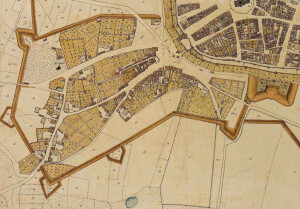
Detail from a cadastral map of Nuremberg from around 1800, showing Gostenhof clearly visible outside the city walls of Nuremberg. Wikimedia Commons
Nuremberg had a population of about 30,000, among whom “there was not a single person who knew nothing about music or who could not play an instrument.” For violin makers, work was plentiful but strictly regulated. Like Maussiell, Leopold had also learned the craft of violin making from Barbara Schelle’s father, Sebastian Schelle, who was a leading maker in Nuremberg of theorboes, lutes, a small number of violins, and the occasional double bass. Leopold also made these instruments, but most of the instruments that have survived are violins and cellos. He is now considered one of the finest German violin makers of his time. He did not receive this recognition during his lifetime in Nuremberg, as evidenced by his correspondence with members of the Vienna City Council. He had worked there for several years before moving to Nuremberg. When Martin was 10, his father began the correspondence, which lasted nearly two years and reveals that he wanted to return to Vienna because he was not receiving the recognition he deserved in Nuremberg. The letters also revealed that he was a well-educated man who believed he and his sons deserved a place among Vienna’s leading builders. Despite his two well-articulated pleas, he was not granted that privilege.

Jacob Stainer
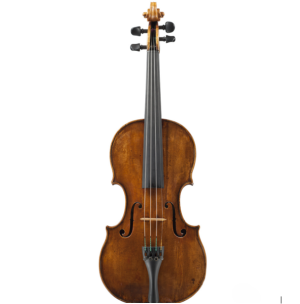
Martin, Gallus, and his brother Veit Anton—nine years his junior—learned the trade from their father. Martin built instruments in his father’s style and with comparable meticulousness, but used a slightly lower-quality varnish. In Leopold’s time, Jacob Stainer’s violins were all the rage throughout Europe. Martin Widhalm, too, modeled his violins after this luthier: highly arched and with similar characteristics. The popularity of instruments built in the Stainer style gradually declined throughout Europe during Martin’s career, and the flatter Italian models, such as those by Stradivari, came into vogue due to changing musical styles. Nevertheless, Martin continued to build primarily his old model until 1799. He cut the f-holes with great precision, but they were often not entirely symmetrical on the soundboard. Their width also varied. Gallus continued to work for Martin and his mother, while Veit Anton left Nuremberg to work for Buchstetter in Regensburg.
The quality of the wood Leopold had used—except for the first few years after their exile—was excellent: good tonewood for the top and beautifully figured maple for the rest. The same was true of Martin’s instruments. He gave all his instruments a “shading” effect, often leaving tool marks visible, just as he did in a few places on the inside. When Martin’s father died in 1776, his mother continued the business with Martin and his brother Gallus Ignatius (1752–1822). In 1781, Barbara passed away, and Martin continued the business together with Gallus. His father had a large output, and Martin was hardly inferior to him. Of Martin’s work, only violins, a few violas, and cellos are known.
The color ranges from orange-yellow to reddish-brown.
His label reads: “Leopold Widhalm, lute and violin maker in Nuremberg, made in 1784,” and he branded his initials on the inside.
Tarisio, Cozio Archive, accessed 2024.
Klaus M., 1996, Leopold Widhalm and Lute and Violin Making in Nuremberg in the 18th century.
Century. Institute for Art Technology and Conservation at the Germanisches Nationalmuseum, Frankfurt am Main.
Sebastian Kirsch, Klaus Martius, A Violin Maker “In Error”: Leopold Widhalm’s Attempt to Settle in Vienna.
Gustav O., “Vienna’s Trades, Guilds, and Manufactories at the Turn of the 17th to the 18th Century,” in: Wiener Geschichtsblätter 42 (1987).