Instrument

violin
Luigi (Aloisio) Marconcini
Ferrara,
1784
played by
Jessica Lukken
Jessica Lukken

*? , Ferrara †1791 , Ferrara
Luigi Marconcini was unable to study violin making in Ferrara, so he went to Cremona instead. Although there is no direct evidence to support this, Luigi Marconcini has gone down in history as a student of Omobono Stradivari, the sixth son of Antonio Stradivari of Cremona.
After completing his training, he returned briefly to Ferrara, where he worked for several years as an independent violin maker, but moved to Bologna in 1760.
It was a university town where the Accademia Filarmonica was renowned far beyond the country’s borders for its excellent training of musicians and for the many musical performances held there. One of the violin makers who worked for the Accademia was Giovanni Guidanti. Given that Luigi Marconcini’s instruments later bore a strong resemblance to those of Guidanti and that virtually no instruments labeled “Bologna” by him survive, it is believed that Luigi Marconcini worked for Giovanni Guidanti. Three years after his arrival in Bologna, the Teatro Comunale opened, where major Italian operas and concerts were performed immediately. This attracted many professional musicians to the city. Luigi Marconcini remained in Bologna for eight years, after which he returned to Ferrara, where he established himself as an independent violin maker.
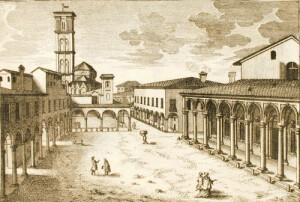
Piazza and exterior view of Bologna's new public theater, Pio Panfili
In 1774, Luigi Marconcini had a son, Giuseppe, who also trained as a violin maker in Cremona, most likely under Lorenzo Storioni. Giuseppe then returned to Ferrara, where he joined his father. Luigi had a second son, Gaetano, but beyond the fact that he also worked in Ferrara and that his instruments were of significantly lower quality than those of his father and brother, we know nothing else. Luigi’s last violin dates from 1791; that is also the year in which he died. After his death, Giuseppe continued his father’s business in Ferrara and also became one of the associates of the expert Count Cozio de Salabue. Luigi Marconcini is known to have made violins, cellos, theorboes, and one double bass.
He built arched violins, expertly finished, and used a hard, golden-yellow varnish.
His labels read: “Luigi Marconcini of Bologna, in the year 17..” and “Aloysius Marconcini of Ferrara, Made in Ferrara, in the year 17..”
Vannes, R., 1999, *Universal Dictionary of Instrument Makers*, Spa.
Giovanni Accornero, Ivan Epicoco, Eraldo Guerci (2005). Count Cozio of Salabue: Violin Making and Collecting in Piedmont.
Dilworth, John. “Count Ignazio Alessandro Cozio di Salabue.”
"Pietro Giovanni Mantegazza." Brompton's Reference Library.
Bologna State Archives, visited in 2023.
Tarizio, Cozio Archive, accessed in 2023.