Instrument

double bass
Lockey Hill
London,
± 1790
played by
Jorge Hernández Hernández
Jorge Hernández Hernández

*1756 , Londen †1797 , Londen
London fell under the spell of Italian opera. Countless Italians flocked to London, allowing musicians to become familiar with Italian instruments. Lockey, too, gradually changed his style in response to shifting tastes: it became more Italian.
Lockey Hill worked for several violin makers in London, including Longman & Broderip. When they went bankrupt, Lockey lost a significant portion of his income. Shortly thereafter, he was caught stealing a horse, after which he was hanged by order of the judge.
His son, Henry Lockey Hill, became an outstanding builder and carried on the family tradition. It was his sons, in turn, who further developed the business into the renowned firm W.E. Hill & Sons that it is today.
As early as 1874, the Hill firm was described by the violinist and connoisseur Henley as “the most reliable in the entire world,” and since then, the Hill dynasty has grown to become nothing short of an institution in its field. Despite the fact that history has proven some of the Hills’ bold claims to be inaccurate, Hill remains virtually untouchable even among contemporary experts.
In one of his diaries, Samuel Pypes wrote in 1660 that there was a violin maker working in London named Joseph Hill. Historians generally consider Pypes’ diaries to be a reliable source, but nothing more is known about this first Joseph Hill beyond that mention in his diaries. Vannes takes Pypes seriously and refers to this violin maker as Joseph Hill I, but many others maintain that the Joseph Hill born in 1715 is the true progenitor of the Hill dynasty.
Thanks to the fact that London’s archives were kept more meticulously around 1700 than in earlier times, more is known about this Joseph Hill. He was born in 1715. His earliest known label, from 1753, states that he worked on “High Holborn” in London, but he had already moved to London from his hometown of Alvechurch in 1746. There, he opened a workshop on Piccadilly called “Ye Harp and Hautboy.”
Three years after Joseph had settled in “High Holborn,” Lockey Hill was born. Joseph already had three sons at that time, the oldest of whom was eleven. A year after Lockey was born, another son was born. He was the only one who did not become a violin maker.
After moving several times, Joseph Hill settled permanently in Haymarket in 1762, where he named his workshop “at the sign of the Harp and Flute.” Joseph Hill trained his four sons there.
For a violin maker, Haymarket was an ideal location. It was situated in the West End, which had been London’s premier entertainment district since the mid-seventeenth century. The “King’s Theatre” was also located on Haymarket. Between 1710 and 1745, most of George Frederic Handel’s operas and several of his oratorios premiered at this theater. In addition, the King’s Theatre staged 112 performances of various operas over the course of 22 seasons.
Haymarket, where Hill’s business was located, was not a cheap spot, because it was one of the few streets in London that was paved. And the tenants and merchants had to pay a tax for that.
A few years later, a fire destroyed several wooden houses in Haymarket, also razing Hill’s workshop. As a result, all of his instruments and part of his supply of wood were lost. He rebuilt the workshop and operated it under the name “Joseph Hill & Sons” from 1773 to 1776. He continued to work there alone until 1780. His grandson, Henry Lockey Hill, would say of him: “Although his instruments were not of the highest caliber, his cellos and double basses were rightly highly regarded.”
In 1772, Lockey Hill married Joanna Wish, and in 1774 they had their first child: Henry Lockey. In the period between his marriage and the birth of his son, the recurring disagreements with his father had escalated to such an extent that Lockey left “Hill and Sons.” He was the last to do so; his other brothers had already struck out on their own.
Lockey moved to Ludgate Hill and began working there for James Longman. Longman was not a violin maker, but an instrument dealer who had started his business in 1767 on Cheapside, just a few streets away from Ludgate Hill. Cheapside, which had previously been populated mainly by merchants, was rapidly emerging and was on the verge of becoming one of London’s most important streets. Since he had started his business, Longman had gone through several partners. In 1775, a year after Lockey began working for him, he entered into a new partnership—this time with Francis Broderip, a publisher of music books and sheet music. This partnership proved very successful and lasted nearly twenty years.
The disagreements with his father seemed to have been temporarily resolved around the time Lockey and Joanna had their second son. He was born in late 1776 and was named Joseph at his baptism, which took place at St. Martin’s in Ludgate.
Longman & Broderip quickly grew into a leading firm in musical instruments, music publishing, and the trade in antique instruments. Only pianos were built in their workshop; their stringed instruments were supplied by various violin makers who worked independently or for other firms. These makers included Henry Jay, David and James Furber, Benjamin Banks, and Lockey Hill. Even after the merger, Lockey continued to build instruments for Longman & Broderip. Business was exceptionally good, for in 1782 they were able to move to Haymarket, close to Joseph Hill, where Lockey had started out.
Lockey’s brother, Joseph II, had continued their father’s business—which their father had closed in 1780—at the same location. Joseph Hill I died in 1784. When his will was read, it turned out that he had disinherited Lockey.
Starting in 1770, the popularity of Italian opera grew rapidly in London. The theaters were packed, and the elite also organized many private performances to which sometimes hundreds of people were invited. This preference also brought Italian instruments to the attention of London musicians, and they became extremely popular. When the Italian violin maker Vincenzo Panormo arrived in London in 1772, there were already hundreds of Italians working in the city. Panormo settled in Soho and offered his instruments to London merchants. Over the years, his influence on violin making in London grew to such an extent that no violin maker in London could ignore him.
It is more than likely that Lockey Hill saw Parnormo’s instruments. The Italian advertised in London newspapers and enjoyed immediate, enormous success with his instruments. His stay in London did not last long. In 1778, virulent anti-Catholic violence flared up in the city, and Panormo was forced to leave England. Panormo’s Italian instruments, however, had permanently supplanted the models of Amati and Stainer, which had been in common use for decades. Like most English makers, Lockey Hill later adopted the Italian style as well.
The firm Longman & Broderip, for which Lockey Hill built his instruments, went bankrupt in 1795 after twenty years in business. That same year, Lockey was caught stealing a horse. Because of that offense, he had to stand trial at the Old Bailey in December 1795. After a witness testified under oath that Lockey had committed the same offense before, the judge held this heavily against him. After being found guilty, Lockey Hill was sentenced to death and hanged in 1797.
The family tried to keep this scandal out of their family history and announced that Lockey had left London in 1795. According to their account, Lockey had died in 1810—contrary to what actually happened.
Lockey’s son, Henry Lockey II Hill (1774–1835), trained under John Betts—whose reputation extended far beyond England—and went on to become an outstanding violin maker. While working with Betts, he had the opportunity to study Stradivari’s work in depth and built his own instruments with the utmost care in the style of the Italian master. Henry Lockey’s work is generally regarded as slightly superior to that of his father. Henry Lockey Hill took over the family business in 1810. In turn, he passed the business on to his sons.
Lockey was a highly prolific maker of mainly cellos, many double basses, and a few violins, but the exact number of instruments he built is unknown. He supplied most of his instruments to London dealers and makers, who affixed their own brand marks or labels to them.
Especially in the beginning, his work closely resembled that of his father and teacher. Later, his work could be distinguished from his father’s because Lockey used a thinner varnish, drew the edge inlays on many instruments rather than carving them into the wood, and had a rougher finish. At first, he drew rather loosely on Stainer or Amati, makers whose work was in vogue throughout Europe. Dilworth characterizes Lockey’s copies of these makers as rather “workmanlike” and unambitious; later, this changed, and Lockey Hill worked more meticulously and in the Italian style.
Like his father, he built many small-sized cellos from attractive, beautifully figured wood, which he finished with a honey-colored varnish. For a small model, the sound is remarkably powerful. A number of double basses by Lockey Hill are known, with the later instruments showing Italian influences. For his basses, he used a somewhat richer, reddish-brown varnish with a higher gloss than for his cellos.
Its label reads: “L. Hill, violin & cello maker, ‘Boro London’”
Lockey Hill lived his entire life in central London, on the north bank of the Thames. He worked in Cheapside from 1774 to 1777, in the Shoreditch neighborhood from 1778 to 1780, and then in Islington.
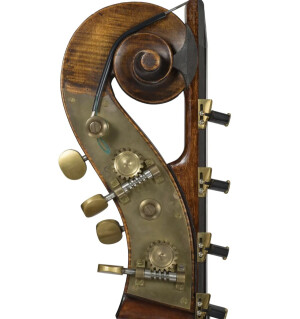
The double bass in the collection of the Musical Instrument Fund dates from around 1790; it is a fine example of the instruments he built during his final, most Italian-influenced period.
Baker T, Dilworth T & Fairfax A., 2001 The British Violin, Londen.
Carlson B., Schmitt J. F., Moroder I., Leonhard F., Italian & French Violin Makers - Vol. 1, 2001, Keulen.
Harrison R., 1998, The Panormo Family, The Troubadour.
Vannes, R., 1999, *Universal Dictionary of Instrument Makers*, Spa.
Westbrook J., 2012, Louis Panormo and His Contemporaries, Cambridge.
Tarisio, Cozio Archive, accessed 2021.
The Old Bailey Archives, visited in 2021.
Tarizio, the Cozio archive, Panormo by Anthony Fairfax. 2021.