Instrument

violin
Leonhard Maussiell
Nuremberg,
± 1730
played by
Esther de Bruijn
Esther de Bruijn

*1685 , Neurenberg †1760 , Neurenberg
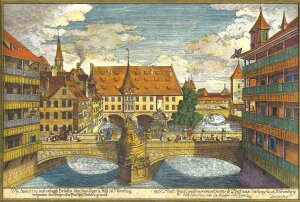
Leonhard Maussiell presumably learned his craft in the Austrian Tyrol and in Italy, continued to work in those countries for several years, and returned to his hometown around 1708. There he worked briefly with Sebastian Schelle (1676–1745), one of the few but prominent instrument makers in the city who crafted theorboes, lutes, a small number of violins, and the occasional double bass. In the first year after Leonhard Maussiell’s return, he made pochettes (narrow, elongated pocket violins) and viola d’amores, viola da gambas, and later he built many violins, all modeled after Tecchler and Stainer, with high arches and short corners. They are beautifully finished, featuring a dark reddish-brown varnish over a golden-yellow base. A distinctive feature is the edge inlay he often made from whalebone. He adorned his viola d’amore with a small female head as a “curl.”
Nuremberg, ca. 1730
In 1744, the violin maker Leopold Widhalm came to Nuremberg. He worked for Schelle for some time, entered into a forbidden relationship with Schelle’s daughter, and was banished from the city. There, he did not consider himself bound by the rules and agreements that the guild had imposed on makers within the city walls. He copied Leonhard Maussiell’s most successful model, prompting Maussiell to file a lawsuit against Widhalm. Maussiell lost time and again, causing the case to drag on for years.
“The imperial eagle brand suggests that he also supplied the court.”
Leonhard Maussiell presumably supplied instruments to the imperial court orchestra, as he was permitted to brand his instruments with the imperial double eagle, surrounded by his initials. Maussiell, along with Widhalm, is considered one of Nuremberg’s finest instrument makers.
His body of work consists of pochettes, lutes, violas d'amore, violas da gamba, cellos, and violins.
Its label is handwritten and reads: “Leonhardus Maussiell me fecit Nurmberg An. 17..”
Tarisio, Cozio Archive, accessed 2023
Klaus M., 1996, Leopold Widhalm and Lute and Violin Making in Nuremberg in the 18th century.
Century. Institute for Art Technology and Conservation at the Germanisches Nationalmuseum, Frankfurt am Main
Sebastian Kirsch, Klaus Martius, A Violin Maker in “Error”: Leopold Widhalm’s Application to Settle in Vienna.
Bavarian State Library Online, accessed in 2023
Germanisches Nationalmuseum, visited in 2023
The University of Leipzig's Musician Profiling Program was visited in 2023
German Biographical Dictionary accessed in 2023