Instrument

cello bow
Jules Fétique
Paris,
1920 - 1934
played by
Jobine Siekman
Jobine Siekman

*1875 , Mirecourt †1951 , Parijs
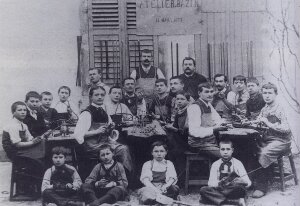
Jules was unable to complete his training with Émile Miquel. His mentor left Mirecourt in 1891 and settled in Nancy. Out of necessity, Jules had to find another master craftsman with whom he could continue his training. He completed it in one year under Charles Nicolas Bazin. Victor had also preceded Jules in this step in his career.
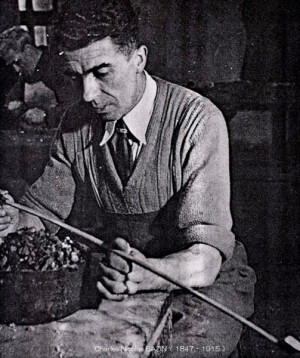
Charles Nicolas Bazin
Bazin was a charismatic teacher who ran a large workshop where he trained young people. He inspired them to continue developing their skills and to experiment until they had found their own path. Even after completing his training, Jules remained in Mirecourt for several more years and presumably also made bows for others, but he spent most of his time with Bazin.
Jules married Marie Therrier in 1897, but they remained childless. Competition among violin makers and bow makers was fierce in Mirecourt; for many skilled craftsmen—whether violin makers or bow makers—their future lay in Paris rather than in Mirecourt.
However, it wasn’t until 1916 that Jules left for the French capital. His wife likely accompanied him, but she is not listed in the Parisian archives. This was the third time he had followed Victor. Victor had already moved to Paris in 1901 with his wife and two young children. There, he had begun working at Caressa et Français, one of the most prestigious fashion houses in Paris, located next to the Paris Conservatoire de Musique. The firm carried on the legacy of Gand and Bernardel—and thus also that of Lupot, who had been one of France’s greatest in the field up to that point. The two owners, Henri Français and Albert Caressa, were keenly aware of their responsibility; they produced instruments of the highest conceivable quality and were also internationally renowned for their exceptional collection of stringed instruments and bows. Victor witnessed the company’s early days firsthand, as he remained there for 12 years, while Jules oversaw its expansion. Upon arriving in Paris, Jules did not immediately join Caressa et Français but worked for a year and a half with one of the finest independent bow makers of the time: Eugène Sartory.

Caressa & Français Catalog
Jules’ next employer, Henri Français, was a violin maker, and Albert Caressa was an expert on antique instruments and the company’s entrepreneur. Both owners had by then earned the coveted title “Luthier du Conservatoire de Musique” and later also those of “Luthiers de l’Opéra” and “Experts du Civil Tribunal de la Seine.” Jules became one of the 15 violin makers and bow makers employed by them; all were among the best in their field. Jules’ colleagues in bow making were Claude Thomassin and André Richaume. Although Jules joined Caressa et Français, he continued to make bows for Eugène Sartory for many years and assisted him in his workshop whenever necessary.
Thanks to their impeccable reputation and strong connections, Caressa and Français steered the company through the difficult period leading up to World War I. However, this came at the cost of having to downsize the company. Victor was laid off in 1913 and started his own business, but he continued to make canes for the Maison.
Jules was incredibly productive. He helped not only Sartory but also Victor during the early years of Victor’s initially difficult start as an independent bow maker. It had been a modest start, but beginning in 1915, due to increased demand, Victor and Jules together produced a large number of bows.
Because of Victor’s efforts to make his drumsticks as slender as possible, they sometimes became too thin and broke. Musicians became reluctant to play with his bows. On top of that, in his ambition to build a large and impressive company, Victor’s entrepreneurial drive had taken precedence in recent years, and he had become more casual in his choice of employees; they ensured production, but not always quality. The tide turned when Jules made a large number of high-quality sticks for him that were less fragile, as did Albert Thomassin and Louis Morizot.
In 1921, Jules’s wife died childless, and he married for the second time that same year. He would have no children with his new wife either. His parents attended their wedding, but his mother died a few months later.
In 1927, Jules received the prestigious title of “Meilleur ouvrier de France” for the exceptionally high quality and consistency of his work. Victor had also been awarded that title six years earlier.
Victor died in 1933. It was not Jules, but Victor’s son who carried on the business. Jules remained employed at Caressa et Français until, after 18 years, he was laid off in 1934 due to the economic crisis that was sweeping across Europe. The violin maker André Paul Dugad was also unable to remain at the Maison. On Rue de Moscou, Jules and André Paul started their own business, which would remain in operation until 1950.

André Devambez, “The 1937 World’s Fair as Seen from the Eiffel Tower,” oil on canvas (1937).
In 1937, Jules entered several bows in the Exposition Universelle in Paris, which was themed “Arts et techniques appliqués à la vie moderne.” Fifty-two countries participated, and the exhibition attracted 32 million visitors. The entry by Caressa et Français won gold, and Jules received a “Diplôme d’Honneur.”
Jules stopped working in 1950 and moved to Gagny-les-Abbesse, where he died in 1951. Along with Eugene Sartory, he is considered one of the finest Parisian cane makers of the early twentieth century.

Eugène Sartory
Jules Fétique’s body of work can be divided into three periods. The first was when he worked for C.N. Bazin, for whom he made slender, elegant canes modeled after Bazin’s own designs. In the second period—which spanned nearly his entire career—he would successfully strive to emulate Eugène Sartory. In the final period, he rediscovered the then-forgotten “school” of Peccatte: a coarser, almost square ferrule with a matching shank.
Intended as a compliment, Jules Fétiques’ bows were also known as “the Sartory’s for the poor”! Many musicians considered them superbly playable bows that deserved an honorable mention. Today, Jules Fétiques’ bows are extremely valuable.
From the moment he started his own business, he gradually moved away from his familiar Sartory model and focused more on that of Dominique Peccatte. As a result, his canes also became somewhat sturdier than his Sartory models. Experts Millant and Raffin see this as the emergence of a new Parisian “school.”
Virtually all of Jules Fétique’s canes are round and made of dark brown-red pernambuco. His brand marks were: J. FETIQUE; J. FETIQUE PARIS; and JULES FETIQUE PARIS EXP’on 1937.
In addition to making canes for Victor and Caressa et Français, Jules also made them for, among others: P. Blancard, Maucotel et Dechamps, C.F. Brugère, and Eugène Sartory.
Millant, B., Raffin, J.F., (2000) *L'Archet: French Bowmakers, 1750–1950*. Paris.
Vatelot, E. (1976), *Les Archets Français*. Nancy.
Jacquot, A., 1912, La Lutherie Lorraine et Française, Paris.
Henley W., 1959 Universal Dictionary of Violin and Bow Makers. Amati Publications. London.
Vannes, R., 1999, *Universal Dictionary of Instrument Makers*, Spa.
Tarisio; the Cozio archives, accessed in 2024.
Geneanet, accessed in 2024.
Archives Nationales de France, accessed in 2024.