Instrument

violin bow
Joseph Arthur Vigneron
Paris,
± 1895
played by
Sjaan Oomen
Sjaan Oomen

*1851 , Mirecourt †1905 , Maisons-Alfort (Parijs)
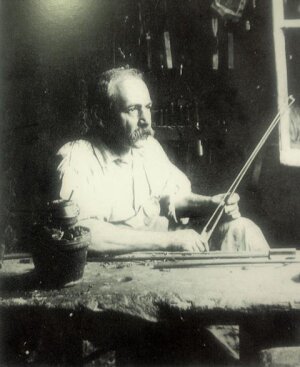
A year before his stepfather’s death, Joseph Arthur married Marguerite Hector, a relative of one of France’s greatest violin and bow makers, Jean-Baptiste Vuillaume. A marriage between two families of violin and/or bow makers was certainly not unusual in Mirecourt. However, in their case, it did not lead to the expected family alliance, as Marguerite died childless three years after their marriage. A year later, Joseph remarried and had three children, one of whom, his son André, would also become a bow maker.
After Claude Husson’s death, he found work in 1872 with Jean Joseph Martin. Martin had just returned from his time with Jean-Baptiste Vuillaume; he was penniless but deeply passionate. The highly skilled Joseph was therefore very welcome in Jean Martin’s fledgling workshop. Together, they initially made many bows inspired by Vuillaume; later, they each developed their own models. After a short time, Martin established a cooperative to market the bows. It supplied major firms such as Mennesson and Thibouville-Lamy. The finest bows sold through this cooperative were crafted by Joseph Vigneron. Martin branded these bows with the name “J. Guarini.” Joseph continued to work for Martin until shortly before André’s birth in 1881. Due to unfortunate circumstances, Martin went bankrupt, and Vigneron had to find a new job.
Like most bow makers from Mirecourt, he sought work in Paris. He moved there with his family in 1881. He soon found a job with Eugène Gand and Gustave Bernardel. He was still working for them when they founded their legendary firm, “Gand & Bernardel.” It quickly became one of the most important workshops in Paris, not only because it was known for the nearly one thousand high-quality instruments and bows it produced, but certainly also because of the large number of outstanding violin and bow makers who were trained there.
In 1888, Vigneron started his own business in Paris. His son André began working with him and would continue to do so until Joseph Arthur’s death. Over the years, their collaboration grew ever closer. By the final years before the turn of the century, their collaboration had reached such a level that there was hardly any difference between Joseph Arthur’s and André’s bow-making styles. Joseph Arthur Vigneron died in 1905.
At first, there was virtually no visible difference between the bows made by the master luthier Claude Husson and those made by his apprentice Joseph Vigneron. It was customary in Mirecourt for young makers not yet to brand their own bows with their own mark. Recognizable bows by Vigneron without a brand mark are therefore often from his earliest period. Experts believe that during his time working for Martin and Gand & Bernardel, the bow model he made still bore some resemblance to Bazin’s: round and with a bell-shaped head. The period that followed was one in which the Parisian school of Vuillaume can once again be seen in his work.
Vigneron, together with Lucien Capet, a professor at the Paris Conservatory, researched new bowing techniques for the violin. The bow he developed based on these new insights featured a triangular shaft. In addition to his own brand mark, he stamped it with the inscription “Modèle Lucien Capet.”
Joseph Arthur Vigneron was a bow maker with a sure hand; he had a reputation for being able to make one bow a day. That may explain why he was able to produce so many bows during his relatively short time as an independent bow maker.
Experts generally agree that the canes he made during his final five years lack a certain refinement. Decorative elements such as tortoiseshell and ivory are entirely absent from his work; functionality was always his top priority. Joseph Vigneron used two brand marks: “A. Vigneron” and “A. Vigneron à Paris.” He is said to have marked most of his canes with the latter.
Vigneron left behind countless excellent bows. He was likely the last Parisian bowmaker to craft his bows using traditional techniques, and the first to attempt to combine those techniques with new insights gained through scientific experimentation.
After his death in 1905, André succeeded him and developed his own model. He would continue to use his father’s brand mark for a long time. It was not until after 1910 that he began stamping his bows with his own name and assigning each bow an individual number.
In addition to his work for Bernardel and Gand, Joseph Arthur Vigneron also made bows for Nestor Audinot, Emile Boulangeot, Chanot & Chardon, Collin-Mézin, and Paul Jombar.
Marie Louis Piernot worked for him from 1900 to 1905. His influence can be seen in the triangular masts used by various shipbuilders.
The Vigneron bow in the collection of The Netherlands Musical Instrument Foundation is a magnificent example of the work he produced during his later period, when he supplied bows to the discerning Gand & Bernandel firm. Those were very good bows, but he sold his best ones under his own name. The rounded back of this violin bow is characteristic of Husson, Vigneron, Piernot, Poirson, and some later imitators such as Morizot.
Millant, B., Raffin, J.F., 2000, *L'Archet: French Bowmakers, 1750–1950*. Paris.
Tarisio.com, Cozio archive. Accessed 2019.
Vatelot, E., 1976, *Les Archets Français*, Nancy.
Henley W., 1969. Universal Dictionary of Violin & Bow Makers. Brighton; England.