Instrument

violin
Johannes Ernst Bachmann
Groningen,
1904
played by
Tiara Kobald
Tiara Kobald

*1851 , Amsterdam †1916 , Groningen
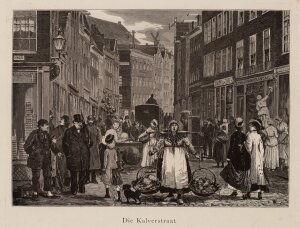
Violin making in Amsterdam had been a thriving and highly significant industry until the end of the eighteenth century, but by the time his father had settled in the city, virtually nothing remained of it. In 1879, Brahms described the members of the Concertgebouw Orchestra as “nice people, but poor musicians.” Nor was he satisfied with their instruments. However, string quartet playing among amateurs had been at a high level since 1825, and the Society for the Promotion of Music enjoyed great success in Amsterdam. In general, the Netherlands was German-oriented in the field of music. Amsterdam’s musical life closely followed the German model, with German immigrants who had come here as musicians or composers. In Amsterdam, there seemed to be plenty of room for new violin makers.
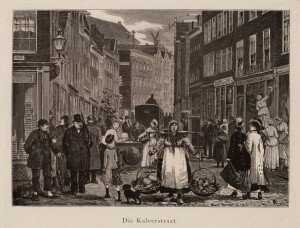
Kalverstraat, second half of the 19th century. Photo: Amsterdam City Archives.
As far as violin making was concerned, the arrival of the French violin maker Louis Bernardel promised to usher in a new era. He was born in Mirecourt and had moved to Paris, where his brother Sébastien Bernardel—from whom he had learned the craft—was a household name. Bernardel had opened a shop on Kalverstraat, near where Johannes Bachmann would later run a shop for several years. Johannes Bachmann undoubtedly knew Louis Bernardel. Bernardel had built only a very small number of instruments and had already passed away in 1847. However, he had trained Johan and Gerrit Kok, who were appointed “Luthiers de la Conservatoire d’Amsterdam” beginning in 1848. Johannes Bachmann was the only person in Amsterdam who built double basses.
Just across the street, where the Bachmann family’s home stood, Warmoesstraat had fallen into disrepair within a few years. “A constant, tremendous din that went on and on, but even worse were the rowdy, drunken men and women—of the most vulgar sort—who came out of the bars. And until two o’clock in the morning, sleep was out of the question.” On top of that, unemployment in Amsterdam had risen dramatically, leading to riots and violence in the streets. For Johannes Ernst, this was not a conducive environment for his ambitions to become a violin maker.
He did learn the basics of the trade from his father, but then left for Germany to train with various violin makers, with whom he also continued to work. In 1878, he returned to the Netherlands. In Sneek, he started his own business, only to move to Groningen a year later, where he registered as a “musical instrument maker.” His business was registered as “Algemeene Muziek-Instrument-Piano- en Orgelhandel.”

Marriage Certificate for the marriage between Johannes Ernst Bachmann and Hillechien Wierenga
There was not yet a violin maker in Groningen. And there was a need for one. The Groningen social club “De Harmonie” had nearly a thousand members at the time and had its own concert hall with excellent acoustics, where musical performances were held weekly. By 1862, it had already established its own orchestra association, which would later become the Northern Philharmonic Orchestra. Johannes Ernst repaired string instruments, built a few for the orchestra members, and also dealt in other musical instruments. He set up shop successively on Zuiderdiep, Ebbingestraat, Herestraat, and finally on the upscale Oude Boteringestraat, not far from the “de Harmonie” concert hall.
Shortly before his father’s death in 1886, he married Hillechien Wierenga in Groningen. Two years later, they had a daughter. His father was already deceased by the time of the wedding. His wife died in 1907. She was able to continue his work until 1916, the year he himself passed away. Feiko Jacob Bouman took over the business.
Johannes Ernst built instruments modeled after those of Stradivari, Maggini, Da Salò, and Stainer.
Its label read: Johannes Ernst Bachmann, fecit in Groningen, 18..
Amsterdam City Archives, visited in 2024
Bolink, J., et al., 1999, 400 Years of Violin Making in the Netherlands, NGV, Amsterdam
Balfoort, D. J., 1931, *Dutch Violin Makers*, H.J. Paris, Amsterdam
Möller M. & Zn, 1955, Violinmakers of the Low Countries, Amsterdam
Vannes, R., 1979, Dictionary of Instrument Makers, 1979, Brussels
Jalovec, K., 1965, Encyclopedia of Violin Making, Prague
Tarisio, Cozio Archive, accessed 2024
Geneanet, accessed in 2024

