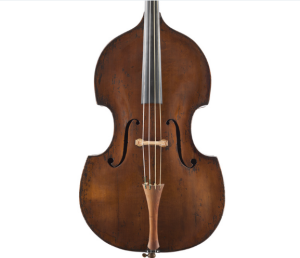
Instrument

double bass
Johannes Bachmann
Amsterdam,
1872
played by
Nienke Kosters
Nienke Kosters

*1816 , Niederhorn †1886 , Amsterdam
Louis Bernardel had established himself at Kalverstraat 40 in 1836 and had become by far the most important violin maker in Amsterdam at that time; he was the teacher of, among others, the brothers Johan and Gerrit Kok. Johannes Bachmann also set up shop on Kalverstraat. There seems to be little doubt that Johannes Bachmann knew Louis Bernardel; starting in 1845, Bachmann’s shop was located not far from Bernardel’s, at 148 Kalverstraat. Bernardel, however, died as early as 1847 at the age of 42 and was succeeded by Joseph Grandjon, who closed the business six months later and left for France. The Kok brothers, who had been trained by Bernardel, were appointed “Luthiers de la Conservatoire d’Amsterdam” a year later. For many years afterward, Johannes Bachmann was the only violin maker in Amsterdam who specialized in double basses.
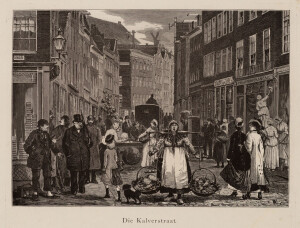
Kalverstraat, second half of the 19th century. Photo: Amsterdam City Archives
A year after Louis Bernardel’s death, Johannes Bachmann moved to Langebrugsteeg 357 and then to Oudezijds Achterburgwal 248. His permanent workshop was on Warmoesstraat, at the time a rather distinguished street with “upscale businesses,” including two piano shops, three theaters, a securities firm, and the “Magasin de Paris.” He moved into the former premises of the piano builder and music dealer Christiaan Bagge, where he built and repaired a few violins and later built many double basses.
In 1851, their first child, Johannes Ernst, was born. He first learned the trade from his father, but then left for Germany to train with various instrument makers. In 1878, he returned to the Netherlands and opened his own workshop in Sneek, only to move to Groningen a year later, where he registered as a “musical instrument maker.” He set up shop successively on Zuiderdiep, Ebbingestraat, Herestraat, and finally on the upscale Oude Boteringenstraat. His business was named “Algemeene Muziek-Instrument-Piano- en Orgelhandel.” Shortly before his father’s death in 1886, Johannes Ernst got married in Groningen. Johannes was not present at the wedding.

The flat back of the double bass from the collection of the Musical Instrument Fund
After Johannes Bachmann’s death, there was no successor, and the business ceased to exist. Balfoort and Vannes believe that Johannes Bachmann was particularly valued for his fine four-string double basses, built in the viola da gamba style with fully arched tops and flat backs made of flamed maple. Many double basses from that period featured painted edge inlays; Bachmann’s, however, had delicate three-part inlays similar to those found on a violin or cello. The refined shape and carving of the f-holes also attest to his great craftsmanship.
Johannes Bachmann usually used a brown-yellow varnish on his basses. His label read: J. Bachmann,
Amsterdam City Archives, visited in 2024
Bolink, J., et al., 1999, 400 Years of Violin Making in the Netherlands, NGV, Amsterdam
D.J. Balfoort, 1931 *Dutch Violin Makers*, H.J. Paris, Amsterdam
Möller M. & Zn, 1955, Violinmakers of the Low Countries, Amsterdam
Vannes, R. 1979, *Dictionary of Instrument Makers*, 1979, Brussels
Jalovec, K. 1965, Encyclopedia of Violin Making, Prague
Tarisio, Cozio Archive, accessed 2024
Geneanet, accessed in 2024