Instrument
cello bow
Jan Willem Lindeman
Amsterdam,
± 1950
played by
Fabius Beelaerts van Blokland
Fabius Beelaerts van Blokland

*1890 , Amsterdam †1971 , Amsterdam
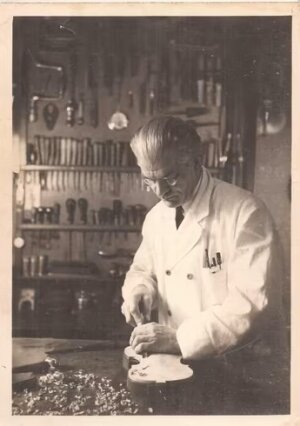
In the early twentieth century, musicians’ attention and interest were focused more on French instruments than on Dutch ones. As a result, the number of luthiers building new instruments in the Netherlands remained limited. However, the rise of the music scene—driven by both talented amateurs and professional musicians—created a need for violin makers who could restore instruments. The Concertgebouw Orchestra made a name for itself with its unique sound, and many musicians—including those outside the orchestra—sought instruments that resembled it. Many old instruments were imported from Italy and France, but they were not always in good condition. Jan Willem Lindeman was highly skilled at restoring them.
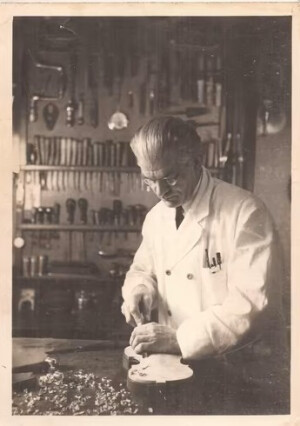
Jan W. Lindeman in his workshop. Photo: anonymous
He himself built only a limited number of instruments. His cellos were highly praised. He built one of them in 1931 for Henk van Wezel, who had been a cellist with the Concertgebouw Orchestra since 1923. Van Wezel played the instrument for many years, including as a soloist with the orchestra. Under Mengelberg, his performance and the sound of the instrument led to a series of letters of recommendation for Lindeman’s cellos, including ones from Caspar Cassadó, Maurice Marechal, and Bruno Walter.
To Mr. J. Lindeman, with my heartfelt congratulations on his beautiful instrument, which possesses all the qualities of the great Italian basses—clarity, volume, and flexibility. A luthier can be proud of such a “creation”! Warm regards, Maurice Maréchal
Bruno Walter, conductor of the Concertgebouw Orchestra, also praised this instrument in a letter from 1935.
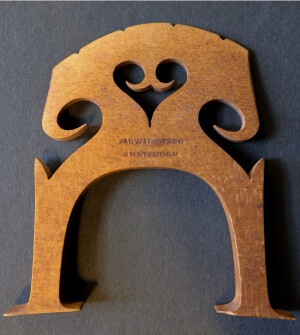
A Cello Bow, Jan W. Lindeman

The "Gould" violin, Antonio Stradivari, 1693. Collection of the Metropolitan Museum of Art
In 1932, his son Fred was born. Fred also became a violin maker. He learned the trade from his father, officially joined his father’s business in 1952, and became a partner five years later. Father and son became interested in the emerging trend of historically informed performance and began to specialize in restoring modernized string instruments to their original Baroque condition. They came into contact with Sigiswald Kuijken, who played an important role in the authenticity movement. Beginning in the mid-1960s, this violinist introduced the authentic playing style for the Baroque violin, which did not involve clamping the instrument under the chin.
When Jan Willem died in 1971, Fred took over the business. He became particularly well-known as an expert in Baroque architecture. Among Lindeman’s most remarkable achievements was the restoration of the “Gould” Stradivari for the Metropolitan Museum of Art in New York, which he undertook four years after his father’s death at the recommendation of Sigiswald Kuijken. The “Gould” is still used by Baroque violinists for concerts at the Met.
The small number of violins that Jan Willem Lindeman built were meticulously crafted and finished with a varnish that ranged from yellow to red. His bows were usually octagonal and were also meticulously crafted and finished.
Dutch Association of Violin and Bow Makers, 400 Years of Violin Making in the Netherlands, edited by Johan Giskes et al., 1999
Willem Mengelberg Foundation; Willem Mengelberg and His Time, No. 125, 2018
The Strad; 2017, Dutch luthier Lindeman has died aged 84, Londen.
Letter from Fritz Busch to Jan Lindeman, 1932, private collection.
Archive, portrait gallery, Royal Concertgebouw Orchestra Retirees Association, accessed 2025