Instrument
viola bow
Hermann Richard Pfretzschner
Markneukirchen,
± 1900
played by
Ivan Saez Schwartz
Ivan Saez Schwartz

*1857 , Markneukirchen †1921 , Siebenbrunn
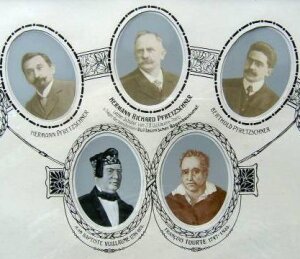
Hermann’s father, Carl, had a small workshop where he made bows for other companies. Although he was registered as a bow maker, no bows bearing his mark are known to exist. After school, Hermann learned the trade from his father and also took violin lessons. To further his education, he went to Paris in 1872—when he was just sixteen—where he was hired as an apprentice bow maker in Vuillaume’s large workshop. A strict regimen prevailed there; no one spoke while working. Jean-Baptiste encouraged his employees’ creativity. Sometimes he asked them to come up with new solutions to problems he encountered. He did not always give credit for inventions to those who deserved it, but instead claimed them as his own.
Only the finest craftsmen were good enough for Vuillaume. Although his time at Vuillaume lasted no more than two years, the French influence proved to be decisive for Pfretzschner’s craftsmanship. Vuillaume died in 1875, and it is believed that Hermann Richard did not return home immediately but remained in Paris to work for some time with François Nicolas Voirin. Voirin had been Vuillaume’s chief bow maker and now ran his own business not far from his former employer. Hermann Richard would follow his style of work for many years to come.
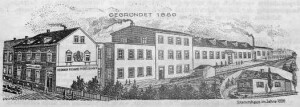
Schützenstraße Workshop (left). Image courtesy of the Pfretzschner family, Markneukirchen
Around 1878, Hermann Richard Pfretzschner returned to Markneukirchen, worked in the family workshop until 1880, and then started his own business at Schützenstraße 569/8. He proved to be not only a highly talented bow maker, but also a virtuoso violinist and, last but not least, a shrewd businessman.
Until 1900, he made fairly accurate copies of Voirin’s model. In doing so, he introduced the French style of work to Germany. Later, he added other French and English models to his repertoire, particularly those by James Tubbs, but he widened the head slightly on nearly all of these models.
Throughout his career, his workshop supplied unstamped bows to various companies in Germany and neighboring countries, but bows made for the company were almost always stamped with “HR Pfretzschner.” In 1901, he received a royal award and, from that point on, stamped a coat of arms on the bow.
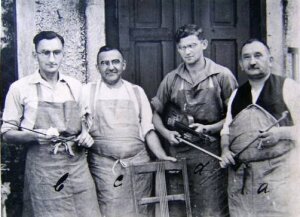
Hermann (a) and Berthold (c), with their respective sons. Photo courtesy of the Pfretzschner family, Markneukirchen

August Wilhelmy
Hermann Richard Pfretzschner maintained close ties with prominent violinists, including Professor August Wilhelmy, a child prodigy, concertmaster in Bayreuth, and professor at the Guildhall School of Music in London. In collaboration with him, Hermann Pfretzschner created a model that he considered his best bow and that he would continue to make until the end of his career.
In 1910, he opened a branch in Dresden, where his sons Hermann and Berthold ran the business. In 1914, he retired and handed the company over to them. He left them a thriving business that, with the exception of the war years and a brief period when the company was owned by several East German firms, has been very successful. He has gone down in history as one of Germany’s most important cane makers.
German bowmaking of the 19th and beginning of the 20th centuries, 1992 Klaus Grunke, Chicago
Tarisio, Cozio Archive, accessed 2023
Britannica Archive, accessed in 2023
Geneanet, accessed in 2023


