Instrument

cello
Giuseppe Dall'Aglio
Mantua,
± 1800
played by
Gideon den Herder
Gideon den Herder

*1774 , Boretto †1855 , Mantua
Giuseppe Dall’Aglio, as we know him today, was baptized as Giuseppe Maria Dalaj. He was born in 1774 in Boretto, a hamlet in Reggio Emilia on the south bank of the Po River, where his father was a farmer. When Giuseppe was seven, his mother died, and his brother moved to Mantua.
Shortly after his 22nd birthday, French troops invaded his native region, and he rightly feared a radical upheaval. Shortly thereafter, Giuseppe crossed the Po River and settled in Mantua, which was located in free Lombardy. There he began a new life as a coachman. Through his work, he met Alessandro Zanti (1771–1819), a renowned violinist who, in addition to his work in various orchestras, had been taught by Tomasso Balestrieri (1713–1796) in the art of violin making.
Balestrieri had been very prolific, and his work was “highly regarded” in the region, according to Philip J. Kass, who has studied him. Balestrieri had worked in the tradition of Pietro Guarneri (1655–1720), but with his somewhat rough finish and crackled varnish, he also leaned toward the work of Guarneri’s “wilder” cousin, Giuseppe del Gesù (1698–1744).
Tomasso Balestrieri was friends with the Zanti family. When Tomasso was 82 years old and ill, Alessandro Zanti took him into his home and cared for him until his death. Dall’Aglio’s career as a coachman was short-lived; a year after his arrival in Mantua, he began repairing instruments and went on to become a violin maker. There is no hard evidence that Alessandro Zanti passed on the knowledge he had gained from Tomasso Balestrieri to Giuseppe Dall’Aglio, but it is highly plausible.
The freedom that Mantua seemed to offer proved short-lived. French troops under Napoleon advanced further and laid siege to the city. A period of cruelty, hunger, and disease followed. The Teatro Nuovo, which had been the center of musical performances, was reduced to ashes, and even before the battle ended in 1797, several relatives of Zanti and Balestrieri had died. Under the influence of the ideas of the French Revolution, Mantua’s cultural landscape changed completely, and most of the city’s intellectual elite were forced to flee.
The large Teatro Nuovo had become unusable; only the smaller Teatro Bibiena remained available for performances. It was affiliated with the Accademia delle Scienze e delle Arti, where Alessandro Zanti taught. Zanti proved to be a leading figure in Mantua’s musical life and performed himself in more than one musical ensemble.
Giuseppe Dall’Aglio and Alessandro Zanti had become good friends by then, and when Alessandro had a daughter, Giuseppe even became her godfather.
Giuseppe Dall’Aglio hardly knew Tomasso Balestrieri—if at all—because Balestrieri died just a few months after Giuseppe arrived in Mantua. He was regarded as one of the most important “descendants” of Pietro Guarneri, and Zanti went down in history as a “fine Italian violin maker,” even though he was, in fact, an amateur. Zanti could therefore be considered the link between Dall’Aglio, Balestrieri, and, by extension, Pietro Guarneri.
In 1807, Giuseppe Dall’Aglio married Theresa de Coppi. Her brother, Sante (1787–1861), was originally a bricklayer and restorer of antique sculptures, but he was a well-educated man. Giuseppe was poor and uneducated. On the marriage certificate, he was no longer listed as a coachman, but as a “violinaio,” or violin maker. After his marriage, he moved in with the De Coppi family.
The De Coppi family owned a great deal of real estate in Mantua, including the building where Zanti lived. Sante de Coppi was presumably impressed by the craft of violin making, as Giuseppe Dall’Aglio trained him to become a violin maker, and they worked together from 1815 until about 1830—largely in the same workshop and later separately, though still in close proximity to one another. Their personalities differed greatly. Sante was well-educated and thoughtful, while Giuseppe was impulsive and unschooled. Sante’s signature was elegant, while Giuseppe’s was more of a scrawled scribble. According to Kass, this was also reflected in their instruments: Dall’Aglio’s work was spontaneous, personal, and not particularly refined, while Sante de Coppi’s was more precise but is often considered less personal. Kass called the two men an “odd couple.”
Before Dall’Aglio, two generations of Mantuan violin makers had already been indebted to Pietro Guarneri. Guarneri had brought the expertise of his illustrious father, Andrea Guarneri, to Mantua in 1680, and since then, most of the city’s violin makers had taken his designs as their model, usually altering them by little more than minor details.
Pietro Guarneri was from Cremona, which was less than two days’ journey from Mantua. However, there was a world of difference between the two cities. They lay within the spheres of influence of two completely different countries: France and Austria. Mantua had the edge over Cremona when it came to music, but Cremona had been the leader in the field of violin making. The progressive rulers of the Gorganza family had held court in Mantua, and the arts had flourished thanks to their patronage. For decades, a steady stream of artists and musicians had been drawn to Mantua, and many entered the service of the Gonzagas. Pietro Giovanni Guarneri was one of them.
The Gonzagas, however, were defeated by the Habsburgs. The new rulers transferred most of Mantua’s art treasures to their palaces in Venice and sold the rest. The city was left culturally depleted. It was only after peace had been restored that the violin makers Antonio Zanotti (1695–1734), Camillo Camilli (c. 1703–1750), and Tommaso Balestrieri (1713–1796) picked up where Pietro Guarneri had left off.
Dall’Aglio carried that legacy with him when he decided to become a violin maker. It seemed he only came to realize this as his career progressed. Especially in the years between 1800 and 1810, his craftsmanship was often still rough—even “clumsy and unregulated,” according to Philip J. Kass—and bore little resemblance to Guarneri’s. The curves in the middle of his violins tend to curve in too much, and his f-holes often stand upright on the top and are not infrequently asymmetrical. He also often carved the scrolls asymmetrically. It was not until around 1820 that he began building his instruments in a style more recognizable as that of Pietro Guarneri, particularly his cellos. Toward the end of his career, he adhered less and less to the traditional principles of Mantuan violin making, and his work became more free-form. He used parts from various other makers and combined them into his own model.
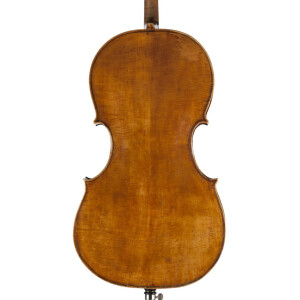
Some of his instruments are renowned for their beauty and, according to many, for their sound as well. The back and purfling are often beautifully flamed and have a dense grain. Most of his violins and violas are yellowish-brown in color, while his cellos are often darker.
His body of work consists mainly of violins, a small number of violas, and a single double bass, but he is best known for his cellos. He built them quite consistently in the style of Pietro Guarneri.
He used a printed label: “Joseph Dalaglio / made in Mantua / 18..”
The cello in the Music Instrument Fund's collection is extremely rare.
Strad: The Odd Couple, Philip Kass/Andrea Zanré, 1-9-2016.
Blot, E., 2001, Italian Violin Making - Piedmont, Eric Blot Edizioni, Italy.
Vannes, R., 1999, *Universal Dictionary of Instrument Makers*, Spa.
Ingles and Hayday; The violin makers of Mantua, geraadpleegd in 2022.
Tarisio, Cozio archive, accessed in 2022.
Geneanet, accessed in 2022.