Instrument

violin
Giuseppe Antonio Rocca
Turin,
1844
played by
Julia Philippens
Julia Philippens

*1807 , Barbaresco †1865 , Genua
Giuseppe Rocca was born in Barbaresco, in the province of Piedmont. At the age of ten, he moved with his father, Giovanni Baptista Rocca, and his mother, Maria Teresa Racca, to nearby Alba, where his parents were originally from. There began an eventful life full of dramatic turns. These included not only his five marriages—four of which ended in the death of his wives—but also incidents that brought him into contact with lawyers and notaries. He was quick-tempered, impulsive, and romantic—a combination of traits that stood in the way of a regular and stable life but posed no obstacle to a career as a great violin maker.
Little is known for certain about his early years in Alba; he appears in the Alba archives as an apprentice clockmaker, but that is all. What is certain is that Rocca entered into service for a year and a half in 1827. After returning to Alba, he married Anna-Maria Calissano in late 1828. That same year, he opened a bakery specializing in bread and pasta in the center of Alba. His life seemed to be going well until, one day, he lost his mother and sister.
Four years after his marriage, he had a daughter. His happiness was short-lived; two years after her birth, his twenty-five-year-old wife, Anna-Maria, died. It is believed that this is why he no longer wanted to stay in Alba and left in a hurry for Turin, where he began a new career with the violin maker Giovanni Pressenda. Like Rocca, Pressenda had grown up in Alba and had made a name for himself in Turin. As Marengo Rinaldi later wrote, Giuseppe Rocca had already made several violas and violins before he came to Turin. That may explain why, after just three years, he considered himself skilled enough to strike out on his own.
Around 1837, he began preparing to start his own business; he bought lumber and tools and rented a workshop. That same year, he married his second wife, Caterina Barone, who came from a wealthy family and promised to bring a substantial dowry. Unfortunately, shortly after their marriage, both fell so seriously ill that Giuseppe had to temporarily abandon his plans. He had incurred heavy debts and therefore demanded the dowry from his first wife—which his father had withheld—and did the same with his second wife’s family. A year later, in 1938, Giuseppe Rocca was able to open his own business.
“His customers stopped coming, and his financial situation became dire once again.”
He continued to make rough violins for Giovanni Pressenda for some time while also building his own instruments. Despite the fact that he had been an apprentice for only three years and his first independent work was not perfect, his instruments already displayed Rocca’s talent and individuality. During the first two years, he was able to devote himself entirely to instrument making. That changed when his father died in 1839. From that moment on, Giuseppe Rocca became embroiled in a protracted legal battle over his father’s will. As a result, his work suffered in many respects. His customers stopped coming, and his financial situation once again became dire. It did not improve until he was vindicated. However, his legal victory was completely overshadowed by Caterina’s death as early as 1842. He did not remain a widower for long. Shortly thereafter, he married Giuseppina Quarelli and had his first son in 1843. Pressenda served as a witness at this wedding and at the registration of Rocca’s son.
‘[...] Rocca would later have the honor of making history with what was called his “Italian reinterpretation” of Stradivari and Guarneri del Gesù [...]”
During this turbulent period, Luigi Tarisio—a dealer, connoisseur, and owner of many valuable violins—asked him to repair some of his instruments; these were presumably the “Alard” violin by Guarneri del Gesù and the “Messiah” by Stradivari. These classical instruments became a new source of inspiration for Giuseppe. He modified his Pressenda model and began to focus on building a modern interpretation of these masterpieces. Until then, the focus in Italy had been primarily on French luthiers who crafted their own versions of Stradivari; Rocca would later have the honor of making history with what was called his “Italian reinterpretation” of Stradivari and Guarneri del Gesù—who, until then, had received little attention in Italy.

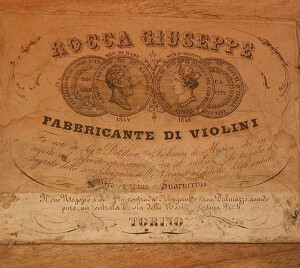
Giuseppe Rocca's labels reflect the places where he has worked and his submissions to exhibitions. Photo courtesy of Tarisio.
Starting in 1844, he entered a more or less stable period that allowed him to devote himself entirely to his work. Between 1844 and 1850, he submitted instruments to exhibitions every two years. Then tragedy struck again; his third wife died in late 1850, three years after the birth of their third son. From that moment on, the turmoil in his life took over once more. He was left with three children and faced increasing competition. Stories about his boisterous behavior soon began to circulate. Nevertheless, he remarried just a few months after the death of his previous wife. With his fourth wife, he went to Genoa, where he worked for some time. He traveled back and forth between Turin and Genoa for a short time until he finally settled in Genoa for an extended period in 1851. There, he prepared for the major exhibition in London, to which he sent his Stradivari and Guarneri models. In 1854, 1855, and 1856, he again participated in exhibitions with varying success; sometimes receiving no award or only an honorable mention, but at the 1855 exhibition in Genoa, the jury described his violin and cello—submitted in 1846—as “masterfully crafted.”
His fourth wife, whose name we do not know, also died after being married to Rocca for only a short time. After her death in 1854, there was no longer any need to remain in Genoa, her hometown, and Rocca once again began commuting back and forth between Turin and Genoa. After marrying his fifth wife, Filomena de Franca, in 1861, he settled permanently in Genoa.

Italy was going through a difficult period; the violence that accompanied the unification of the republic had taken its toll on the music scene. As a result, Rocca was once again struggling financially; unable to afford the expensive maple wood for his instruments, Rocca was building only mediocre violins at that time. The jury’s commentary on his 1861 entry in Florence noted that the instruments he submitted were “of varying quality, not particularly well-built, and the finish left much to be desired.” His medal was therefore awarded solely for the instrument’s fine tone.
At that time, violin makers were heavily dependent on recognition from influential figures. That required a good relationship with them. Rocca’s personality stood in the way of that, according to his biographers. He worked alone, took on no apprentices, and his quick-tempered, restless nature often caused problems. This makes it all the more remarkable that Rocca managed to carve out a place for himself among the very greatest makers of his time.
He was not able to enjoy his recognition for long; he died in 1865 after an unfortunate fall into a well. There was much speculation about the cause; his son Enrico would suggest in a later interview that Giuseppe Rocca, driven by a unhappy marriage, had taken his own life.
Rocca had four children: a daughter from his first marriage and three sons from his third marriage. His youngest son, Enrico, would follow in his father's footsteps and also become a violin maker.
Rocca is considered one of the greatest Italian violin makers of the nineteenth century. The first models he built, starting in 1838, were exact copies of Pressenda’s, but he later added his own personal touches, setting them apart from his teachers’ instruments.
Pressenda was trained in the French tradition of violin making; he had learned the craft from French makers from Paris who were employed by his employer, Lété-Pillemont. Many of these makers, in turn, had learned the craft in Mirecourt and brought that knowledge with them to Italy. Pressenda had developed his own designs after much experimentation. He often used exquisite wood and an impressive varnish. Three years of apprenticeship were enough for Giuseppe Rocca to master Pressenda’s interpretation of the French luthier tradition.
Starting in 1842, after he had handled violins by Guarneri and Stradivari, his preferences changed rapidly. He no longer built his instruments using external molds like Pressenda did, but instead used the Cremonese internal molds around which the violins were constructed. He adapted the curves to those of Guarneri’s and Stradivari’s instruments. Around 1845, he limited his work to two models, though he again gave them his own interpretation. During that time, he built outstanding instruments.
Rocca experimented very little, but he did sometimes combine elements from the old masters. For example, some of his instruments are known to have the shape of Stradivari’s “Messiah” and peg holes similar to those made by Guarneri.
Depending on his financial situation, his choice of wood and varnish sometimes deviated from the ideal; instead of beautifully figured wood, he used simple local poplar or maple with small knots that he had to repair before working with it. The varnish he used also varied greatly; in 1848, the jury praised it as “varnish whose composition came very close to that of Stradivari,” but there are also known instruments of his with a less impressive finish. Especially in Genoa, he built instruments that were not highly regarded. To be able to sell them anyway, he replaced the labels with his Turin ones and backdated them.

Giuseppe Rocca label. Photo courtesy of Benning Violins.
Giuseppe Rocca moved around constantly, which is why he used at least four different labels indicating his place of residence and a year. Research has shown that these do not always correspond to reality; Rocca sometimes removed them so he could stick one of his other labels in their place.
Rocca's finest instruments are now highly regarded for their distinctive appearance—based on a personal interpretation of his two great predecessors—and for their excellent sound.
The violin in the collection of the Musical Instrument Fund dates from 1844; everything about this instrument points to his prime. He may have just studied the “Alard” and the “Messiah,” and that same year he submitted his first violin to the exhibition.
Blot E., Liuteria Italiana IV - Piemonte, 2001, The life of Giuseppe Rocca, Eric Blot Edizioni, Italy.
Kass P., 2009, Guadagnini-re-evaluated, Turijn
Miyasaka T., 2017, J. F. Pressenda-Italian passion hidden behind consistency of form, zp.
Giordano A., 2014, The Strad,
Landon Ch., 2007, The Strad
Tarisio, Cozio archive, bezocht 2019