Instrument

violin
Giovanni Battista Rogeri
Brescia,
± 1690
played by
Sarah Kapustin
Sarah Kapustin

*± 1642 , Bologna †± 1710 , Brescia
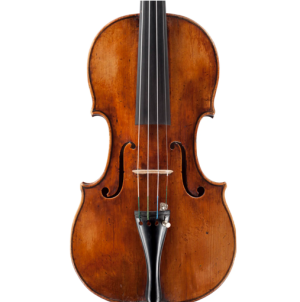
Giovanni Battista Rogeri was born in Bologna around 1642. Nothing is known about his parents or his early childhood. He presumably left for Cremona in 1661 to become an apprentice to Nicolò Amati. Amati usually accepted only family members as apprentices, but the plague had forced him to abandon that practice and even admit apprentices from outside Cremona. Giovanni Rogeri was one of the first to be accepted under these new circumstances. After completing his training, Rogeri left and settled in Brescia in 1664.
This city had a history of instrument making dating back to the 15th century. Around 1490, the workshop of a “Maestro delle viole” (a viola da gamba maker) was first mentioned in the archives of Brescia. Thereafter, the number of instrument makers increased at an unprecedented rate, and in the second half of the 16th century, violin makers also began to emerge. This development had made the city strong and independent of Cremona’s influence. The differences between the two styles of instrument-making could be traced to the differences in the music played there. In Brescia, the emphasis was on music for groups and ensembles rather than on solo performance. Brescian violin makers therefore focused more on making violas, violas da gamba, cellos, and double basses than on instruments in the higher register. The Brescian school of violin making produced two important violin makers: Caspar da Salo and his pupil Giovanni Paolo Maggini.
After the plague claimed the life of Paolo Maggini, the last violin maker in Brescia, in the mid-seventeenth century, the city struggled greatly to rebuild its cultural life. Most artisans had not survived the plague, and skilled craftsmen from outside the city were more than welcome. Giovanni Rogeri was regarded as a violin maker who could contribute to the revival of the city’s former glory. That would certainly take another twenty years. Until then, Rogeri remained one of the few violin makers in the entire region around Brescia.
He presumably worked alone until 1690, but thereafter received assistance from his son Pietro Giacomo. It is not known who trained Pietro, but by the time he began working with his father, he already had some experience. Pietro’s influence is evident in Rogeri’s simplest instruments. At that point, he still lacked craftsmanship. He would later become a great luthier in his own right. Pietro’s first instruments date only from 1705; they bear his label. He Latinized his name to Ruggerius, which led people—and sometimes his father as well—to be mistaken for one of the luthiers of the Cremonese Ruggeri family for a long time. Giovanni Battista Rogeri died around 1710. Despite the fact that he continued to build in the Cremonese style throughout his career, he would go down in history as a Brescian violin maker.
In the 17th century, Brescia was at the crossroads of musical life and violin making in northern Italy. As a result, the characteristics of Brescian violins could even be found in England, Germany, and the Low Countries. Many of the outside influences that reached Brescia were primarily focused on improving the sound; for a long time, the construction technique itself remained largely unchanged.
The Brescian school of violin making was distinctive and differed from the more common Cremonese style. By the time Rogeri arrived in Brescia, the plague had destroyed the entire Brescian violin-making tradition. Rogeri had been trained in Cremona and brought the tradition practiced there with him. As a result, he was hardly influenced by the old, virtually extinct Brescian style of violin making. Until the end of his life, he continued to work in the style of his teacher, which was Cremonese. The fact that he is nonetheless regarded as the link between the old and the new Brescia is not due to his adoption of a particular building style, but because Giovanni Rogeri kept violin making alive in Brescia.
Giovanni Rogeri contributed to Brescia’s revival by building elegant and refined cellos and violins. These differed from the freer and more improvised style of the earlier Brescian makers. Around 1690, he also made instruments based on Amati’s large model. These are considered among his best. By then, his craftsmanship had already reached the very highest level.
The curvature of his violins is slight, and their shape is somewhat angular. He positions the f-holes almost vertically in the soundboard. They are exquisitely carved—long, narrow, and elegant. The corners are equally impressive: pointed, sharp, and exceptionally well-constructed. In contrast to the Brescian tradition, in which the grain of the wood was not the most important factor, Giovanni Rogeri used material of the highest quality. Many of his back plates are beautifully flamed, particularly those of his cellos. He made concessions only with his simpler instruments; for example, he omitted genuine edge inlays on the back plates. He simply left them out or scratched them on.
Rogeri’s cellos were smaller than was customary at the time. They are close to the size we know today. In 1690, he made a cello so magnificent that it was mistaken for a Stradivarius throughout the 19th century, until researchers discovered its true maker. To this day, the instrument is still called “The Lancashire Strad.” His instruments are highly prized by concert musicians.
The Giovanni Battista Rogeri violin in the collection of the Musical Instrument Fund is a fine example of the instruments he built during his prime. The instrument is believed to date from the same year as “the Lancashire Strad.”
Blot, E., 2007, 1520–1724. Liutai in Brescia, Brescia.
Hamma, W., 1987, Master of Italian Violin Making, Herrsching am Ammersee.
Tarisio; Cozio archive, the Brescian school by John Dilworth.