Instrument

double bass
Gaspero Piattellini
Florence,
1825
played by
Sasha Witteveen
Sasha Witteveen

*±1762 , Florence †1840 , Florence
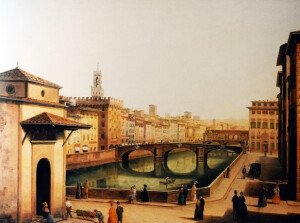
In Florence, the Medici had been the ruling family for 300 years, and from 1737 onward, the Habsburg dukes took over. They contributed greatly to the flourishing of musical life in the city. The Medici had their own court orchestras, sought out the best musicians for them, and commissioned instruments from the most prominent makers, both within and outside their territory. Among these were no fewer than four instruments by Antonio Stradivari. After the Medici’s hegemony ended, not much changed in that regard.
He [Pietro Leopoldo] wanted to make Florence a model of the Enlightenment, which meant that new musical influences from outside Italy entered Florence more quickly than before
Three years after Gaspero Piattellini’s birth, the Habsburg Grand Duke Peter Leopold I, son of the Austrian emperor, had come to power. He was only 18, destined to be a ruler, and trained as a legal philosopher. But Pietro Leopoldo was also a great lover of music. Immediately upon taking office, he had an ensemble formed that was to include musicians “of talent and renown,” and he hired the violinist Pietro Nardini—who had been praised by Mozart—as concertmaster for his ensemble: the Virtuosi da Camera. Eugenio di Ligneville, whom Mozart had praised as an outstanding contrapuntist, became “Superintendent of Music for the Royal Chamber and Chapel.” As early as 1768, the intendant had been working to have the operas and oratorios of Handel, Gluck, Hasse, and Traetta performed in Florence, in which the Virtuosi da Camera were also expected to play.
For all musicians and violin makers in Florence, the arrival of Pietro Leopoldo of Austria was of great significance. He wanted to make Florence a model of the Enlightenment, which meant that new musical influences from outside Italy began to reach Florence more quickly than before. This also meant that violin makers had to adapt their instruments to new playing styles. This became possible only after Pietro Leopoldo abolished the conservative guild system that had held back innovation in Tuscan violin making for centuries.
The collection of stringed instruments that the Medici had begun was preserved even after the House of Lorraine took power. Wealthy private individuals formed a network of patrons who financed performances of secular music in the city. They often supported the most prominent musicians as well.
Florence, Santa Trinita Bridge, Fabio Borbottoni
Gaspero Piattellini was born around 1762. Several double basses made by a certain Luigi Piattellini have been found; experts believe he was the father of Gaspero and his brother Luigi II, but no records of him have been found in the Florentine archives.
As a boy, Gaspero began working in the workshop of Florence’s leading violin maker, Giovanni Battista Gabrielli. His brother Luigi II, who was twelve years his senior, had already been working there for several years. Gabrielli had many apprentices and employees. One of them was Alvisio Piattellini, about whom we know nothing other than that he stated on his labels that he had been an apprentice of Giovanni Battista Gabrielli, and that a double bass made by him in 1791 has survived. It is not known whether he was a brother or a cousin of Gaspero. Gabrielli himself died in 1771, but the business on Via della Studio was continued by one of his brothers.
The pieces by both Piattellini brothers were later frequently attributed to Gabrielli
Gaspero Piattellini continued to work in the Gabrielli family workshop until he got married at the age of 25. Gabrielli had been one of the most renowned violin makers in Florence; a few days after his death, a newspaper wrote favorably of him, noting that “his violins were praised by professors throughout Italy, and his instruments were shipped to many parts of Europe.”
Gaspero Piattellini was still building them in the Gabrielli workshop before he turned 25. These were experimental, Jakob Stainer-style designs for violas and cellos that continued to be produced in the Gabrielli workshop by other craftsmen even after his death. They were so successful that many Florentine dealers continued to print his name on labels and affix them to instruments made by other builders for a long time afterward. The instruments made by both Piattellini brothers were later frequently attributed to Gabrielli.
During his final years working for Gabrielli, Gaspero Piattellini was already building instruments under his own name. His earliest known instrument is a violin from 1780; Gaspero was 18 years old at the time.
After his marriage in 1787, Gaspero Piattellini left Gabrielli, first moving in with his older brother Luigi for a few years and working in his workshop before striking out on his own. Shortly after his marriage, his son Gaetano was born, and he raised him himself. After Gaspero’s death, Gaetano would take over the business.
Gaspero Piattellini became acquainted with the ambitions of the Grand Duke and his superintendent through Bartolomeo Bimbi. This violin maker was already in the service of the Grand Duke but also worked as an instrument dealer in Florence and Siena.
One of the last things Eugenio di Ligneville did before he was dismissed was to appoint Bartolomeo Bimbi as an advisor and curator of the instrument collection. Bimbi likely also restored instruments while assembling the collection. An invoice from Bimbi for this work was later discovered. Bimbi’s own cellos are reminiscent of those by Amati, while his violins show a blend of influences from Stainer and Amati.
The modifications that Bartolomeo Bimbi had made to the cellos in the collection were intended to adapt the instruments to new trends in musical performance practice. He did not do all of this himself, but hired Gaspero and Luigi Piattellini. They were already building cellos smaller than the usual large sizes and giving these cellos a different neck angle. That was exactly what Bimbi asked them to do with the cellos from the court collection.
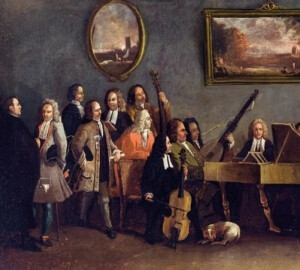
Excerpt from *Riunione musicale* by Marco Ricci. Note the (small) size of the cello.
In 1791, just as Gaspero was getting his career on track, his brother Luigi died and Grand Duke Pietro Leopoldo left Florence. The Grand Duke was succeeded by his son, marking the beginning of a long series of changes in power that did not end until 1814, after which Florence once again came under Habsburg rule. For the arts, science, and music, not much had changed. During the intervening period when Florence came under Napoleon’s rule, his sister—whom he had appointed Grand Duchess of Florence—had strongly promoted the arts, literature, science, and music.
In 1839, Gaspero’s son Gaetano registered as a violin maker in the Florentine archives. He took over the business when Gaspero died in 1840 at the age of 78.

The scroll of the Piattellini double bass (1825; extension by Melle Wondergem, 2025) from the collection of the Musical Instrument Fund
Gaspero Piattellini’s instruments were also highly regarded during his lifetime. This is evident from the fact that between 1815 and 1819, only three Tuscan instruments were purchased for Grand Duke Pietro Leopold’s collection: a 1792 double bass by Castelliani, a violin by Antonio Gragnani, and a cello by Gaspero Piattellini.
The last two instruments did not originally bear labels from their makers; the violin had a label from Nicolò Amati, and the Piattellini cello bore one from Antonio Stradivari.
Given the importance of music in early 19th-century Florence, violin makers must have had a high output. Yet very few instruments by Gaspero Piattellini have been found. It is suspected that many of them were relabeled and have not yet been traced back to Piattellini. His few known early works bear a strong resemblance to Gabrielli’s instruments. Later violins and violas attributed to him are relatively flat-arched for their time and finished with a thin coat of brown varnish. His cellos are generally regarded as his finest work.
Gaspero Piattellini used both a printed and a handwritten label;
Gaspero / Small Plates / made in 1763
Rice. J., 2009, An early Handel revival in Florence, Londen
Barabaschi A., 2018, Stradivari’s Medici Quintet, lecture about the Stradivari Medici Quintet at the Library of Congress, Washington, D.C., in December 2018.
Leonhard F., 2022, The Grand Ducal Court restorers of stringed instruments in late 18th century Florence.
Pieri D, 2006, in Philomusica, Marquis Eugène de Ligniville, Superintendent of Music for the Royal Chamber and Chapel.
Mutschlechner, M., *The World of the Habsburgs*, in Hamann, Brigitte (ed.), *The Habsburgs: A Biographical Dictionary*, Vienna, 1988
Rumpler, H., 2005, A Chance for Central Europe: Bourgeois Emancipation and the Decline of the State in the Habsburg Monarchy, Vienna
Academic Bass portal, bezocht in 2025