Instrument

violin bow
François Nicolas Voirin
Paris,
± 1860
played by
Idil Yunkuş
Idil Yunkuş

*1833 , Mirecourt †1885 , Parijs
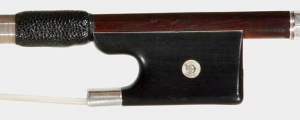
Jean Baptiste Vuillaume was an unrivaled all-around talent in his field—a master copyist, innovator, and source of inspiration. François Voirin was quickly captivated by his ideas and began crafting Vuillaume’s models. He would continue to do so for years, alongside his own designs. However, Voirin also continued to develop his craft; today, there is a widely held view among experts that not only were the best “Vuillaume” bows made by François Voirin, but also that many of the innovations for which Vuillaume is known can be attributed to Voirin.
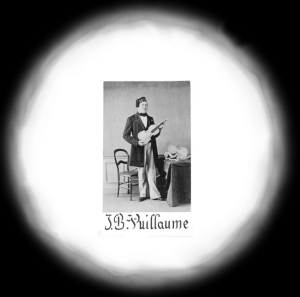
Example of a microphotograph of J.B. Vuillaume behind the lens in its socket
At first, Vuillaume and Voirin got along well. As a result, Voirin was soon put in charge of supervising several bow makers who worked in Vuillaume’s large workshop. Vuillaume often selected Voirin’s bows to create his famous “slipper with lens and photo” (a slipper that concealed a microphotograph of Vuillaume, which became visible only through a small lens in the mother-of-pearl eye). Voirin made countless examples of these. Vuillaume also regularly praised him as his assistant for the bows he submitted to exhibitions. After a few years, Voirin took a break from his work with Vuillaume and went on to manage the workshop of the Laberte brothers. He then returned to Vuillaume. He even moved into Vuillaume’s home with his family. After fifteen years, the good relationship between the two came to an end. Their personalities clashed with increasing frequency. Whereas bow makers had always worked quietly side by side, their “heated arguments now regularly filled the workshop.” François Voirin left in 1870.
François Voirin married Anne-Thérèse Magnié in 1859. They had three daughters together. After parting ways with Vuillaume, the family could no longer continue living with him. In 1870, they opened their own workshop in the center of Paris. At first, Voirin ran the workshop together with Anne-Thérèse, but in 1872, Louis Thomassin joined them. In 1876, Joseph Alfred Lamy joined them. They formed a close-knit group and worked together as friends for many years. The bows they made did not differ greatly from one another; what they had in common was that they were all refined designs. In 1885, Voirin died unexpectedly. He was 51 years old. With the help of Louis Thomassin, his widow, Anne-Thérèse, continued to run the workshop for several more years. Thomassin continued to work with her until he left five years after Voirin’s death to start his own workshop. Without skilled craftsmen, the workshop did not survive long, and Anne-Thérèse was forced to close its doors for good around 1892.
In the early years, there was little difference between Pierre Simon’s bows and those of François Nicolas Voirin. They were so good that he continued to use them even after he began working for Jean Baptiste Vuillaume. Vuillaume apparently recognized this as well, as there are several known bows made by François Voirin based on the Pierre Simon model, on which Vuillaume had his own brand mark applied.
After 1855, François Voirin began crafting the model that Jean Baptiste Vuillaume had developed: bows with frogs whose edges were flattened. This gave the maker more freedom to add his own details and, not insignificantly, resulted in weight savings. Building on this, Voirin developed a bow that was even lighter. He achieved this by omitting all metal parts and the mother-of-pearl underlay. In doing so, he drew inspiration from his illustrious predecessor, Tourte. He called it his “Alard” model, presumably because he had conceived it together with his cousin, the violinist Delphin Alard. He also chose wood that was so strong and flexible that he could make the bow thinner than his predecessors had done. He also made the bow tip smaller. He sometimes took these refinements so far that his bows became extremely fragile. That fragility was exacerbated even further when Voirin began to curve his bows differently as well; he placed the curve very far forward, just behind the head. While this did improve the bow’s playability, when the bow was drawn back far, too much force was applied to the front, thinnest part, causing the bow to break quickly.
After working for Vuillaume and others for fifteen years, he had developed his own “signature style.” Even though his bows differed somewhat from one another, they were all unmistakably “Voirin.”
Between 1870 and 1880, he began crafting an increasing number of bows, which he adorned with precious materials such as ivory, tortoiseshell, and gold. Sometimes he engraved the initials of his clients or buyers onto them. The wood he selected for these bows was also of exceptional quality. With a clientele that could afford such items, it is likely that this period was very successful for him. His gold-mounted bows are legendary for their refinement and quality. After his death, François Voirin was honored with a Gold Medal at the “Universal Exhibition” in Antwerp.
Starting in 1870, his mark was “F.N. Voirin à Paris.” After his death, his widow continued to use his name for a long time. She purchased bows from other makers, including Joseph Alfred Lamy and Charles-Nicolas Bazin, and marked them with Voirin’s old brand stamp. These “widow Voirin” bows are not nearly as good as the ones François himself had made.
François Voirin made bows for S.A. Deroux, Gand & Bernardel, Hill, and Chardon. Voirin had a profound influence on the world of French bow makers. His work served as a benchmark for later makers. His influence was most directly evident in the work of Charles Peccatte, Charles-Claude Husson, and Charles Nicolas Bazin. It is telling that his contemporaries already referred to him as the “modern Tourte.” His bows remain highly sought after and valuable to this day.
Millant, B., Raffin, J.F., 2000, *L'Archet: French Bowmakers, 1750–1950*.
Vatelot, E., 1976, *Les Archets Français*, Nancy.
Vannes, R., 1999, *Universal Dictionary of Instrument Makers*, Spa.
Haine, M., 2013, “Trademarks for Musical Instrument Components Registered with the Paris Commercial Court.” zp.
Tarisio, Cozio, Digital Archive, accessed 2019.


