Instrument
pan flute
Flentrop Orgelbouw
Zaandam,
2025
played by
Matthijs Koene
Matthijs Koene

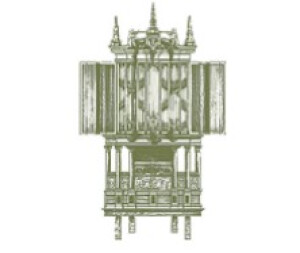
In 1898, organ builder Daniël Steenkuyl began rebuilding the organ in the Westzijderkerk, where Hendrik served as organist. Driven by a desire for modernization, Steenkuyl transformed the organ into an instrument that bore no resemblance to the old one. Flentrop thought it was technically sound, but he was not impressed with the sound. For him, the difference between the sound of the old and the new organ was one of the reasons he decided to go into organ building.
Hendrik Wicher Flentrop sold his painting business and started a piano, organ, and music store. In 1906, he moved the business to Zaandam.
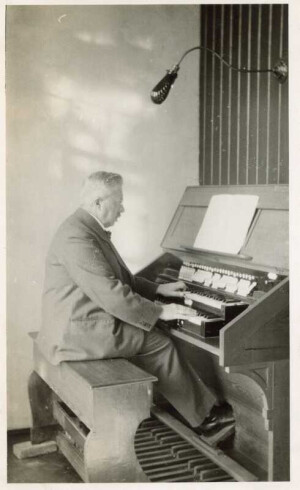
Hendrik Wicher Flentrop, 1927. Credits: C.J. Turner
In the 19th century, Romantic ideals flourished in music. Composers such as Franz Liszt and César Franck brought emotion and lyricism to organ music. In addition to church music, they also wrote non-religious, often symphonic organ compositions. These Romantic organ pieces are characterized by rich harmonies and the use of the organ’s full range of timbres. This style placed different demands on the organ than had been the case previously.
For centuries, a system of strings and slats had served as the link between the keyboard and the valves that supplied air to the organ pipes. In the nineteenth century, new inventions in just about every field led to the belief that modernism would make everything better than it had been. This belief also took hold in organ building.
Because romantic compositions required a different sound and different registers from an organ, the mechanical parts that transmitted signals from the console to the pipes were replaced by pneumatic and electric transmission systems. This made playing easier, and there were fewer restrictions on the distance between the console and the organ. By around 1920, virtually no organ builders were still making mechanical organs.
Hendrik Wicher Flentrop initially adhered to this modern architectural style in both restoration projects and new construction. In the early years, he secured only a few small commissions, sometimes in collaboration with other organ builders. There were about 35 such organ builders in the Netherlands at the time. He built his first new organ in 1915. It was for the Mennonite church in Hoofddorp and was still entirely in the style of the time, featuring pneumatic action. He continued to use this technique until 1940.
After being commissioned to build the organ in Koog aan de Zaan, Flentrop found he needed more space. In 1927, the company purchased a large building with a workshop in Zaandam.

Dirk A. Flentrop, Évora Cathedral 1967 (c) Flentrop Orgelbouw
Hendrik Wichers’ son, Dirk Andries, was born in 1910. He grew up in his father’s workshop, began working in the business in 1926, trained with Paul Faust in Germany, and was influenced by the insights of leading musicologists and organists who were searching for a more authentic organ sound. He found this, in particular, in the work of the theologian and organ expert Christhard Mahrenholz from Göttingen and in the views of Albert Schweitzer.
In the first half of the 20th century, the romantic sound of organs came under increasing scrutiny. A counter-movement emerged: the Organ Reform Movement, followed around 1925 by the Organ Movement, and after World War II by two other variants: the Neo-Baroque and the Historical movements. Their common goal was to oppose symphonic organs with pneumatic action and the use of modern materials. All of them advocated a return to the principles and sound of Baroque organ building, but they sometimes clashed fiercely along the way. Albert Schweitzer provided them with a guiding principle. In 1906, he published the book *Deutsche und Französische Orgelbaukunst und Orgelkunst*, which became the charter of the Orgelbewegung.

Albert Schweitzer at the organ, 1954
In 1928, Flentrop and his son attended a lecture by Dr. Albert Schweitzer in Zaandam. Afterward, Schweitzer accompanied them to view an organ that Flentrop had rebuilt. He actually thought it was a rotary organ, but the encounter marked the beginning of a good relationship between Dirk Andries and Albert Schweitzer.
Albert Schweitzer was not only a physician, theologian, and Nobel Prize laureate, but also an influential organist and Bach scholar. He had an almost scientific interest in historical organs and was critical of late 19th- and early 20th-century Romantic organ building. He was a strong advocate of Johann Sebastian Bach’s tonal ideals, which centered on transparency, clarity, and a well-balanced disposition.
For the deeply religious Schweitzer, the “true” organ was a “Bach” organ. Such an organ could capture religion in sound. For Schweitzer, Bach was a poet and painter in music, but also a mystic. Bach could express something in music that was impossible to convey with words. Something that new organs should also be able to do—including Flentrop’s organs.
Although Schweitzer himself was not an organ builder, he had a major influence on the “Orgelbewegung.” Of the Flentrop father and son, Dirk Andries was particularly impressed by Schweitzer. They exchanged ideas about building organs in the Baroque style. Schweitzer encouraged Flentrop to focus even more on reconstructing late 17th-century building techniques, such as those used by the organ builders Arp Schnitger and Gottfried Silbermann.
While Dirk Andries Flentrop became increasingly impressed by Schweitzer’s ideas, Flentrop Sr. made a passionate case for organs with electric action and built them as well.
Dirk Andries studied historically significant organs both at home and abroad and gained experience working with various organ builders. His internship with Frobenius in Denmark proved decisive for his later work. Starting in 1925, Frobenius built organs exclusively according to the principles of the Orgelbewegung. This led Dirk Andries to definitively distance himself from pneumatic and electro-pneumatic action systems. In the Netherlands, he became one of the pioneers in historical construction techniques and sound principles.
Dirk Flentrop promoted his ideas about historically authentic restorations and advocated for the construction of new organs based on historical models; however, the Flentrop company still followed Hendrik Wichers’ old “modernist” views.
In 1933, Flentrop built his first mechanical organ, a parlor pipe organ for a private client in The Hague. Dirk Andries likely played a decisive role in this decision. In an article he wrote about that organ, he referred to Schweitzer’s preference for historical sound production and thereby distanced himself from the “electrical systems commonly used today,” as he put it, and thus also from his father’s ideas. Dirk Andries Flentrop never revisited that position. He did, however, find himself compelled to make concessions to his principles for a few more years.
Just as passionately as Hendrik Wicher Flentrop had advocated for the electric organ, Dirk Andries delivered a well-reasoned case for his historical views in Utrecht. In that same presentation, he also advocated for collaboration and the sharing of knowledge among organ builders. The outcome of this and the four subsequent conferences helped establish the Netherlands as the world’s leading nation in the field of organ building.
Dirk Flentrop gradually became one of the driving forces behind the historical organ movement in the Netherlands, which grew in importance throughout the 20th century.
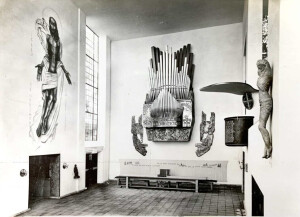
The Flentrop Organ at the World's Fair in Paris
For the 1937 World’s Fair in Paris, the “Exposition Internationale des Arts et Techniques dans la Vie Moderne,” Flentrop built an organ in the Dutch Pavilion. The Exposition was intended to be a showcase of modernity and progress. It attracted 31 million visitors. From a cultural-historical perspective, it was “the last time before World War II that everyone and everything that still believed in the restoration of European civilization came together,” according to historian Schlögel regarding this event.
The Flentrop organ won the Grand Prix in the musical instruments category.
The organ was fully in line with French notions of modernity and progress, but was far removed from the principles of the Orgelbewegung. After the World’s Fair, the organ was purchased by the Dutch Bach Society and moved to the Grote Kerk in Naarden.
A year later, Flentrop built an organ for the World’s Fair in New York. A series of setbacks—none of which were the company’s fault—meant that the project was not a success.

Dirk Flentrop was a co-founder of the International Society of Organ Builders
A month after the German invasion, Hendrik Wicher handed the business over to Dirk Andries. There were still enough commissions to keep the business going for several years without interference from the occupying forces. In 1944, Dirk Andries Flentrop delivered a monumental, three-manual organ for the Grote Kerk in Wageningen, incorporating a wide range of innovations. A year later, in 1945, the Germans blew up the tower, and the organ was largely destroyed. Flentrop used the remains in an organ that they delivered ten years later.
In 1960, Dirk Andries Flentrop was elected president of the International Society of Organbuilders, which he had helped found, thereby increasing his influence.
In 1948, Flentrop built his first organ outside of Europe—in Aruba; due to the humidity, it was the last instrument to be electrically powered. After that, Flentrop built and restored only mechanical organs and established his own pipe-making workshop.
The major breakthrough began with the award of the contract to restore the organ in the Grote Kerk in Zwolle. The project was widely praised, Flentrop received more commissions, and was able to expand.

Flentrop organ built for the demonstration lecture during the American Guild of Organists symposium in 1956
In 1950, Dirk Andries Flentrop traveled to Sweden at the invitation of the Swedish government and returned with three commissions. When the Marshall Plan aid from the United States began in 1952, hundreds of American students came to the Netherlands on scholarships. Among them were many organ students. Dirk welcomed them with open arms. The organ in Alkmaar, which Flentrop had just restored, was an eye-opener for these students. They were followed by organists, teachers, and musicologists who came to study the “superiority of European organs, particularly the old ones,” as they themselves wrote upon their return.
In 1956, Dirk Andries Flentrop was invited by the American Guild of Organists to give a lecture at their symposium in New York and to bring a Flentrop organ as an example. Both his talk, “Trends in European Organ Building,” and the instrument were well received. The event drew a crowd of 1,500 people.

E. Power Biggs, Dirk Flentrop, Charles Kuhn, and Margaret ("Peggy") Allen Biggs at the dedication of the new organ at the Harvard University Museum
E. Power Biggs, organist and president of the Society, was looking for a new organ for Harvard University’s Busch-Reisinger Museum. A year after the symposium, he visited the Netherlands and was welcomed in Zaandam. Two years later, the Flentrop organ, built specifically for Harvard, was inaugurated. It was a grand event attended by hundreds of prominent Americans. Dirk Andries was the guest of honor.
For three years, Biggs performed on the organ for CBS Radio and became one of Flentrop’s most important advocates in America. In 1960, a documentary about the organ was produced and broadcast. In “Flentrop in America,” a reviewer wrote: “Biggs, playing the Flentrop organ, educated the American public in classical music and made Flentrop the most famous organ builder of the Old World.” Flentrop had gained a firm foothold in America.
In the 1960s, the “Historically Informed Performance” movement conducted research into performance practices that were common during the Baroque period; string instruments were fitted with gut strings, and replicas of harpsichords were used in concerts. The “Orgelbewegung” had been a pioneer in this field and now enjoyed widespread support.
Despite the prevailing views of the organ movement in Europe, organ building and restoration in the Netherlands after World War II were dominated by the influential expert and president of the Dutch Organists’ Association, Lambert Erné (1915–1971). He did so in an unorthodox and rather undiplomatic manner. Lambert Erné stubbornly held to the view that modern organ builders should be able to create something from scratch, while his opponents, including Dirk Andries, increasingly espoused the view that organ builders should rely on historical precedent.
When Dirk Andries Flentrop was commissioned to rebuild the Morlet organ in Doetinchem, the client assigned Lambert Erné to serve as his advisor! The relationship between Dirk Andries and Lambert was downright hostile. It turned out to be a milestone: Dirk Andries rebuilt the organ, which originally dated from 1610, incorporating his own vision of sound. Gustav Leonhardt was thrilled with the result—and he wasn’t the only one.
Lambert Erné stubbornly held to the view that modern organ builders should be able to create something from scratch, while his opponents, including Dirk Andries, increasingly held the view that organ builders should rely on history
Flentrop found many solutions to the problems posed by the use of the old materials. Other organ builders outside the Netherlands did the same. The group of organ builders who had come together to restore the 1710 Arp Schnitger organ in the city of Weener exchanged knowledge and discussed their views on the reconstruction. Flentrop joined them.
The wider sharing of knowledge led Flentrop to experiment with alloys for the pipes and to cast the material in sand, as was done in the late Baroque period. The pipes were stronger and had richer tonal nuances.

Trouw daily newspaper, April 11, 1968. Source: Delpher.nl
After the United States and Sweden, the company began building organs in Germany, Curaçao, and Portugal. Flentrop expanded its workforce to 40 employees. Orders from the United States increased. In 1966, Flentrop was commissioned to build an organ for Carnegie Hall in New York. Just as the organ was nearly complete, the commission was canceled. Stokovsky, Horowitz, Ormandy, and Stern feared that the massive organ would negatively affect the Hall’s acoustics. Flentrop completed the organ anyway, and it was eventually installed at the State University of New York.
In 1968, Dirk Andries Flentrop received an honorary doctorate in musicology from Oberlin College in Ohio for his pioneering work in classical organ building. He later received an honorary doctorate from Duke University in North Carolina.
In 1958, Hans Steketee had been hired as an apprentice organ builder. He had been playing the organ from a young age and had graduated with a degree in mechanical engineering.
Hans Steketee gradually worked his way up to become Dirk Andries's assistant and was appointed deputy director in 1969. Dirk Andries and Hans managed a staff of 55 people.
Hans Steketee’s first major project was building an organ in Ohio and, later, one in Seattle. In the process, he developed a vision of restoration that did not always align with Flentrop’s. Dirk Andries focused on the organ as an independent instrument, whereas Hans Steketee brought a vision to the company that took the surrounding environment much more into account. “The highest standard is … to gather all the data … and use it to build an organic whole. This led to a wide variety of organs. Hans Steketee made the pipe-making workshop a fully-fledged part of Flentrop.”
Flentrop organs were installed in more than 100 American churches and concert halls
The company was doing well and was hiring new employees. In 1971, Flentrop acquired the Utrecht-based organ-building firm De Koff. That company had built about a hundred organs and repaired or restored more than five hundred. Flentrop also took over the workshop in Odijk.
The good relationship between Flentrop and E. Power Biggs continued under Hans Steketee. Partly due to his influence, Flentrop was able to deliver a large organ to Warner Hall at Oberlin College in 1974. Hans Steketee was present at its dedication and at the symposium. All these successes led many American churches and concert halls to approach Flentrop for new instruments in the 1960s and 1970s. Flentrop organs were installed in more than 100 American churches and concert halls.
The economic tide turned in the early 1980s, which had an impact on organ building. Nevertheless, Flentrop was able to carry out major projects. In addition to numerous restoration projects, including that of the extremely large mechanical organ in Riga Cathedral, the company also received commissions for new organs in Tokyo, Huizen, and Columbia (U.S.).
In 1986, Flentrop merged with Vermeulen Organ Builders, took over commissions, and built new organs in Taipei and Chicago. Only 33 people were still employed there. The number of new organs built during those years was modest, whereas the number of restorations was many times that.
Cees van Oostenbrugge joined Flentrop in 1969 and took over from Hans Steketee in 1998. Cees coined the term “organ archaeology,” which refers to reconstructing the builder’s thought process from old instruments that sometimes seem beyond repair. Later, he placed strong emphasis on creativity and on giving each organ a unique personality. He believed that following fixed rules could not produce a work of art; creativity is essential in the building process.
Cees [van Oostenbrugge] coined the term “organ archaeology,” which refers to reconstructing the builder’s thought process from old instruments that sometimes seem beyond repair
In addition, Cees van Oostenbrugge placed great value on openness and engagement within the company. Specialized employees became broadly trained employees. As director, he moved his desk so that he could greet his colleagues, and he made a daily round through the workshop.
Under his leadership, the restoration of the oldest playable choir organ, dating from 1511, in the Grote of Sint-Laurenskerk in Alkmaar was completed. Cees van Oostenbrugge was involved in many international projects, including the restoration of organs in Mexico City Cathedral.
Cees van Oostenbrugge took Frits Elshout on as an apprentice organ builder in 1971 after he had completed his training in the United States. Elshout worked on many projects, including both organs at the Laurenskerk in Alkmaar, St. John’s Cathedral in Den Bosch, the Westerkerk in Amsterdam, the revoicing of the Müller organ at St. Bavo’s Cathedral in Haarlem, and he began the reconstruction of the organ at St. Catherine’s Church in Hamburg. By then, Frits had become deputy director.
When Cees van Oostenbrugge passed away in 2008, Frits Elshout became director. Under his leadership, seven years after the project began, the organ was completed in Hamburg. It was a spectacular project in every respect.

The organ pipes of the “Bach organ” in St. Catherine’s Church in Hamburg were cast in sand.
Bach had once called this organ his favorite. He had played it in 1720 and praised its sound at length. The organ was almost completely destroyed by a bombing raid in 1943. Based on the remaining, damaged pipework and an organ-archaeological study, Frits Elshout and Erik Winkel—who had become deputy director of Flentrop—succeeded in building an organ that seems to have stepped right out of Bach’s time. In 2013, Bach’s favorite organ was inaugurated. It is widely regarded in organ circles as a stunning example of craftsmanship and artistry. It is considered the pinnacle—to date—of Flentrop’s historical-technical expertise and musical insight.
In 2016, Frits Elshout handed over leadership of the company to Erik Winkel. However, he remained artistic director and advisor.
Erik Winkel had joined Flentrop back in 1998. He had earned a degree in civil engineering from Delft University of Technology. Once at the company, he was deeply impressed by Oostenbrugge’s vision and his “organ archaeology.” He continued to follow that vision when he became deputy director and later director. Under his leadership, Flentrop completed several prestigious projects. Erik Winkel had been the technical director for the reconstruction of the organ in Hamburg from the very beginning. He leads the company with a passion for historical organ research and considers Cees van Oostenbrugge and Jan Jongepier to be his most important mentors.
In 2022, the company hired two employees from Slooff Orgelbouw, which had ceased its own operations.
Secularization, a declining interest in organ music, and a reorientation of cultural policy led to reduced subsidies and a less organ-friendly stance on the part of various government bodies. As a result, Flentrop began looking beyond the borders of the Netherlands more than ever before.
Just as E. Power Biggs had been instrumental to Flentrop’s success in America, Gustav Leonhardt played that role in Europe. He played a key role in the authenticity movement within early music and was an admirer of the Flentrop organs. His interpretations of Baroque music called for instruments with historical timbres. Gustav Leonhardt had attended the dedication of the Flentrop organ at Harvard and, from that point on, frequently used Flentrop organs for concerts and recordings.

Reconstructed organ at the Grote Kerk in Doetinchem © Flentrop Orgelbouw B.V.
Gustav Leonhardt and Anton Heiller, who had also attended the inauguration at Harvard, praised Flentrop to the skies after hearing the 1610 Morlet organ in Doetinchem that Flentrop had reconstructed. Thanks to Leonhardt’s influence on younger generations of musicians who embraced historical performance practice, their appreciation for Flentrop grew.
Following Power Biggs, the American physicist and organ builder Charles Fisk took up the mission in the 1960s to further promote historic organ building in the U.S. Charles Fisk worked with several major organ builders in America and visited Flentrop in Zaandam, who had a profound influence on him. He later based his own organ designs in part on the principles he had learned there.
The Austrian organist and composer Anton Heiller was another important figure in the international organ movement. He, too, praised Flentrop organs and used them in concerts and master classes. Heiller taught at the Vienna Conservatory, where he trained generations of organists who later favored Flentrop organs.
Finally, the Italian organist and musicologist Luigi Ferdinando Tagliavini was a strong advocate of the historical organ movement. He used Flentrop organs in master classes and helped strengthen the company’s reputation in Southern Europe.
Not everyone supported what Flentrop stood for. In the Netherlands, Lambert Erné was the spokesperson for the fierce but small counter-movement that sought a modern, 20th-century organ sound.
In France, people remained faithful to the Romantic and symphonic tradition for a long time, and Neo-Baroque organs were sometimes even viewed as an impoverishment of the organ’s tonal palette. This was also true of German proponents of the pre-Orgelbewegung. They viewed the Neo-Baroque as an excessive simplification of the sound and considered it a step backward. Composers and organ experts such as Max Reger, Marcel Dupré, and Helmut Walcha criticized what they considered to be overly rigid restorations that ignored new developments in modern music and thus even hindered them.
Finally, there were avant-garde composers such as György Ligeti and his contemporaries who experimented with new sounds. They considered the neo-Baroque style too conservative and sought a different sound.
Flentrop has built, rebuilt, or restored more than 635 church, concert, and home organs.
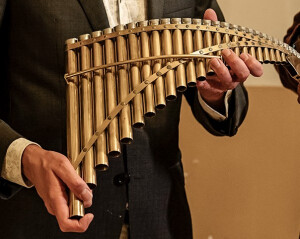
The metal pan flute that Flentrop built for the Musical Instrument Fund
In 2020, Flentrop and the Musical Instrument Fund began their initial discussions about creating a pan flute. Flentrop’s expertise in pipe-making proved to be invaluable. Just as Albert Schweitzer wanted to hear the voice of God in an organ, Matthijs Koene also had high musical expectations for his new instrument. Flentrop’s craftsmanship and knowledge made both of these possible.
100 Years of Flentrop Organ Building, edited by R. van Dijk and H. Fidom, 2004.
Brouwer, J.K.G. 2016, Johan van Meurs: A Study of a Pioneering Organ Consultant; Leiden.
National Service for the Preservation of Historic Monuments; 2004, Historic Organs in the Netherlands, Zeist.
Diepenhorst, W. 2022, in Religious Interiors in the Netherlands: Valuable Heritage, Museum Catharijneconvent | Cultural Heritage Agency of the Netherlands, Utrecht.
In Memoriam: Dirk Andries Flentrop by Jan Jongepier, *Het ORGEL*, Volume 100, (2004) Issue 2
The Flentrop Organ in the Grote Kerk in Doetinchem by Jan Pieter Karman, *Het ORGEL*, Volume 95, (1999) | Issue 4
Owen. B, 2022, E Power Biggs Concert Organist, Indiana University Bloomington, USA.
Fesperman J., 1982, Flentrop in America: An account of the work and influence of the Dutch organ builder D.A. Flentrop in the United States, 1939-1977
Fidom H, 2001, Dutch Organ Building in the Early 20th Century: German Influences.
Fidom, H. 2001: The Beginning: The Organ Movement, Organs of the Reconstruction.
Ravenzwaay, G. “A Revival in Organ Music,” in *De Schalmij*, journal of the Organ Movement, 1950.
Schweitzer A., 1906, The art of German and French organs and organbuilding, Leipzig.
Schweitzer A., 1906, The Art of organ Building and organ playing in Germany and France.
Wiersma, O., 2002. “Developments in Organ Building,” in *Yearbook of Historic Preservation*.
Website of the Bureau International des Expositions in Paris, accessed in 2025
Website: The Organ, visited in 2025
